White Label Casino App in 2026: Build vs Buy — The Operator's Real Cost Breakdown

What exactly is a white label casino app and how does it differ from a turnkey platform?
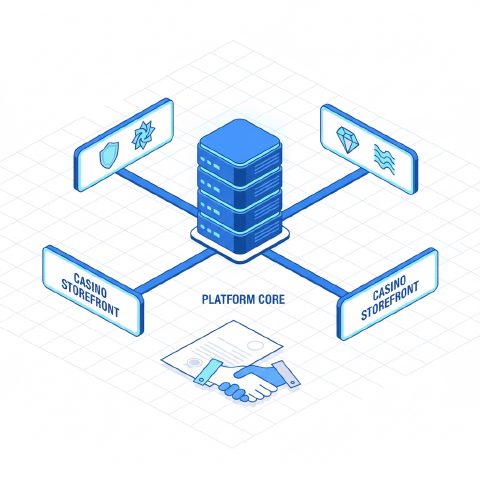
A white label casino app is a pre-built mobile gambling product — front-end, back-office, game content, and payments included — that an operator brands and deploys under their own name. A turnkey platform goes further by also covering licensing and sometimes operational staffing. The distinction matters because the cost structure, revenue share, and exit flexibility are fundamentally different.
The terminology gets sloppy in vendor decks, so let's be precise. A white label casino app typically means you're licensing a software layer: the platform provider (think SoftSwiss SOFTGAMINGS, EveryMatrix, Digitain, or Slotegrator) supplies the engine, you supply the brand and the traffic. You're usually on a revenue-share arrangement of 15–30% of GGR, sometimes with a monthly minimum. The app itself is often a progressive web app (PWA) or a WebView wrapper around a responsive web front-end — not always a true native iOS/Android application.
A turnkey solution layers on top of that: the provider also handles the licensing application (typically Curaçao eGaming or Anjouan, occasionally MGA), payment processing relationships, and sometimes even customer support staffing. Companies like Income Access, BetConstruct, and Softswiss's full-service arm operate in this space. You pay more per unit of revenue, but your operational lift at launch is dramatically lower. The catch is that exiting a turnkey arrangement is harder — your player data, your CRM, your entire tech stack is inside someone else's infrastructure.
The mobile-specific nuance is where operators get burned. Many 'white label casino app' offerings are literally a responsive website with a PWA manifest slapped on it. That works fine for Android, where users can install PWAs to their home screen, but Apple's App Store restrictions on real-money gambling mean you either need a regional workaround, a .app domain with a native shell, or you're operating PWA-only. True native iOS casino apps require Apple's approval and are only available in specific regulated jurisdictions — mostly licensed US states, the UK, and a handful of EU markets. Make sure you know which category your vendor's 'app' actually falls into before you sign anything.
What does a white label casino app actually cost in 2026?
Expect a setup fee of $15,000–$80,000 depending on the provider tier, plus an ongoing revenue share of 15–30% of GGR or a flat monthly platform fee of $3,000–$15,000. Some providers bundle game content aggregation into that share; others charge separately. The total cost of ownership over 24 months is almost always higher than the headline number suggests.
The setup fee is the number vendors lead with, but it's rarely the number that matters. SoftSwiss, for example, has historically charged setup fees in the $30,000–$50,000 range for their white label product, with a revenue share starting around 20% of GGR. EveryMatrix's CasinoEngine can be licensed as a standalone aggregator layer, which changes the math if you already have a front-end. Smaller providers like Slotegrator or Digitain often quote lower setup fees ($10,000–$25,000) but may have narrower game libraries or less mature compliance tooling — worth verifying independently.
The revenue share is where the real cost lives. At $500K GGR per month, a 20% platform share is $100K/month — $1.2M/year — going to your provider. That's before payment processing fees (typically 1.5–4% of deposits depending on method and geography), affiliate commissions, and your own operational costs. At that revenue level, a custom build that cost $600K upfront starts looking rational. The break-even point varies by margin, but most operators I've advised hit it somewhere between $3M and $6M annual GGR.
Hidden costs to budget for: custom front-end design work (most white label themes are recognizable and generic — you'll want at least a reskin, which runs $5,000–$20,000), payment method integration beyond the defaults ($2,000–$8,000 per additional PSP depending on API complexity), responsible gambling tool customization if you're targeting regulated markets, and ongoing compliance updates when regulators change requirements. Curaçao's 2023 regulatory overhaul, for instance, forced platform providers to push significant back-end updates — operators on white label platforms got those updates automatically, but operators on custom builds had to pay their dev teams to implement them from scratch.
| Provider Tier | Setup Fee | Revenue Share / Monthly Fee | Game Library (approx.) | Typical Time to Launch |
|---|---|---|---|---|
| Tier 1 (SoftSwiss, EveryMatrix) | $30K–$80K | 15–22% GGR or $8K–$15K/mo | 5,000–10,000+ titles | 6–12 weeks |
| Tier 2 (Digitain, Slotegrator, BetConstruct) | $10K–$30K | 20–28% GGR or $3K–$8K/mo | 2,000–6,000 titles | 4–8 weeks |
| Offshore/Budget Providers | $3K–$10K | 25–35% GGR | 500–2,000 titles | 2–4 weeks |
| Custom Build (in-house or agency) | $300K–$1M+ | 0% (own infrastructure) | Depends on aggregator deals | 9–18 months |
How long does it take to launch a white label casino app versus building from scratch?
A white label casino app can be live in 4–12 weeks once your licensing is in order. A custom build — from technical spec to production — realistically takes 9–18 months for a competent team, and that's before you factor in regulatory certification of your RNG and responsible gambling systems, which adds another 3–6 months in most jurisdictions.
Speed to market is the strongest argument for the white label route, and it's not close. Providers like Turnkey Casino, SoftSwiss, and Digitain have done hundreds of launches — their onboarding is a documented process. You're configuring, not building. Typical milestones: brand assets and domain setup in week one, game content selection and payment method configuration in weeks two through four, UAT and soft launch in weeks five through eight. If your Curaçao or Anjouan license is already in hand, you can be taking real-money bets before your custom-build competitor has finished writing their technical specification.
Custom builds are slower for reasons that are often underestimated. The core gambling engine — wallet, transaction ledger, RNG integration, game round history, bonus engine — is genuinely complex software. A team that has never built one before will spend months on problems that white label providers solved years ago. RNG certification with a lab like BMM, GLI, or iTech Labs adds 8–16 weeks on top of development time, and regulators like the MGA or UKGC won't grant a license until that certification is complete. Operators who try to shortcut this by using an uncertified RNG in a regulated market get their licenses revoked — I've seen it happen.
There's a middle path worth mentioning: a headless or API-first integration model, where you build your own front-end and mobile app but license the core platform engine (game aggregation, wallet, bonus engine) via API from providers like EveryMatrix or Paysafe's iGaming division. This gives you genuine mobile UX control — real native app development — without rebuilding the compliance-critical back-end. Timeline is typically 4–9 months and cost runs $100K–$400K depending on scope. For operators who care deeply about mobile UX differentiation but don't want to rebuild a bonus engine, this is often the right answer.
Which licensing jurisdictions work best with a white label casino app?
Curaçao eGaming and Anjouan (AGCL) are the most common jurisdictions for white label casino app launches because most platform providers already hold master licenses there, dramatically simplifying your sub-license application. MGA and UKGC are viable but require more compliance infrastructure than a basic white label setup typically provides out of the box.
Curaçao has been the default offshore jurisdiction for white label operators for over a decade, and despite its 2023 regulatory overhaul (the new Curaçao Gaming Control Board framework replacing the old master license system), it remains the most accessible entry point. Most established platform providers — SoftSwiss, Slotegrator, BetConstruct — operate under a Curaçao master license that allows sub-licensees to launch under their umbrella. The new framework requires operators to apply for their own license directly with the CGCB, but costs are still relatively low ($15,000–$30,000 in application and annual fees, roughly) compared to MGA or UKGC.
Anjouan (the Autonomous Island of Anjouan in the Comoros) has grown as an alternative since 2021, with lower fees and faster processing — some operators report approval in 4–8 weeks. It's legitimate but carries less reputational weight than Curaçao, which itself carries less weight than MGA. Where you're licensed matters to payment processors: some acquiring banks and PSPs won't work with Anjouan-licensed operators, which can limit your payment stack options.
For operators targeting the EU seriously, the MGA (Malta Gaming Authority) is the gold standard. MGA licenses cost €25,000 in application fees plus ongoing compliance costs, and the process takes 4–6 months minimum. Not every white label platform is MGA-certified — verify this before you assume your provider's compliance covers your license application. EveryMatrix and SoftSwiss both have MGA-certified platform components, but you'll still need your own MGA license as the operator. For LATAM markets — Colombia (Coljuegos), Peru (MINCETUR), Mexico (SEGOB) — local licensing is mandatory and most offshore white label setups technically can't serve those markets legally, though enforcement varies dramatically.
US state licensing is a different universe. New Jersey, Pennsylvania, Michigan, and other regulated states require both a platform certification and an operator license — the platform provider must be approved by the state gaming regulator, and that list is short. If you're targeting the US market, your choice of white label platform is constrained to providers with existing state approvals, which narrows the field considerably. Scientific Games, IGT's platform division, and a handful of others have done the work; most offshore white label providers have not.
What are the real trade-offs between a white label casino website and a proper mobile app?
Most white label casino 'apps' are progressive web apps or WebView wrappers — functional, but not the same as native iOS/Android applications. The distinction affects push notification reach, app store discoverability, payment method access (Apple Pay integration is smoother in native), and user retention metrics. For most offshore operators, PWA is sufficient; for regulated market operators, it may not be.
Let's be direct about what you're usually getting. When a white label provider says they offer a 'mobile casino app,' they almost always mean a responsive web front-end optimized for mobile browsers, often packaged as a PWA so users can add it to their home screen. On Android, this is genuinely close to a native app experience. On iOS, Apple's restrictions on real-money gambling apps mean that PWAs have historically had limitations — reduced push notification functionality, no App Store listing, and the occasional Safari update that breaks something unexpected.
True native iOS casino apps exist, but they're only available in jurisdictions where Apple explicitly permits real-money gambling apps: the UK, select EU markets, Australia, and licensed US states. If you're launching under a Curaçao or Anjouan license, you will not get an iOS App Store listing. Full stop. Some operators work around this with Android APK sideloading (common in markets like Brazil and India) or by building a native Android app distributed outside the Play Store, but these approaches carry their own friction and user acquisition challenges.
From a product standpoint, native apps genuinely outperform PWAs on retention metrics — push notification open rates for native apps typically run 2–4x higher than web push, and the install-to-deposit conversion is measurably better in most A/B tests I've reviewed. If your target market and license jurisdiction support native apps, investing in a proper native shell (even built on top of a white label back-end via API) is worth the additional $40,000–$100,000 in development cost. For operators running purely on Curaçao targeting markets where PWA is the norm, it's probably not worth it at launch — revisit after you've validated the market.
| Feature | PWA | Native App (iOS/Android) | WebView Wrapper |
|---|---|---|---|
| App Store listing | No (Android home screen only) | Yes (where permitted) | Possible on Android only |
| Push notifications | Limited on iOS | Full access | Full access |
| Apple Pay / Google Pay | Limited | Full native integration | Partial |
| Offline capability | Partial | Yes | No |
| Development cost | Included in most WL platforms | $40K–$150K additional | $10K–$40K additional |
| Update deployment | Instant (web) | App store review required | Instant (web layer) |
| Best for | Offshore/Curaçao operators | Regulated markets (MGA, US states) | Budget Android-first launches |
How do payment stacks work on a white label casino app — and where do operators get stuck?
White label platforms bundle basic payment integrations — usually Visa/Mastercard via an acquiring partner, plus a few crypto options — but the default stack is rarely sufficient for your target market. Operators consistently underestimate the effort required to add local payment methods, and the PSP relationships that come with the platform are often non-exclusive, meaning you're sharing acquiring capacity with dozens of other operators.
Payment processing is where the gap between a vendor demo and a live operation becomes painfully visible. Most white label providers integrate with 2–5 PSPs out of the box. SoftSwiss, for instance, integrates with their own payment solution (SoftSwiss Payments) plus a handful of crypto processors. EveryMatrix's PaymentIQ is actually one of the stronger payment orchestration layers in the space — it connects to 200+ PSPs and handles routing logic, which is a genuine differentiator. But even with PaymentIQ, you need to establish your own merchant accounts with each PSP, and that's where offshore operators hit walls.
Acquiring banks are deeply skeptical of online gambling merchants. Expect to provide a clean corporate structure, a legitimate license, 3–6 months of bank statements (hard if you're a new entity), and references. High-risk acquirers like Payvision, Genome, or Nuvei's gambling division will work with licensed operators, but reserve rates of 5–10% of monthly volume are common for new accounts, and your rolling reserve can tie up significant working capital. Crypto payment processors (CoinsPaid, B2BinPay) are far easier to onboard with and increasingly accepted by players — for offshore operators, offering BTC, ETH, and USDT from day one is not optional, it's table stakes.
LATAM-specific operators need local payment methods: PIX in Brazil, PSE in Colombia, PagoEfectivo in Peru, OXXO and SPEI in Mexico. None of these come standard with most white label platforms. Adding them requires either a local acquiring relationship or an aggregator like dLocal or Nuvei that specializes in emerging market payment methods. Budget $5,000–$15,000 per market for integration and compliance work, plus ongoing per-transaction fees that are typically higher than card processing. The operators who skip this step and launch with cards-only in LATAM see deposit conversion rates of 15–25%; operators with local payment methods hit 45–65%. That gap is the business.
What game content do you get with a white label casino app — and is it enough?
Tier 1 white label platforms aggregate 5,000–10,000 titles from 100+ studios via their built-in aggregator layer. That's more than enough content depth for launch. The real questions are exclusivity (you have none), revenue share on game content (typically 10–15% of GGR to the aggregator layer on top of platform fees), and whether the studios are certified for your target jurisdiction.
Game content is one area where white label genuinely delivers. A platform like SoftSwiss or EveryMatrix gives you access to content from Pragmatic Play, Evolution Gaming (live casino), NetEnt, Play'n GO, Hacksaw Gaming, and hundreds of others — all pre-integrated, all certified, all maintained. You're not negotiating direct deals with studios, which for a new operator would be nearly impossible anyway. Pragmatic Play requires a minimum guaranteed revenue commitment that most new operators can't meet; Evolution's live casino tables have minimum revenue requirements that run into the tens of thousands per month. The aggregator model solves this by pooling volume across operators.
The trade-off is margin compression. When you're on a white label platform with a built-in aggregator, you're typically paying: 10–15% of game GGR to the studio (via the aggregator), plus the aggregator margin (often 3–5% of GGR), plus the platform revenue share. Stack those up and your effective take rate on slots can drop below 50% of GGR before you've paid for marketing, payments, or operations. This is why direct studio deals become attractive at scale — but they require volume commitments, dedicated account management, and a platform that can handle direct API integrations rather than routing everything through an aggregator.
Jurisdiction certification matters more than operators realize. A game certified by the MGA is not automatically certified for the New Jersey DGE or the Pennsylvania Gaming Control Board. If you're targeting a regulated US state, you need to verify that each title in your lobby is approved in that state — the approved game lists are published by each regulator and they're surprisingly short compared to what offshore operators take for granted. Launching a New Jersey online casino with 400 approved titles instead of 4,000 is a real constraint that white label platforms don't always flag prominently in their sales process.
When does building a custom casino platform actually make sense?
Custom builds make financial sense above roughly $5M annual GGR, when the revenue share savings exceed the annualized cost of maintaining your own platform. They make strategic sense when you have a genuinely differentiated product concept that a white label template can't execute — not just a different color scheme, but a fundamentally different game mechanic, UX model, or market positioning.
The revenue share math is straightforward. At $10M GGR/year, a 20% platform share costs $2M annually. A well-scoped custom build — platform engine, game aggregator API integration, payment layer, CRM, responsible gambling tooling — runs $400K–$900K to build and $150K–$300K/year to maintain with a small in-house team. The payback period at $10M GGR is roughly 12–18 months, after which you're saving $1.5M+ per year. The problem is getting to $10M GGR on a white label platform while simultaneously building a replacement — that requires capital, management bandwidth, and a migration plan that doesn't disrupt your player base.
The strategic argument for custom builds is weaker than most operators think. The honest reality: 90% of online casino differentiation happens in marketing, bonusing strategy, payment method selection, and customer service quality — not in the software. A white label platform with a well-designed front-end, a smart bonus structure, and excellent payment coverage will outperform a mediocre custom build every time. The operators who succeed with custom builds are those who have a specific technical advantage — a proprietary game type, a unique live dealer format, a vertically integrated sportsbook — that genuinely can't be replicated on someone else's infrastructure.
If you're seriously considering a custom build, be honest about your team. Do you have a CTO who has shipped gambling software before? Do you have developers who understand PCI DSS compliance, RNG certification requirements, and responsible gambling system architecture? If the answer is no, you're not building a casino platform — you're funding an expensive education. Hire an established gambling software development firm (Playtech's B2B division, GAN, or specialized boutiques) rather than a generic software agency, and budget 30% more than their initial quote.
How do you evaluate and compare white label casino app providers before signing?
Evaluate providers on five dimensions: platform stability and uptime SLAs, game content breadth and certification coverage, payment method flexibility, compliance tooling depth, and exit terms. The last one — exit terms — is the one operators consistently skip and later regret. Your player data ownership and migration rights need to be explicit in the contract before you sign.
Start with uptime and infrastructure. Ask for 12 months of uptime data, not a marketing claim. Tier 1 providers like EveryMatrix and SoftSwiss publish SLAs of 99.9% uptime — verify what compensation you receive for downtime below that threshold. Platform outages during peak traffic (Friday/Saturday evenings, major sports events) are where you lose players permanently. Also ask specifically about their mobile performance: page load time on 4G connections in your target markets, PWA Lighthouse scores, and whether they've done any localized CDN optimization for regions like Southeast Asia or LATAM where infrastructure varies.
Compliance tooling is a proxy for how seriously the provider takes regulated market operations. A provider with robust KYC/AML workflow integration (Jumio, Onfido, or similar), configurable responsible gambling limits (deposit limits, session limits, self-exclusion, reality checks), and audit-ready reporting is a provider that has dealt with real regulators. A provider whose compliance tooling consists of a checkbox in the back-office is a provider whose clients have never been audited. Ask them specifically which regulated jurisdictions their clients operate in and request references from operators in those jurisdictions.
The exit terms conversation is uncomfortable but essential. Who owns the player database? Who owns the player transaction history? What is the data migration process if you move to a different platform, and what does it cost? Some providers build deliberate friction into the exit process — proprietary data formats, contractual restrictions on exporting player data, minimum notice periods of 6–12 months. If a provider is reluctant to clarify these terms upfront, that tells you something important about how the relationship will go when you're the one wanting to leave. Get everything in writing, have a gambling-specialist lawyer review the contract, and budget $5,000–$15,000 for that legal review. It's the cheapest insurance you'll buy.
| Evaluation Dimension | Key Questions to Ask | Red Flags |
|---|---|---|
| Platform Stability | 12-month uptime data? SLA compensation terms? CDN coverage in target markets? | No published SLA; vague 'best efforts' language |
| Game Content | How many studios? Which jurisdictions are titles certified for? Aggregator margin? | Can't confirm certification by jurisdiction; inflated title counts |
| Payment Flexibility | Which PSPs are pre-integrated? Can you add your own acquiring relationships? Crypto options? | Locked to their PSP; no ability to add local payment methods |
| Compliance Tooling | KYC/AML provider integrations? RG limit configurability? Audit reporting format? | Compliance is manual; no third-party KYC integration |
| Exit Terms | Who owns player data? Export format? Migration assistance? Notice period? | Data ownership is ambiguous; long notice periods; no migration support |
| Commercial Terms | All-in revenue share including game content? Setup fee refundable? Volume discounts? | Hidden fees discovered post-signature; no volume discount structure |
What ongoing costs and compliance obligations should operators budget for after launch?
Post-launch costs that operators routinely underestimate include platform revenue share (ongoing), payment processing fees (1.5–4% of deposits), responsible gambling compliance updates (especially as regulations tighten), annual license renewal fees, and the cost of a dedicated compliance officer — which is mandatory in most regulated jurisdictions and strongly advisable even offshore.
The platform revenue share doesn't stop at launch — it's a permanent operational cost that scales with your revenue. At $1M GGR/month with a 20% platform share, you're writing a $200K check to your platform provider every month before you've paid for anything else. Model this explicitly in your P&L from day one. Many operators launch with optimistic GGR projections and discover that even at their target revenue, the margin after platform share, payment fees, affiliate commissions, and operational costs is thinner than expected. The operators who survive long-term are those who either negotiate their revenue share down as volume grows (most providers will negotiate at $500K+ GGR/month) or migrate to a lower-cost infrastructure.
Regulatory compliance is not a one-time cost. Curaçao's 2023 overhaul required operators to implement new technical standards — updated RNG requirements, enhanced AML reporting, new responsible gambling features. MGA pushes compliance updates regularly. UKGC has been particularly active, with significant changes to bonus terms, affordability checks, and VIP program restrictions in 2023–2024. Each update requires technical implementation work: on a white label platform, your provider handles most of this, but you're still responsible for ensuring your front-end configurations comply. Budget a compliance management retainer of $2,000–$5,000/month if you're in a regulated jurisdiction.
Payment processing costs compound quickly. A typical deposit mix might be 40% card (1.8–2.5% processing fee), 30% e-wallet (1.5–2.5%), and 30% crypto (0.5–1.5%). On $1M in monthly deposits, you're spending $15,000–$25,000 on processing fees alone. Add chargeback management, fraud tooling (Kount, Seon, or similar — $1,000–$3,000/month), and the working capital tied up in rolling reserves, and payments is a meaningful cost center. Operators who treat payment optimization as a post-launch problem rather than a launch-day priority leave real money on the table.


Comments
No comments yet, be the first.