What Is PAM Software in iGaming? The Operator's Complete Guide for 2026

What exactly is PAM software in iGaming?
PAM stands for Player Account Management. It is the server-side platform that creates and manages every player account on an online casino — storing credentials, balances, transaction history, bonus entitlements, and compliance data. Think of it as the operating system your casino runs on. No game loads, no deposit clears, and no bonus triggers without the PAM sitting in the middle of that transaction.
Every online casino operator, whether running a full-scale proprietary platform or a white-label skin, depends on a PAM to function. At its most basic level, the PAM handles player registration and authentication, maintains a real-money wallet, enforces bonus rules, logs every session and transaction, and exposes the APIs that connect your front-end to your game aggregator and payment processor. Strip those functions out and you don't have a casino — you have a website with no backend.
The term gets used loosely in vendor sales decks. Some suppliers call their entire turnkey solution a PAM. Others sell a narrower PAM module designed to plug into an existing tech stack. The distinction matters when you're scoping a build. A true standalone PAM — the kind you'd buy from EveryMatrix's EGS layer or SoftSwiss's SGMS — is a discrete software product with documented APIs. A white-label platform that bundles PAM, CMS, and game aggregation into one monthly fee is a different commercial arrangement entirely, even if the vendor calls both a 'PAM.'
From a product management perspective (and I spent several years on that side before moving into advisory work), the PAM is the hardest system to replace mid-operation. Your players' entire history — deposits, withdrawals, bonus consumption, responsible gambling limits, self-exclusion flags — lives inside it. That data portability question is something operators almost never ask during procurement and almost always regret not asking when they want to switch providers two years in.
What core functions does a PAM platform handle?
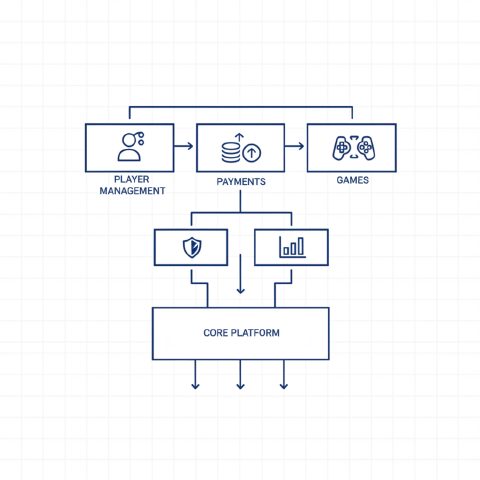
A PAM platform manages six core functional areas: player registration and identity verification (KYC), real-money wallet and transaction ledger, bonus and promotion engine, session and game-round tracking, responsible gambling controls, and regulatory reporting. Every other system in your stack — game aggregator, payment gateway, CRM, fraud tool — feeds data into or pulls data from the PAM.
Player registration sounds simple until you're operating under MGA or New Jersey DGE rules, where the PAM must enforce document upload, age verification, and source-of-funds checks before a player can deposit. The PAM has to orchestrate calls to your KYC provider (Jumio, Onfido, Sumsub — take your pick), store the verification outcome against the player record, and block or permit transactions accordingly. A poorly architected PAM creates friction in that flow and kills conversion at registration.
The bonus engine is where operators feel PAM limitations most acutely. Wagering requirements, game contribution weights, bonus abuse detection, free spin grants tied to deposit triggers — these rules get complex fast. Platforms like SoftSwiss's SGMS have relatively mature bonus engines; some smaller PAMs have bonus modules that look fine in a demo but break under real player behavior. I always recommend stress-testing bonus scenarios with actual edge cases before signing a contract.
Responsible gambling tooling has moved from a nice-to-have to a hard regulatory requirement across every serious jurisdiction. Your PAM must support deposit limits, loss limits, session time limits, cooling-off periods, and integration with national self-exclusion registers like GAMSTOP (UK), OASIS (Germany), or state-level systems in the US. If the PAM vendor can't show you a working GAMSTOP API integration, that's a red flag for any operator targeting the UK market.
Regulatory reporting is the unglamorous function that keeps your license. Curaçao eGaming's 2023 framework overhaul, the MGA's technical standards, and US state requirements all mandate specific audit logs, player activity reports, and suspicious transaction flagging. A PAM that can't generate those reports automatically will cost you in manual compliance overhead — and potentially your license if an audit goes badly.
| PAM Function | What It Does | Typical Third-Party Integration |
|---|---|---|
| Player Registration & KYC | Account creation, identity verification, age checks | Sumsub, Jumio, Onfido |
| Wallet & Transaction Ledger | Real-money balances, deposits, withdrawals, adjustments | Payment gateway, PSP aggregator |
| Bonus & Promotion Engine | Wagering rules, free spins, cashback, loyalty tiers | CRM, game aggregator |
| Session & Game-Round Tracking | Logs every spin, bet, win, and session timestamp | Game aggregator (RGS) |
| Responsible Gambling Controls | Limits, self-exclusion, reality checks, cooling-off | GAMSTOP, OASIS, state registers |
| Regulatory Reporting | Audit logs, suspicious activity reports, player data exports | Regulator portals, AML tools |
How does PAM software differ from a turnkey or white-label casino platform?
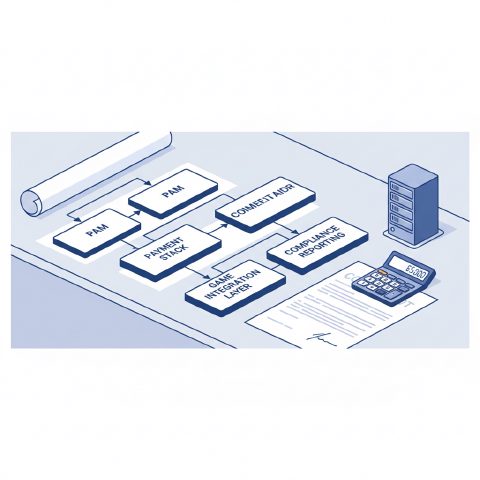
A PAM is one layer within a broader platform stack. A white-label or turnkey solution bundles the PAM with a front-end CMS, game aggregation, and sometimes payments into a single commercial package. Buying a white-label means you're renting someone else's PAM. Buying a standalone PAM means you own that layer and build or source the rest yourself — more control, more cost, more technical overhead.
The confusion between these terms causes real procurement mistakes. When a white-label provider like Softgamings, Hub88, or EveryMatrix's white-label arm sells you a 'platform,' you're getting a PAM plus a content aggregation layer plus a CMS template plus a back-office interface — all bundled. You don't interact with the PAM directly as a product; you interact with the operator back-office UI that sits on top of it. That's fine for operators who want to launch fast without a technical team, but it means your bonus engine, your player data structure, and your reporting are all constrained by the vendor's PAM architecture.
A standalone PAM deployment — the approach larger operators and those building proprietary brands tend to take — means licensing the PAM software separately and integrating it yourself (or through a systems integrator) with your chosen game aggregator, payment stack, and front-end. SoftSwiss sells its SGMS this way. EveryMatrix's CardsChat PAM can be deployed as a standalone module. This route gives you full API access, direct database control, and the ability to negotiate individual contracts with game studios and PSPs. The trade-off is a 6–12 month build timeline versus 4–8 weeks for a white-label launch.
From a cost perspective, white-label platforms typically charge a revenue share in the 10–15% GGR range plus a setup fee of €15,000–€50,000 depending on the provider and the market. Standalone PAM licensing looks different — you might pay a monthly SaaS fee of €10,000–€30,000 or a one-time license fee in the six-figure range, then own your GGR margin outright. The breakeven point is usually somewhere around €500,000–€1,000,000 in monthly GGR, above which a standalone PAM starts making economic sense. Below that, the white-label model is almost always the right call.
| Factor | White-Label (Bundled PAM) | Standalone PAM |
|---|---|---|
| Launch Timeline | 4–8 weeks | 6–12 months |
| Setup Cost | €15,000–€50,000 | €100,000–€500,000+ |
| Ongoing Cost | 10–15% GGR revenue share | Monthly SaaS or license fee; keep full GGR margin |
| Technical Control | Limited to back-office UI | Full API and database access |
| Data Ownership | Shared/restricted | Full ownership |
| Best For | New operators, sub-€500K/mo GGR | Established operators, scaling brands |
| Provider Examples | Softgamings, Hub88, EveryMatrix WL | SoftSwiss SGMS, EveryMatrix CardsChat, Digitain |
Which PAM software providers should operators evaluate in 2026?
The shortlist worth evaluating in 2026 includes SoftSwiss SGMS, EveryMatrix CardsChat, Digitain, BetConstruct, and Altenar for sports-focused builds. Each has meaningful differences in market focus, regulatory certifications, and pricing structure. No single provider is best for every market — your jurisdiction, your game vertical, and your technical capacity all shape the right choice.
SoftSwiss SGMS is probably the most operator-familiar PAM in the offshore and crypto casino space. It handles multi-currency wallets natively (including crypto), has a solid bonus engine, and integrates with SoftSwiss's own game aggregator — though you're not locked into that aggregator if you want to bring your own. It's MGA-certified and widely used for Curaçao-licensed operations. The downside: the back-office UI feels dated compared to newer entrants, and support responsiveness varies depending on your account tier.
EveryMatrix's CardsChat PAM is the platform I see gaining the most traction with mid-market operators right now. It's modular — you can take the PAM standalone or bundle it with their CasinoEngine aggregator and OddsMatrix sportsbook. Their compliance tooling for regulated European markets (MGA, UKGC, Romania, Sweden) is genuinely strong. The pricing is competitive but not cheap, and the sales process is slow — expect 4–6 weeks just to get a technical proposal.
Digitain and BetConstruct both originate from the Armenian tech cluster and offer full-stack platforms with PAM at the core. They're strong in LATAM and CIS markets and tend to be more price-flexible than European vendors. If you're launching in Peru (MINCETUR), Colombia (Coljuegos), or Mexico (SEGOB), Digitain has local market experience worth paying for. The trade-off is that their documentation and API quality isn't always at the same standard as EveryMatrix.
Altenar is worth mentioning specifically for operators building a sportsbook-first product with casino as a secondary vertical. Their PAM handles both verticals in a unified wallet, which matters for player experience and bonus cross-sell. For pure casino plays, though, it's not my first recommendation. One provider I'd flag as often overlooked is Delasport — they've made meaningful investments in PAM architecture for regulated EU markets and are worth a demo if you're evaluating the space seriously.
What does PAM software cost, and what drives the price?
PAM software costs range from roughly €15,000 setup plus 10–15% GGR on a white-label bundle, to €100,000–€500,000+ for a standalone license plus ongoing SaaS fees of €10,000–€30,000 per month. The main cost drivers are the deployment model, the number of regulated jurisdictions you need certifications for, the level of customization, and your projected player volume.
Vendors rarely publish pricing, which means every operator goes into negotiations blind. Here's what actually drives the number: first, deployment model. SaaS-hosted PAMs cost less upfront but accumulate over time. On-premise or private-cloud deployments require more upfront infrastructure investment but give you more control over data residency — which matters if you're operating under GDPR or in jurisdictions with local data storage requirements.
Second, regulatory certifications. A PAM that's already MGA-certified, UKGC-compliant, and approved under the new Curaçao framework costs more because the vendor has invested in building and maintaining those compliance modules. If you need your PAM to integrate with Germany's LUGAS system, Sweden's Spelpaus, or Italy's ADM requirements, expect to pay a premium or a bespoke integration fee on top of the base license.
Third, player volume tiers. Most PAM vendors price on a tiered model based on active players, transaction volume, or GGR. At low volumes (under 5,000 active players/month), you're often on a flat monthly fee. At scale, you're negotiating per-active-player pricing or a capped GGR share. I've seen operators get caught by volume overage fees they didn't read carefully in the contract — always model your growth scenarios against the pricing tiers before signing.
Fourth, customization. The base PAM license gets you the standard feature set. Custom bonus mechanics, bespoke reporting dashboards, proprietary loyalty program logic, or a custom front-end integration will all attract development fees. Budget €50,000–€200,000 for meaningful customization on a standalone deployment, and don't let a vendor tell you it's 'just configuration' without seeing the scope in writing.
How do regulatory requirements shape PAM software selection?
Your target jurisdiction determines which PAM features are legally mandatory, not optional. MGA requires certified RNG integration and responsible gambling tools. Curaçao's 2023 framework demands audit logs and AML controls. US state licenses (NJ, PA, MI) require geolocation, identity verification, and integration with state self-exclusion databases. A PAM that isn't pre-certified for your jurisdiction will cost you months and significant fees to get there.
The MGA (Malta Gaming Authority) has some of the most prescriptive technical standards in the industry. Their Player Protection requirements mandate that your PAM enforces cooling-off periods, session time reminders, and deposit limit requests within specific response windows. The MGA also requires that player data be stored on servers within the EU or in jurisdictions with adequate data protection frameworks. If your PAM vendor hosts on AWS US-East and can't demonstrate EU data residency, you have a problem before you've even applied for the license.
Curaçao went through a significant regulatory overhaul starting in 2023 with the National Ordinance on Offshore Games of Hazard (NOOGH). The new framework — which operators are still adapting to as of 2026 — requires licensed operators to have PAMs capable of generating real-time player activity reports on demand, maintaining five-year transaction histories, and integrating with Curaçao's central monitoring system. Operators who launched on legacy Curaçao sub-licenses and never updated their PAM infrastructure are facing real compliance exposure right now.
US state iGaming is where PAM compliance gets most granular. New Jersey's Division of Gaming Enforcement, Pennsylvania's PGCB, and Michigan's MGCB all publish technical standards that your PAM must meet before you can go live. These include geolocation verification on every session start, integration with the state's self-exclusion database (NJ's NJSEP, PA's iExclusion, MI's MSECS), and specific responsible gambling pop-up triggers. Most US-market PAMs are custom-built or heavily modified versions of European platforms — don't assume a PAM that works in Malta will pass a New Jersey technical review without significant work.
LATAM is more fragmented. Colombia's Coljuegos and Peru's MINCETUR both have technical certification requirements, but they're less prescriptive than the MGA or US states. Mexico under SEGOB is notoriously slow to process technical certifications. If you're targeting multiple LATAM markets simultaneously, choose a PAM vendor with existing regional certifications rather than trying to get your chosen platform certified from scratch — the timeline difference is typically 6–18 months.
How does a PAM integrate with game aggregators and payment providers?
PAM integration with game aggregators happens via a standardized wallet API — typically the provider's own protocol or an industry-standard like SoftSwiss's or EveryMatrix's documented API. Payment provider integration runs through the PAM's cashier module, which handles deposit and withdrawal requests, routes them to the appropriate PSP, and reconciles transaction status back to the player wallet. Poor integration architecture here is the leading cause of payment failures and game-round errors.
The wallet API between your PAM and your game aggregator is the most critical technical integration in your entire stack. When a player spins a slot, the game client sends a bet request to the game aggregator (say, Relax Gaming or Pragmatic Play's RGS), which then calls your PAM's wallet API to debit the bet amount and credit any win. That round-trip needs to complete in under 200 milliseconds to feel seamless. If your PAM's wallet API has latency issues or inconsistent error handling, players will see frozen screens, failed rounds, and disputed balances — all of which generate chargebacks and support tickets at scale.
Most major game aggregators (Hub88, Slotegrator, EveryMatrix CasinoEngine, Pariplay) publish their wallet API specifications. Your PAM either has a pre-built connector to that aggregator or needs a custom integration built. Pre-built connectors are faster to deploy but sometimes lag behind aggregator API updates. Custom integrations give you more control but require ongoing maintenance. When evaluating a PAM, always ask for a list of certified aggregator integrations — a PAM claiming 'thousands of games' but with only three or four direct aggregator connections is doing a lot of re-aggregation, which adds latency and a margin layer.
Payment integration is where I see the most operator pain post-launch. The PAM's cashier module needs to handle multiple PSPs simultaneously — because no single payment provider covers all your player markets — and route transactions intelligently based on player geography, payment method, and transaction size. Some PAMs have sophisticated payment routing built in; others expect you to bring a separate payment orchestration layer. Providers like Nuvei, Trustly, and Volt have direct PAM integrations with the major platforms, but if you're serving emerging markets with local payment methods (PIX in Brazil, SPEI in Mexico, PSE in Colombia), verify those integrations exist before you commit to a PAM.
What responsible gambling features must a PAM include?
Any PAM operating under a serious license — MGA, UKGC, Swedish Spelinspektionen, or US state authorities — must include deposit limits, loss limits, session time limits, self-exclusion (both operator-level and national register integration), reality checks, and cooling-off periods. These aren't add-ons; they're table stakes for licensure and increasingly for payment processor relationships too.
Responsible gambling tooling has become a payment processing prerequisite, not just a regulatory one. Several acquiring banks and card schemes now require evidence of RG controls before approving a casino merchant account. If your PAM can't demonstrate these features in a technical review, you'll struggle to get a Visa/Mastercard processing relationship — full stop. This is a shift that's accelerated since 2022 and shows no sign of reversing.
The technical implementation matters as much as the feature checklist. Deposit limits need to apply in real-time across all channels — if a player sets a €100 daily deposit limit and can bypass it by switching payment methods or logging in on mobile, that's a compliance failure, not just a UX problem. The MGA has fined operators specifically for limit enforcement gaps. Your PAM's limit logic needs to be wallet-level, not payment-method-level.
National self-exclusion register integration is jurisdiction-specific and technically non-trivial. GAMSTOP (UK) has a documented API that most UK-market PAMs support. Germany's OASIS system, Sweden's Spelpaus, the Netherlands' CRUKS, and Spain's RGIAJ all have different integration specifications. If you're operating in multiple regulated EU markets, you need a PAM that either has pre-built connectors to each register or has a documented process for adding them. Verify this before signing — some vendors will tell you 'we support self-exclusion' and mean only their internal exclusion system, not national register integration.
What are the biggest risks of choosing the wrong PAM?
The three biggest risks are migration lock-in, compliance gaps that surface during license audits, and scalability failures under player load. PAM migration is one of the most disruptive events an online casino can go through — it typically requires a full platform freeze, player data migration, regulatory notification, and 2–4 months of parallel running. Getting the initial selection wrong is expensive in ways that don't show up in the vendor's sales deck.
Migration lock-in is the risk I see operators underestimate most consistently. When you sign with a PAM provider, your player data — every account, every transaction, every bonus history, every responsible gambling limit — is stored in their database schema. If you want to move to a different PAM two years later, you need to export that data in a format the new PAM can import. Some vendors make this easy; others make it deliberately difficult. Ask for a data portability clause in your contract, specifying the format and timeline for a full data export. If the vendor pushes back on this, that tells you something important about their confidence in retaining you as a client.
Compliance gaps are the risk that can actually kill your business. I've seen operators launch on PAMs that had a responsible gambling module in the demo environment but couldn't actually enforce limits correctly in production. The gap only surfaced during a regulator audit 18 months after launch. The remediation cost — emergency development, legal fees, regulatory fines, and the distraction of a compliance investigation — far exceeded what a proper PAM evaluation would have cost upfront. Technical due diligence on a PAM should include a live compliance scenario test, not just a feature list review.
Scalability failures are less existential but operationally painful. PAMs that perform fine at 500 concurrent players can fall over at 5,000 during a promotional spike. Ask any PAM vendor for load test results and reference customers at your target scale. If they can't provide either, that's a yellow flag. SaaS-hosted PAMs generally handle scaling better than on-premise deployments, but even SaaS platforms have architectural limits — and finding them during a live promotion is a bad day.
How long does PAM implementation take, and what does the process look like?
White-label PAM deployment takes 4–8 weeks from contract signing to soft launch. Standalone PAM implementation runs 4–12 months depending on customization depth, regulatory certification requirements, and the complexity of your game and payment integrations. The critical path is almost always the compliance and certification process, not the technical build.
For a white-label deployment, the timeline breaks down roughly as follows: week one is contract signing and access provisioning; weeks two and three are brand configuration, game content selection, and payment method setup; weeks four through six are QA, UAT, and responsible gambling testing; week seven or eight is go-live. This assumes your license is already in place — if you're waiting on a Curaçao license approval simultaneously, add 4–8 weeks to that timeline under the new framework.
Standalone PAM implementation has a more complex critical path. The technical integration work — connecting the PAM to your game aggregator, payment providers, KYC tool, and CRM — typically takes 8–16 weeks for a competent development team. But regulatory certification often takes longer. Getting a PAM certified under MGA technical standards involves submitting documentation, a technical review, and potentially remediation rounds. Budget 3–6 months for MGA certification if the PAM isn't already pre-approved. US state certifications (NJ, PA, MI) are even slower — 6–18 months is realistic for a first-time applicant with a new platform.
The implementation process that works best, in my experience, follows this sequence: start with a detailed technical specification review of the PAM's APIs before signing; run a parallel compliance gap analysis against your target jurisdiction's technical standards; negotiate data portability and SLA terms into the contract before execution; then run a phased integration with game aggregator first, payments second, and third-party tools (KYC, fraud, CRM) last. Trying to integrate everything simultaneously is how projects run six months over schedule.
How is PAM software evolving in 2026?
The major PAM trends in 2026 are AI-driven player segmentation built into the bonus engine, real-time AML monitoring integrated at the PAM layer rather than as a bolt-on, and headless PAM architectures that decouple the back-end logic from the front-end presentation layer. Crypto and blockchain-native PAMs are also gaining traction for operators targeting decentralized casino models.
AI integration in PAM software has moved beyond marketing language into actual product features. EveryMatrix and SoftSwiss both now offer bonus engine modules with ML-based player segmentation — the system automatically identifies player cohorts by behavior and adjusts bonus offers accordingly, rather than requiring manual segment creation. This matters operationally because it reduces the labor cost of CRM management and can meaningfully improve bonus ROI. That said, I'd encourage operators to validate these claims with actual A/B test data from reference customers before treating them as proven — vendor marketing is ahead of production reality in some cases.
Real-time AML monitoring at the PAM layer is a response to regulatory pressure across multiple jurisdictions. The traditional approach was to export transaction data to a separate AML tool (like ACAMS or a custom rules engine) on a batch basis. Regulators increasingly expect real-time flagging and the ability to freeze accounts automatically when thresholds are breached. PAMs that can't do this natively are adding it through middleware integrations, which introduces latency and reconciliation risk. If AML is a priority for your jurisdiction — and in the EU it should be — ask specifically about real-time transaction monitoring architecture, not just what rules the system can enforce.
Headless PAM architecture is the most significant technical evolution for operators who want front-end flexibility. Traditional PAMs bundle the back-end logic with a specific front-end framework, which constrains your UI/UX options. A headless PAM exposes everything through APIs, letting you build any front-end — React, Vue, native mobile app — without touching the back-end. EveryMatrix has been moving in this direction; some newer entrants like Sportstech and Pronet Gaming are building headless-first. For operators who care about front-end differentiation, this is worth prioritizing in your evaluation criteria.




Comments
No comments yet, be the first.