iGaming Software Development: Real Costs, Build Paths and What Actually Ships in 2026
What does iGaming software development actually cover?
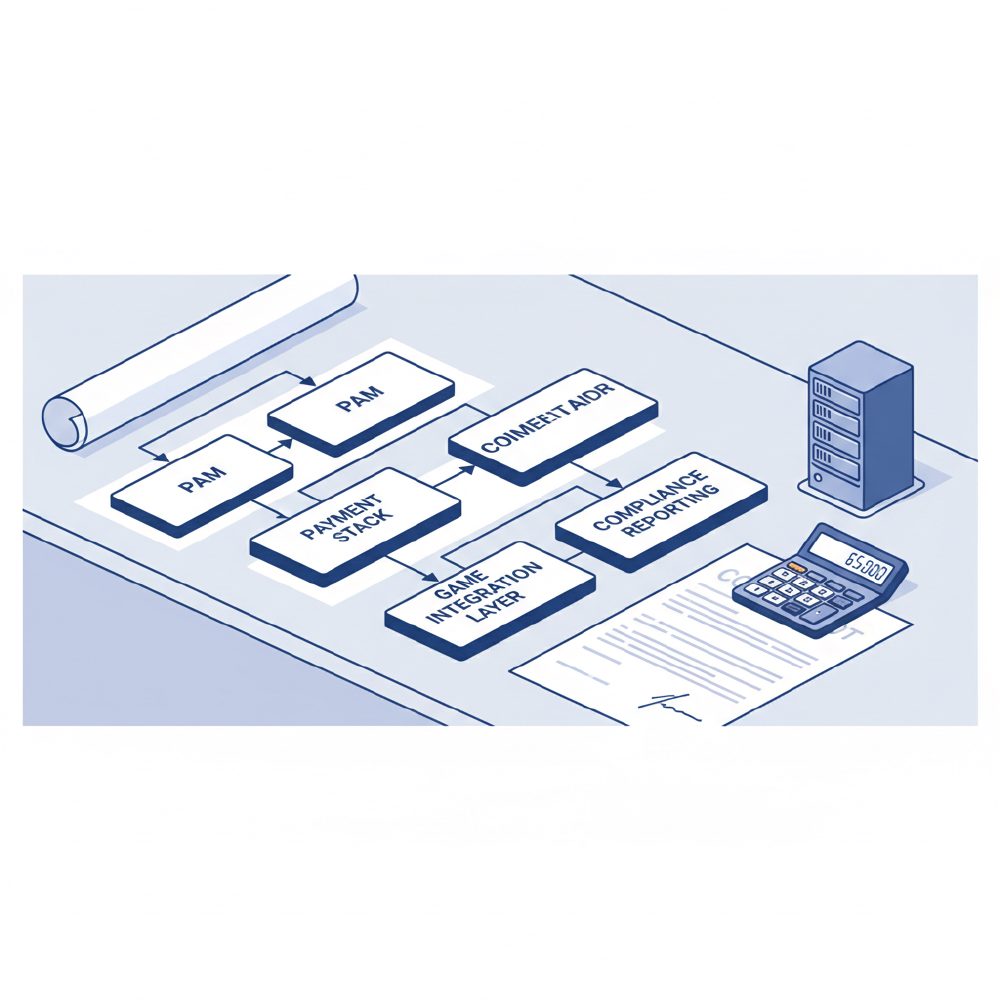
iGaming software development encompasses the full technology stack required to operate a licensed online casino or sportsbook: the player-facing front end, back-office management system, game integration layer, payment processing module, KYC/AML pipeline, bonus engine, reporting suite and the APIs that stitch all of it together. It is not just 'building a website.'
Most founders come in thinking iGaming software development means a front-end casino lobby and maybe a payment page. What they discover — usually after the first vendor call — is that the back office is where the real complexity lives. You need a CMS for promotions, a player account management (PAM) system that logs every session and transaction for regulators, a risk and fraud engine, affiliate tracking, and a reporting layer that can produce the audit files a Curaçao or MGA compliance officer will actually accept. That's before a single game loads.
The game integration layer alone is a project. Studios like Pragmatic Play, Evolution and Play'n GO each have their own API flavors. An aggregator like Pariplay or Hub88 abstracts that into a single integration, but adds a commercial layer — typically 2–4% of GGR on top of studio revenue share. A custom build means you're writing and maintaining those integrations yourself, which is manageable if you have a competent dev team and a clear roadmap, but painful if you don't.
Then there's the compliance tech. Responsible gambling tools (session limits, self-exclusion, reality checks) are not optional features you add later — MGA mandates them at launch, and US state regulators like the PGCB in Pennsylvania or the DGE in New Jersey have their own specific implementation requirements. GLI-11 and GLI-19 certifications for RNG and system integrity testing add both time and cost. Budget for these from day one, not as an afterthought.
What are the three main build paths and which fits your situation?
The three paths are white-label (fastest, least control), turnkey (more configurable, still vendor-dependent) and custom development (full ownership, highest cost and timeline). Which one fits depends on your budget ceiling, your target jurisdiction's technical requirements and whether you want to exit via acquisition — buyers pay more for proprietary tech.
White-label platforms like SoftSwiss's SOFTSWISS Casino Platform, EveryMatrix's CasinoEngine or Digitain's turnkey suite let you launch under a sub-license of the provider's master Curaçao or MGA license, or plug into their certified system if you hold your own license. The economics look attractive upfront: setup fees of $20K–$50K, a monthly platform fee of $5K–$15K, plus revenue share of 15–25% of GGR. You're live in 8–16 weeks. The catch is that 20% GGR share compounds brutally at scale — at $2M monthly GGR you're paying $400K/month to a vendor for infrastructure you don't own.
Turnkey solutions sit between white-label and custom. Providers like Softgamings, BetConstruct or GamMatrix (EveryMatrix's standalone PAM) give you a licensable, configurable platform you can run under your own license with more control over the tech stack. Setup costs run $80K–$250K, timelines are 3–6 months, and ongoing fees shift more toward flat licensing than GGR share. This is often the right answer for operators targeting a single regulated market with a realistic path to 1,000+ DAUs within 18 months.
Custom iGaming software development means you own the IP. Companies like Betsson, bet365 and DraftKings built and maintain their own platforms — that's not a coincidence, it's a strategic moat. For a new operator, a realistic custom build budget starts at $400K for a stripped-down MVP and climbs past $1M once you've added proper compliance tooling, a redundant payment stack and a QA process that will satisfy a third-party testing lab. Timeline: 12–24 months minimum. I've seen operators budget $600K and hit $1.4M by go-live. Plan for overruns.
| Criteria | White-Label | Turnkey | Custom Build |
|---|---|---|---|
| Upfront cost | $20K–$80K | $80K–$250K | $400K–$1.2M+ |
| Time to launch | 8–16 weeks | 3–6 months | 12–24 months |
| Ongoing cost model | 15–25% GGR share + monthly fee | Flat license + lower rev share | Dev team + hosting + maintenance |
| IP ownership | None | Partial / licensed | Full |
| Regulatory flexibility | Limited to provider's certs | Moderate | Full control |
| Acquisition value | Low | Medium | High |
| Best for | MVP / offshore test | Single-market operator | Scaling platform or exit play |
How do you choose an iGaming software development company?
Shortlist vendors who have shipped live, licensed products in your target jurisdiction — not just demo environments. Ask for references from operators who launched in the last 18 months, request a live back-office walkthrough, and get the compliance certification documentation before signing. Sales decks are meaningless; GLI test reports and live operator references are not.
The iGaming software development company market is crowded and the quality variance is enormous. You have established B2B platform vendors (SoftSwiss, EveryMatrix, Kambi on the sportsbook side), specialist boutique dev shops that build custom PAMs and front ends, and a long tail of offshore agencies that will quote you $80K for a 'full custom casino platform' and deliver a reskinned open-source script with no compliance layer. Distinguishing between them requires due diligence, not just RFP responses.
The questions that separate real vendors from pretenders: Which specific regulators have certified your platform? Can you show me a GLI-11 certificate issued in the last 24 months? Who are three operators currently live on your system in my target market, and will you connect me with their CTOs? What is your SLA for critical bug fixes during a regulatory audit? If a vendor hesitates on any of these, walk away. The cost of a failed launch — lost license fees, delayed revenue, re-integration work — dwarfs whatever you saved on a cheaper vendor.
For custom development, the offshore dev shop model (Eastern Europe, India, Latin America) can work if you have an in-house technical lead who can manage scope and QA rigorously. Rates for senior iGaming backend engineers in Ukraine or Romania run $60–$90/hour versus $150–$200/hour in Western Europe or the US. The math is attractive, but timezone friction, compliance knowledge gaps and turnover risk are real. I've seen operators lose 6 months because a key backend engineer on a Kyiv-based team left mid-project and took undocumented architecture decisions with them.
What does iGaming software development cost in 2026?
Realistic all-in costs range from $30K–$100K for a white-label launch (including license, integrations and first-year platform fees) to $600K–$2M+ for a proprietary platform ready for a regulated Western market. The figures vendors quote in their sales materials almost never include payment integration, compliance tooling, testing lab fees or the first 6 months of operational overhead.
Let me break down where the money actually goes on a mid-market custom build targeting, say, a Curaçao eGaming license with ambitions to move to MGA within two years. Platform core development (PAM, back office, bonus engine, reporting): $200K–$400K. Front-end casino lobby and mobile-responsive UI: $80K–$150K. Game aggregator integration (single API to Pariplay or Hub88): $15K–$40K in setup, then ongoing rev share. Payment stack — two to three PSPs, a crypto processor, a KYC/AML provider like Sumsub or Jumio: $40K–$100K in integration and annual fees. Third-party testing lab (BMM, GLI, eCOGRA): $20K–$60K depending on scope. Curaçao eGaming license or the new Curaçao Gaming Authority license under the revised 2024 framework: $30K–$50K in fees and legal costs. That's $385K–$800K before you've paid a single salary or bought a single marketing impression.
Ongoing costs are the number operators consistently underestimate. Hosting for a properly redundant iGaming stack (multi-region, DDoS-protected, sub-100ms latency for live casino) runs $8K–$25K/month depending on traffic. A lean but functional operations team — CRM manager, risk analyst, customer support leads — adds $15K–$40K/month in payroll. Platform maintenance and feature development: budget 20–30% of your initial build cost annually. At $600K build cost, that's $120K–$180K/year just to keep the lights on and stay compliant as regulations evolve.
The wildcard is regulatory change. The Curaçao gaming authority's overhaul that took effect in 2024 required operators to re-certify systems and implement new player protection APIs — operators on white-label platforms absorbed that via their provider, but custom-build operators had to fund the engineering work themselves. In the US, each new state launch (Pennsylvania, New Jersey, Michigan, now potentially Texas or California) requires a separate technical submission and GLI certification, costing $30K–$80K per state in testing fees alone. Build a regulatory change reserve into your financial model from day one.
| Cost Component | Low Estimate | High Estimate | Notes |
|---|---|---|---|
| Core platform (PAM, back office, bonus engine) | $200K | $400K | Scales with feature scope |
| Front-end / UX development | $80K | $150K | Mobile-first adds cost |
| Game aggregator integration | $15K | $40K | Plus ongoing GGR rev share |
| Payment stack (PSPs, crypto, KYC/AML) | $40K | $100K | Annual fees recur |
| Testing lab certification (GLI, BMM, eCOGRA) | $20K | $60K | Per jurisdiction |
| Licensing (Curaçao or MGA) | $30K | $80K | Legal fees add 30–50% |
| First-year hosting & infrastructure | $100K | $300K | Redundant multi-region |
| Total estimated range | $485K | $1.13M | Excludes marketing and payroll |
How long does iGaming software development take from contract to launch?
White-label: 8–16 weeks. Turnkey with your own license: 4–8 months. Custom build: 12–24 months for a properly certified, commercially ready product. The licensing process runs in parallel but is often the actual bottleneck — Curaçao's new framework takes 3–5 months; MGA can run 6–12 months; US state approvals routinely exceed 18 months.
Timeline slippage in iGaming software development almost always comes from three sources: scope creep in the back office, payment integration delays and regulatory certification queues. The first is controllable with disciplined product management — lock your MVP scope before development starts and resist the temptation to add features mid-sprint. The second and third are partially outside your control, which is why experienced operators start the PSP onboarding and testing lab submission processes as early as possible, often before the platform build is complete.
Payment integration is chronically underestimated as a timeline risk. Getting approved by a Tier-1 PSP as an online gambling merchant takes 4–12 weeks of underwriting, even with a clean Curaçao license. Crypto processors like CoinsPaid or B2BinPay are faster — 2–4 weeks — but you still need a fiat fallback for most markets. If you're targeting the US, each state's approved payment method list is different; ACH works in some states, credit cards are restricted in others, and PayPal's availability varies by market. Map your payment architecture to your target markets before you write a line of integration code.
For US operators specifically: the technical submission to a state gaming lab is a discrete project, not a checkbox. The Pennsylvania Gaming Control Board, for example, requires a full system submission including RNG certification, internal controls documentation and a disaster recovery plan. GLI's queue for new submissions can run 8–16 weeks. Factor that into your state launch timeline — operators who treat it as a 2-week formality get surprised every time.
What technical architecture decisions matter most for a scalable iGaming platform?
Microservices over monolith, API-first game integration, event-driven transaction logging and a jurisdiction-aware compliance layer are the architectural decisions that determine whether your platform scales cleanly or becomes a maintenance nightmare at 50,000 concurrent users. Getting these right at the design stage is far cheaper than refactoring under live traffic.
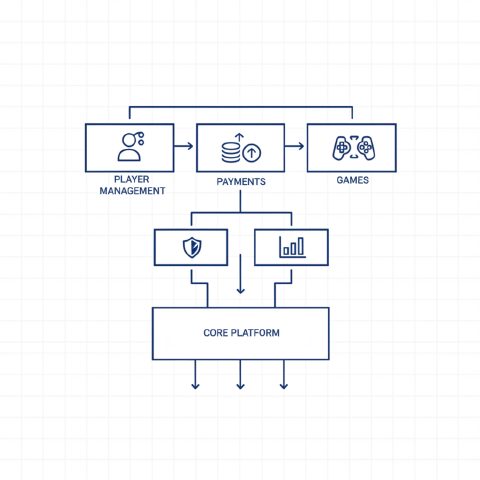
The PAM (Player Account Management) system is the architectural heart of any iGaming platform. It handles authentication, wallet, session management, responsible gambling controls and the audit trail regulators will inspect. Build it as a monolith and you'll hit scaling ceilings and deployment bottlenecks within 18 months of meaningful growth. A microservices architecture — separate services for wallet, identity, bonus, reporting — lets you scale the bottleneck independently and deploy updates to one service without risking the whole platform. SoftSwiss and EveryMatrix both run microservices architectures; if you're building custom, there's no good reason not to follow the same pattern.
Event sourcing for the transaction ledger is non-negotiable in any jurisdiction with serious audit requirements. Every bet placement, win, deposit and withdrawal needs to be logged as an immutable event, not just a database row that can be overwritten. Regulators in Malta, the UK and US states will ask for complete transaction histories going back years. An event-sourced ledger makes that trivial; a traditional CRUD database makes it fragile and expensive to reconstruct.
The game integration layer deserves its own architectural decision. If you're using an aggregator (Hub88, Pariplay, Relax Gaming's Silver Bullet), you get a single API endpoint and a content library of 10,000+ titles, but you're dependent on the aggregator's uptime and latency. For live casino content specifically — Evolution, Pragmatic Play Live, Ezugi — latency matters enormously; a 200ms delay in a live blackjack stream is noticeable and kills player experience. Run your own CDN layer and cache static assets aggressively. For direct studio integrations, budget 2–4 weeks of engineering per studio and maintain a dedicated integration team to handle API version updates.
How do regulatory requirements shape your iGaming software development choices?
Regulation is not a compliance checkbox you bolt on after build — it dictates your data architecture, your responsible gambling feature set, your RNG implementation and your reporting pipeline from day one. Building for Curaçao first and MGA second is a legitimate strategy, but only if the architecture is designed to support MGA's requirements without a full rebuild.
Curaçao eGaming (now the Curaçao Gaming Authority under the 2024 National Ordinance) has historically been the most accessible offshore license and the most forgiving on technical requirements. That's changing. The new framework requires operators to implement player protection tools, maintain local data retention and submit to periodic technical audits. It's still lighter-touch than MGA or UKGC, but the gap is narrowing. If you're using Curaçao as a stepping stone to a more regulated market, architect your compliance layer to MGA standards from the start — the incremental cost is modest, the rebuild cost if you don't is enormous.
MGA (Malta Gaming Authority) requires, among other things: a certified RNG (tested to EN ISO/IEC 17020 standards), a responsible gambling system with mandatory player-set limits, a self-exclusion integration with Malta's national self-exclusion register, and a real-time reporting API that pushes transaction data to the MGA's systems. That last requirement — the MGA's Gaming Authorisation and Compliance Directorate's B2C reporting — is a specific technical integration that takes 4–8 weeks to build and certify. It's not optional and it's not trivial.
US state regulation is the most technically demanding environment in the world for iGaming software development. New Jersey's DGE requires internal controls documentation that reads more like a banking compliance manual than a gaming regulation. Pennsylvania's PGCB mandates specific responsible gambling API integrations with the state's self-exclusion database. Michigan's MGCB has its own technical standards. Each state is essentially a separate certification project. Operators who want to be live in multiple US states need either a platform that has already been certified in those states (a major advantage of partnering with an established US-market platform vendor like GAN, Kambi or NRT Technology) or a dedicated compliance engineering team that can manage parallel certification tracks.
What payment integration decisions can make or break your casino's conversion rate?
A casino with a brilliant game lobby and a broken deposit flow will fail. Payment integration for iGaming means building a multi-PSP stack with local acquiring, fallback routing, fraud scoring and currency handling — not just plugging in Stripe. The difference between a 60% and an 80% deposit success rate is the difference between a viable business and a struggling one.
iGaming is one of the highest-risk merchant categories for payment processors, which means your options are narrower and more expensive than in most e-commerce verticals. Tier-1 processors (Visa, Mastercard direct acquiring) are largely inaccessible to offshore operators. You're working with specialist iGaming payment providers: Nuvei, Payvision, Praxis Cashier, Trustly (for open banking in Europe), STICPAY, MiFinity and a growing set of crypto processors. Each has different geographic coverage, fee structures and risk appetites. A properly built payment stack uses at least two PSPs with automatic failover routing — if PSP A declines a transaction, PSP B gets the retry. That alone can recover 10–15% of failed deposits.
Crypto payments have moved from a niche to a mainstream requirement for offshore operators. CoinsPaid processes a significant share of iGaming crypto volume; B2BinPay and Coinify are credible alternatives. The integration is technically straightforward — typically a REST API with webhook callbacks — but the compliance layer around crypto KYC (source of funds, wallet screening) is getting more scrutiny from both regulators and banking partners. Build your crypto payment flow with a wallet screening tool (Chainalysis or Elliptic integrations are available via most major crypto processors) from day one.
For LATAM markets — which are genuinely the highest-growth region in iGaming right now — local payment methods are not optional, they're the primary conversion driver. In Brazil, Pix instant payment is how most players deposit; in Mexico, SPEI and OXXO cash vouchers; in Colombia, PSE and Efecty. If you're targeting these markets and your payment page shows only Visa/Mastercard, you're leaving the majority of your potential player base unable to deposit. Praxis Cashier and PayRetailers both offer aggregated LATAM payment coverage via a single integration — worth the cost given the alternative.
Should you use a game aggregator or pursue direct studio deals?
Use an aggregator to launch — it's faster, cheaper and gives you content breadth that direct deals can't match at low player volumes. Pursue direct studio deals only once you can demonstrate 5,000+ daily active players to a studio's partnership team, because below that threshold the economics don't justify the integration overhead or the minimum guarantee commitments studios will ask for.
Game aggregators — Hub88, Pariplay, Relax Gaming's Silver Bullet, Slotegrator — solve a real problem: getting to 5,000+ game titles without 5,000 separate API integrations. The commercial model is typically a 2–4% aggregator fee on top of the studio's own revenue share (usually 10–20% of GGR depending on volume). So on a slot from Pragmatic Play via an aggregator, you might be paying 15% to Pragmatic plus 3% to the aggregator — 18% of GGR in content costs. That's significant, but it's the cost of speed and simplicity at launch.
Direct studio deals make economic sense when you have the volume to negotiate. Pragmatic Play, Play'n GO, NetEnt (now part of Evolution) and Microgaming all have minimum volume thresholds below which they won't offer direct deals, or will offer them at rates that don't beat aggregator pricing. The threshold varies by studio but is generally in the range of $100K–$500K monthly GGR from their content. Below that, you're better off with an aggregator and a clean integration contract that lets you migrate to direct deals later without re-platforming.
Live casino is the exception to the aggregator-first rule. Evolution Gaming — which dominates the live casino market with roughly 70% share — prefers and often requires direct integration for operators above a certain scale. Their API is well-documented and the integration is a 4–8 week project. Given that live casino typically drives 40–60% of GGR for mature online casinos, getting a direct Evolution deal and building a dedicated live casino section in your lobby is worth prioritizing once you're past the MVP phase. Pragmatic Play Live and Ezugi are credible alternatives with lower entry thresholds.
What are the most common iGaming software development mistakes operators make?
The most expensive mistakes are: scoping the back office too lightly, starting payment integration too late, building for one jurisdiction without a path to the next, and hiring a dev shop with no iGaming compliance experience. These aren't hypothetical — they're the pattern I see repeatedly from operators who arrive post-launch needing a rebuild.
Under-scoping the back office is endemic. Operators focus on the player-facing lobby — which is visible, exciting and easy to demo — and treat the CMS, affiliate system, risk tools and reporting suite as secondary. Then they go live and discover that their bonus engine can't handle a simple free-spins promotion without manual intervention, or that their reporting can't produce the monthly GGR summary their accountant needs for tax filings. Back-office functionality is unglamorous but it's where your operations team spends 80% of their time. Scope it properly upfront.
Starting payment integration late is the single biggest launch-delay cause I've seen. PSP underwriting takes time — sometimes longer than the platform build itself. Nuvei, for example, requires a full KYC package on the operator entity, a compliance questionnaire, a review of your responsible gambling policies and sometimes a site audit before they'll issue a merchant account. Start this process the day you sign your platform contract, not the week before go-live. The same applies to KYC/AML provider onboarding (Sumsub, Jumio, Onfido all have onboarding queues) and to your banking relationships.
Building for a single jurisdiction without architecture that supports expansion is a strategic mistake that's expensive to unwind. If you launch on Curaçao with a PAM that has no data residency controls, no multi-currency ledger and no jurisdiction-specific responsible gambling config, adding MGA or a US state later means a significant re-engineering project. The incremental cost of building these capabilities in from the start is 15–25% of your initial build budget. The cost of retrofitting them later — while the platform is live and generating revenue you can't risk disrupting — is usually 50–100% of the original build cost. Architect for where you want to be in 3 years, not just where you're launching.





Comments
No comments yet, be the first.