Casino Management System for Online Casinos: The Operator's Complete Guide for 2026
What is a casino management system and what does it actually do?
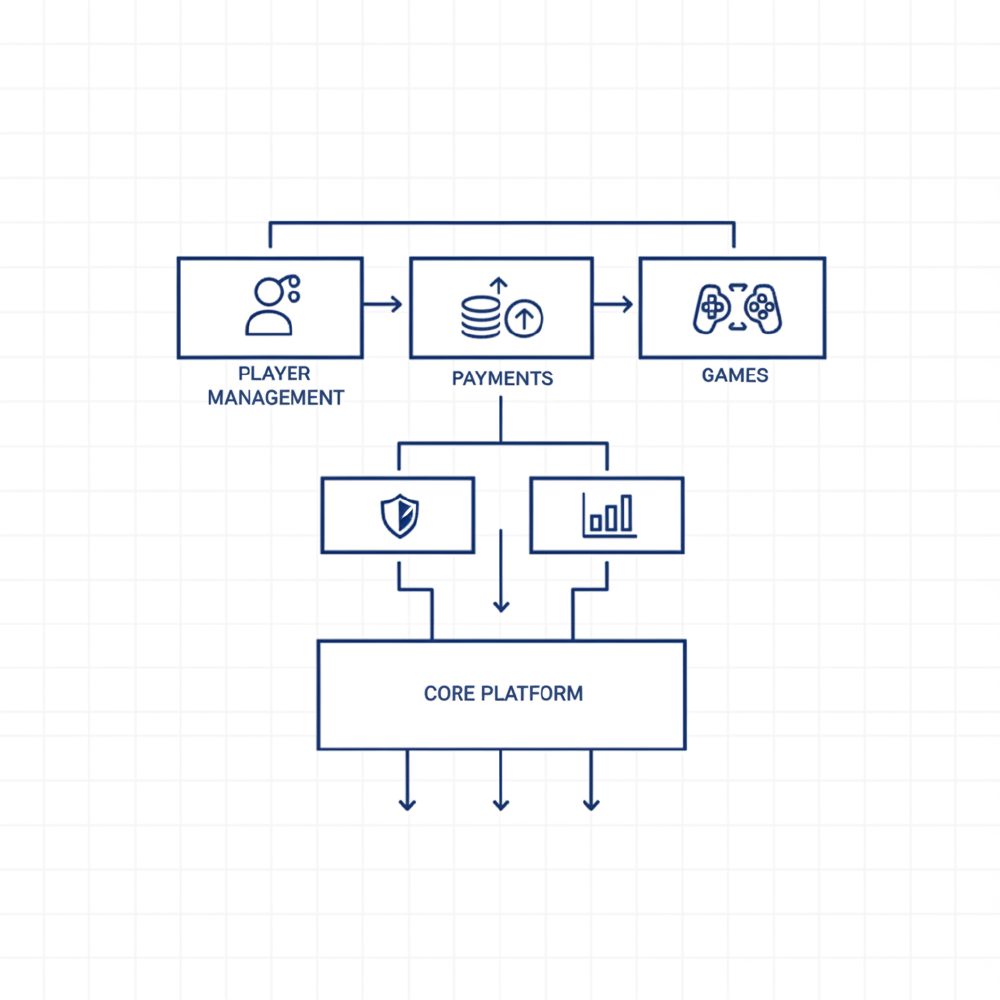
A casino management system is the centralized back-office software that runs an online casino's operations end-to-end — player registration, KYC, wallet management, game content delivery, bonus logic, reporting, and regulatory tools. Think of it as the operating system your entire business runs on. Without it, none of the customer-facing pieces work together.
The term gets used loosely, so let me be precise. In the B2B iGaming context, a CMS is not a content management system in the WordPress sense — it's the operational platform that sits between your players and every service provider you've contracted. When a player registers, the CMS triggers the KYC workflow. When they deposit, the CMS routes the transaction through your payment stack and credits the wallet. When they claim a bonus, the CMS enforces the wagering rules. When a regulator asks for a responsible gambling report, the CMS generates it. Every one of those actions flows through the same system.
At the architectural level, a modern online casino management system typically consists of several tightly integrated modules: a player account management (PAM) layer, a game integration layer (usually via an aggregator API), a payment processing hub, a bonus and promotions engine, a CRM and segmentation tool, a reporting and analytics dashboard, and a compliance toolkit covering AML, KYC, and responsible gambling limits. Some vendors bundle all of these natively; others offer a core PAM and let you plug in third-party modules. The difference matters enormously when you're debugging a payment failure at 2 a.m. before a big promotion goes live.
It's worth separating the CMS from the front-end website or mobile app — those are presentation layers that sit on top of the CMS via API. Some operators conflate the two because white-label packages bundle them together. But if you ever want to redesign your UI without touching your player data or game catalog, you need those layers cleanly separated. Vendors like EveryMatrix and SoftSwiss have invested heavily in decoupled, API-first architectures precisely because operators kept getting burned by monolithic setups where changing a button color required a platform migration.
What are the core modules every online casino management system must include?
At minimum, a production-ready online casino management system needs six functional modules: player account management, a payment hub, a game aggregation layer, a bonus engine, a compliance and KYC toolkit, and a reporting dashboard. Missing any one of these forces you to bolt on a third-party solution post-launch — which is expensive and creates integration debt you'll be paying down for years.
Player Account Management (PAM) is the foundation. It handles registration, login, session management, account verification, responsible gambling settings (deposit limits, self-exclusion), and the player wallet. A weak PAM creates cascading problems everywhere else. I've seen operators choose a CMS purely on game library size, only to discover the PAM had no native support for multi-currency wallets — a fatal gap for any crypto-friendly operation or LATAM market entry.
The payment hub is where most operators underestimate complexity. It's not just about connecting to a PSP — it's about routing logic, currency conversion, fraud scoring, chargeback handling, and reconciliation. A good CMS payment module will let you configure routing rules (e.g., route Visa deposits under €50 to Provider A, route above €50 to Provider B) and give your finance team a unified ledger view. Providers like Nuvei, Paysafe, and Trustly each require their own integration; a CMS that has these pre-built saves you three to six months of development time per PSP.
The bonus engine deserves more scrutiny than it usually gets during vendor demos. Operators ask "can you do free spins and deposit matches?" and every vendor says yes. The real questions are: can you configure wagering contribution by game provider? Can you run simultaneous overlapping promotions without conflicts? Can you A/B test bonus structures? Can you retroactively adjust a bonus if a player triggers a fraudulent pattern? SoftSwiss's bonus engine, for example, supports highly granular wagering rules per game category — that's the kind of detail that separates a serious platform from a demo-ware showcase.
On compliance, the requirements differ sharply by jurisdiction. An MGA-licensed operator needs a CMS that can enforce mandatory cooling-off periods, generate RG reports on demand, and maintain a full audit log of every player interaction. A Curaçao operator under the new OGL framework (effective 2024) faces tighter AML documentation requirements than the old master-license regime. A New Jersey DGE-licensed operator needs a CMS that has passed technical standards review against NJAC 13:69O. If your vendor can't show you a current certificate or letter of compliance for your target jurisdiction, treat that as a hard blocker, not a negotiation point.
| Module | Primary Function | Common Gaps to Probe |
|---|---|---|
| Player Account Management (PAM) | Registration, wallet, session, RG limits | Multi-currency support, crypto wallet integration |
| Payment Hub | PSP routing, reconciliation, fraud scoring | Number of pre-built PSP integrations, chargeback workflow |
| Game Aggregation Layer | API connections to game studios/aggregators | Certified RNG compliance, game launch speed, fallback logic |
| Bonus Engine | Promotions, free spins, wagering rules | Granularity of wagering contributions, abuse detection |
| KYC / AML / Compliance Toolkit | Identity verification, AML screening, RG reporting | Jurisdiction-specific certifications, audit log completeness |
| Reporting & Analytics Dashboard | GGR, NGR, player LTV, cohort analysis | Real-time vs. delayed data, custom report builder, API export |
White-label, turnkey, or custom build — which CMS model is right for your operation?
White-label gets you live in 4–8 weeks with a shared platform and shared license, turnkey gives you your own license and more control in 3–6 months, and a custom build takes 12–24 months but gives you full ownership. The right choice depends on your budget, timeline, target market, and long-term differentiation strategy — not on what the vendor pitches hardest.
White-label is the fastest path to revenue, and that's genuinely valuable if you're testing a market or raising early traction to show investors. Vendors like SoftSwiss (their Turnkey product) and EveryMatrix offer white-label setups where you're essentially renting a slice of their infrastructure and operating under a sub-license. The catch: you share the platform with other operators, your ability to customize the CMS logic is limited, and if the master licensee loses their license — as happened with several Curaçao master-license holders during the 2023–2024 regulatory transition — your operation goes dark with it. I've had clients call me in a panic exactly because of this scenario.
Turnkey is the middle path. You get your own gaming license (typically Curaçao OGL, MGA, or an emerging-market license like Anjouan), your own player database, and a CMS instance that's yours — but the software itself is still the vendor's product, and you pay ongoing fees accordingly. Digitain and BtoBet both offer strong turnkey packages with reasonable customization latitude. Expect 3–6 months from contract signing to go-live, assuming your licensing runs in parallel. Budget-wise, turnkey setups typically run $50,000–$150,000 in setup fees plus ongoing revenue share or flat monthly fees depending on the vendor's commercial model.
Custom builds are for operators who have already validated a market, have a clear technical vision, and have the runway to sustain 12–24 months of development before seeing a return. The upside is total control: you own the IP, you can build proprietary features competitors can't copy, and you're not paying perpetual revenue share to a platform vendor. The downside is everything else — hiring or contracting a development team, managing integrations with 50+ game studios and a dozen PSPs, and building compliance modules from scratch for every jurisdiction you want to enter. Most operators who say they want a custom build in year one end up on a turnkey platform by year two. That's not failure; it's good judgment.
| Model | Time to Launch | Typical Upfront Cost | Ongoing Cost Structure | Best For |
|---|---|---|---|---|
| White-Label | 4–8 weeks | $5,000–$30,000 | Revenue share 15–25% GGR | Market testing, limited capital, fast entry |
| Turnkey | 3–6 months | $50,000–$150,000 | Rev share 3–8% GGR or flat monthly fee | Serious operators wanting own license and brand control |
| Custom Build | 12–24 months | $300,000–$1M+ | Internal tech costs, direct vendor deals | Scaled operators, proprietary product vision, full IP ownership |
Which CMS vendors dominate the market and how do they actually differ?
SoftSwiss, EveryMatrix, Digitain, BtoBet, and Altenar are the most frequently evaluated platforms in 2026. Each has a genuine market niche — SoftSwiss leads in crypto-native setups, EveryMatrix excels in modular enterprise architecture, Digitain is strong in LATAM and emerging markets, BtoBet owns sportsbook-led operations, and Altenar specializes in sports betting integrations. None is universally best.
SoftSwiss has built a strong reputation in crypto casino operations — their platform natively supports 70+ cryptocurrencies, and their game aggregator (SOFTSWISS Game Aggregator) connects to over 200 studios. Their Turnkey Casino product bundles CMS, game aggregation, and a Curaçao license solution into one commercial package. The trade-off: their revenue share model can get expensive at scale, and operators who want to move to a direct-license setup later find the migration painful because player data portability isn't always clean.
EveryMatrix takes a different architectural philosophy. Their CasinoEngine, MoneyMatrix (payments), and PlayerMatrix (PAM) are sold as standalone modules or as a full suite. That modularity is genuinely useful if you already have a payments setup you like or if you want to swap out one layer without rebuilding everything. They're MGA-certified and have done serious work on UKGC compliance. The downside is that the modular pricing model means your total cost of ownership can creep up as you add modules — get a fully itemized quote before you sign anything.
Digitain has carved out strong market share in LATAM, Central Asia, and Africa — markets where some EU-centric vendors haven't bothered to build local payment integrations or Spanish/Portuguese language support natively. Their GreenPlatform CMS is a solid mid-market option. BtoBet (now part of Kambi Group) is worth evaluating if sports betting is your primary vertical and casino is secondary; their sportsbook engine is genuinely best-in-class, but their casino CMS is less differentiated. Altenar sits in a similar sportsbook-first position.
One vendor category I'd flag that often gets overlooked: regional specialists. For US state-licensed operations (New Jersey, Michigan, Pennsylvania), platforms like GAN (now Sightline) and Pariplay have done the heavy lifting of getting their tech certified against state technical standards — a process that can take 12–18 months if you're starting from scratch. For LATAM regulated markets (Colombia's Coljuegos, Peru's MINCETUR, Mexico's SEGOB), you need a vendor who has actually integrated local payment methods like PSE, Efecty, OXXO Pay, and Khipu — not one who says they can "add them later."
How does a casino management system handle payments and why does this make or break conversion?
The payment module in a CMS controls deposit routing, currency handling, fraud scoring, withdrawal processing, and reconciliation. A poorly configured payment stack is the single most common reason operators see abandoned deposits and chargeback rates above 1.5%. Getting this right requires both the right PSP mix and intelligent routing logic inside the CMS itself.
Most operators focus on which PSPs they can connect to and overlook the routing intelligence inside the CMS. Smart routing means the system automatically selects the best-performing PSP for a given transaction based on factors like card BIN country, transaction amount, historical approval rates, and current PSP uptime. EveryMatrix's MoneyMatrix module, for example, supports waterfall routing — if PSP A declines, the transaction automatically retries with PSP B within milliseconds, invisible to the player. That alone can recover 8–15% of transactions that would otherwise fail, which is real money at scale.
Currency and crypto handling is increasingly non-negotiable. In 2026, operators targeting European or LATAM players who don't support at least SEPA bank transfers, major card schemes, and one or two popular e-wallets (Skrill, Neteller, or local equivalents) are leaving significant conversion on the table. Crypto support — particularly BTC, ETH, USDT, and LTC — is now a baseline expectation for offshore operators, not a differentiator. The CMS needs to handle crypto wallet generation, on-chain confirmations, and exchange rate locking at the point of deposit natively, not through a clunky third-party plugin bolted on after the fact.
Withdrawal processing is where player trust lives or dies. A CMS that can't process withdrawals within 24 hours — ideally same-day for verified players — will generate negative reviews that follow your brand for years. The CMS should automate withdrawal approval for low-risk, verified players up to a configurable threshold (say, €2,000), flag higher amounts for manual review, and maintain a clear audit trail for every transaction. If your compliance team is manually approving every €50 withdrawal because the CMS has no risk-scoring logic, you have a staffing problem that's actually a technology problem.
What does regulatory compliance look like inside a casino management system?
Compliance modules in a CMS handle KYC verification, AML transaction monitoring, responsible gambling tools (deposit limits, self-exclusion, reality checks), and audit logging. The specific requirements differ sharply by jurisdiction — an MGA-compliant CMS has different technical obligations than one built for Curaçao OGL or a US state regulator. Verify certifications before committing to any platform.
Let's be concrete about what regulators actually require from your CMS. The Malta Gaming Authority (MGA) mandates that operators maintain a full, tamper-proof audit log of all player transactions and account changes, enforce mandatory responsible gambling tools (self-exclusion must propagate across all MGA-licensed brands via the national self-exclusion register), and submit regular compliance reports. Your CMS must be technically capable of generating these reports in the format the MGA specifies — not in a PDF export you manually reformat. EveryMatrix and SoftSwiss both have dedicated MGA compliance modules; verify the version is current because the MGA updated its technical standards in 2023.
Curaçao's new OGL (Online Gaming License) framework, which replaced the master-license system in 2024, introduced direct licensing with enhanced AML requirements. Operators now need to demonstrate that their CMS can perform real-time transaction monitoring against PEP and sanctions lists, maintain source-of-funds documentation workflows, and generate SAR (Suspicious Activity Report) data on demand. Some legacy CMS platforms that were built for the old Curaçao regime don't have these capabilities natively — a fact vendors are not always upfront about during sales calls.
For US state-licensed operations, the compliance bar is the highest in the world. New Jersey's Division of Gaming Enforcement (DGE) requires that your CMS and all third-party integrations pass a technical review against NJAC 13:69O standards. Michigan's MGCB and Pennsylvania's PGCB have similar processes. This is not a rubber stamp — it involves source code review, penetration testing, and RNG certification. GAN's platform has pre-cleared this process in multiple US states, which is a meaningful time advantage. If you're evaluating a European CMS vendor for a US state launch, ask them directly: "Which US state technical standards have you been certified against, and can you provide documentation?" The answer will tell you everything.
Responsible gambling tooling deserves specific attention because regulators are tightening requirements across every jurisdiction. At minimum, your CMS needs to support: deposit limits (daily, weekly, monthly), loss limits, session time limits, reality check pop-ups, cooling-off periods, and permanent self-exclusion. The UK Gambling Commission (UKGC) additionally requires operators to integrate with GAMSTOP, the national self-exclusion scheme — your CMS must query GAMSTOP at registration and login. Sweden's Spelinspektionen requires integration with Spelpaus. These are not optional features you add later; they are launch blockers.
How does game integration work within a casino management system?
Games connect to the CMS either through a game aggregator (one API to access hundreds of studios) or via direct studio integrations. Aggregators like Relax Gaming, Pariplay, and SoftSwiss Game Aggregator are the standard path for most operators — they reduce integration time from months to days per studio. Direct deals make sense only at significant volume, typically above €5M GGR per month.
The aggregator model works like this: instead of negotiating and integrating with 50 game studios individually, you connect your CMS to a single aggregator API that already has those studios pre-integrated. The aggregator handles the game launch URLs, wallet calls (debit/credit per spin), session management, and RNG certification documentation. You pay the aggregator a percentage of GGR from the games they supply — typically 1–3% on top of the studio's own revenue share — in exchange for that infrastructure. For most operators below €10M monthly GGR, this math makes complete sense.
The game integration layer inside your CMS needs to handle seamless wallet integration — meaning every spin debit and win credit happens in real time against the player's main wallet, with no separate game wallet the player has to manually transfer to. Some older CMS architectures used a "transfer wallet" model where players moved funds into a game-specific wallet before playing. That model creates friction, confuses players, and is increasingly rare in 2026 — but it still exists on some legacy platforms, so check explicitly.
Content certification is a compliance issue, not just a technical one. Games offered to players in regulated markets must be certified by an approved test lab (GLI, BMM, eCOGRA, Gaming Laboratories International) for that specific jurisdiction. A game certified for MGA play is not automatically approved for New Jersey. Your CMS should maintain a content certification matrix — which games are approved for which jurisdictions — and automatically suppress non-certified content for players in restricted markets. If you're running a multi-market operation and this logic isn't automated in your CMS, you have a regulatory exposure that could cost you your license.
What does a casino management system cost in 2026?
CMS costs in 2026 range from $5,000–$30,000 upfront for white-label setups to $50,000–$150,000 for turnkey platforms, with ongoing revenue share of 3–25% GGR depending on the model. Custom builds start at $300,000 and scale with scope. The headline number is rarely the real number — integration fees, certification costs, and module add-ons routinely double the initial quote.
The pricing structures vendors use vary enough that direct comparisons are genuinely difficult. Some charge a flat monthly SaaS fee (common with EveryMatrix's modular approach), some take a pure revenue share on GGR (common with white-label setups), and some use a hybrid — a lower monthly fee plus a reduced revenue share percentage. The revenue share model looks cheap at low volumes and expensive at high volumes; the flat fee model is the inverse. Model both scenarios with your projected GGR before you sign, and make sure you understand what "GGR" means in the contract — some vendors define it before bonus costs (gross), some after (net). That distinction can represent a 20–30% difference in your actual fee.
Setup and integration fees are where budgets get blown. A typical turnkey setup will include a base platform fee, but then charge separately for: custom payment integrations (€2,000–€10,000 per PSP not already in their library), additional language/currency configurations, custom front-end design work, and compliance module setup for specific jurisdictions. I've seen operators sign a $60,000 turnkey contract and end up at $120,000 by go-live because they didn't get a fully itemized scope of work upfront. Always ask for a line-item breakdown of everything that's included and everything that's billable extra.
Ongoing costs beyond the platform fee include: game aggregator revenue share (1–3% of GGR from aggregated content), PSP processing fees (typically 1.5–4% per transaction depending on method and market), KYC/AML service costs (providers like Jumio, Onfido, or ComplyAdvantage charge per verification or per month), and hosting/infrastructure if not bundled. A realistic all-in cost model for a mid-size online casino doing €500,000 GGR per month might look like: €15,000–€25,000 in platform fees, €5,000–€15,000 in game aggregator fees, €7,500–€20,000 in payment processing costs, and €2,000–€5,000 in KYC/compliance services. These figures are illustrative ranges — flag this as an area where you need vendor-specific quotes for your actual volume and market.
How long does it take to implement a casino management system and go live?
White-label setups can go live in 4–8 weeks. Turnkey platforms with a new license take 3–6 months. Custom builds take 12–24 months minimum. The licensing process is usually the critical path, not the technology — a Curaçao OGL application currently takes 3–5 months, while an MGA license takes 4–6 months and a US state license can take 12–18 months or more.
The technology implementation itself is rarely the bottleneck. A competent CMS vendor can have a configured platform environment ready in 4–8 weeks for a standard turnkey setup. What slows operators down is the parallel workstream of licensing, payment account opening, and content certification. PSP account opening for gambling merchants is notoriously slow — expect 6–12 weeks for a major card processor, and some will decline outright depending on your license jurisdiction. Starting the PSP application on day one of your project, not after the platform is ready, is one of the most valuable pieces of advice I give new operators.
For regulated US markets, the timeline is a different category entirely. New Jersey's DGE technical review alone can take 6–9 months after submission, and submission requires your CMS to already be substantially built. Michigan and Pennsylvania have similar timelines. The practical implication: if you're targeting a US state launch, your CMS vendor needs to have pre-existing certification in that state, or you need to budget 18–24 months minimum from project start to first real-money wager. There are no shortcuts here — the regulators have seen every attempt.
For LATAM regulated markets, timelines are improving but still substantial. Colombia (Coljuegos) has streamlined its process somewhat, with license applications now taking roughly 6–9 months for qualified applicants. Peru (MINCETUR) and Mexico (SEGOB) remain slower and more document-intensive. Argentina's provincial licensing landscape is fragmented — Buenos Aires province has an active licensing framework, but it operates independently of other provinces, so "Argentina" is not a single addressable market from a licensing perspective. Your CMS needs to support the local payment infrastructure from day one, not as a post-launch addition.
What are the biggest mistakes operators make when choosing a casino management system?
The most damaging mistakes are: choosing on game library size rather than compliance capability, signing a revenue share contract without modeling it at scale, skipping a proper data portability clause, and not verifying that the CMS is certified for the target jurisdiction before signing. These are the errors that surface six months into a launch and cost far more to fix than they would have cost to prevent.
The game library trap is the most common. Vendors lead with "access to 10,000+ games from 200+ providers" because it's a compelling headline. But if the CMS's bonus engine can't handle split wagering contributions by provider, or if the game integration layer doesn't support real-time RTP monitoring, or if the compliance module isn't certified for your license jurisdiction — none of those 10,000 games matter. Evaluate the CMS on its weakest module, not its strongest marketing claim.
Revenue share contracts deserve a proper financial model before you sign. A 10% GGR revenue share looks manageable at €100,000 monthly GGR (€10,000/month). At €1,000,000 monthly GGR, you're paying €100,000/month — €1.2M annually — to a vendor for software that cost them nothing incremental to serve you. Most contracts have no revenue share cap and no provision for renegotiation. The vendors who offer flat monthly fees at higher volumes are often the better long-term partners for operators with serious growth ambitions. Model the five-year cost, not the year-one cost.
Data portability is the clause operators regret not negotiating when they want to migrate. Your player database — account records, transaction history, KYC documents, bonus history — is your most valuable asset. Some CMS contracts grant the vendor a license to your player data, limit your ability to export it, or charge migration fees that are effectively a lock-in penalty. Before signing, confirm in writing: you own your player data, you can export it in a standard format (CSV, JSON, SQL), and the vendor will cooperate with a migration if you choose to leave. If they resist this clause, that tells you everything about how they view the relationship.
Finally, the jurisdiction certification gap. I've had operators sign six-figure CMS contracts, get their Curaçao OGL license, and then discover that the CMS vendor's AML module doesn't meet the OGL's new direct-licensing requirements. Or they sign for a platform and then learn it hasn't been certified for the US state they're targeting. The fix is always expensive — either a rushed compliance build at premium rates or a platform migration mid-launch. Thirty minutes of due diligence — asking for the specific certification documents for your target jurisdiction and verifying them against the regulator's published technical standards — prevents this entirely.
How should operators evaluate and compare casino management system vendors before signing?
A structured RFP process covering six evaluation dimensions — compliance certification, payment integrations, bonus engine capability, data portability, commercial model, and references — will surface the real differences between vendors that demos never reveal. Get a sandbox environment, run a structured test, and talk to at least two operators already on the platform before committing.
Start with a written RFP that forces vendors to answer specific questions rather than presenting their standard deck. The questions that matter most: Which jurisdictions is your platform currently certified for, and can you provide documentation? How many PSPs are pre-integrated, and what is the process and cost to add one that isn't? What is the data export format and process if we choose to migrate? What is the SLA for platform uptime and support response time, and what are the penalties for breach? What does the full commercial model look like — setup fees, monthly fees, revenue share, module fees — at €500K, €1M, and €5M monthly GGR? Written answers to these questions, compared across vendors in a spreadsheet, reveal gaps that a polished demo will never show.
Sandbox testing is non-negotiable for any serious evaluation. Ask every vendor for a test environment where you can run through the full player lifecycle — registration, KYC, deposit, gameplay, bonus claim, withdrawal — and specifically test the edge cases: a failed deposit routing to a backup PSP, a self-exclusion request propagating correctly, a manual withdrawal review workflow. The quality of the sandbox environment itself is a signal about the vendor's engineering culture. If the sandbox is broken, slow, or missing features "that will be ready in production," treat that as a preview of your go-live experience.
Reference calls with existing operators on the platform are the highest-value due diligence step and the one most operators skip because vendors make it inconvenient. Ask the vendor for three operator references in your target market segment — not cherry-picked logo clients, but operators of similar size and license type to you. Ask those operators specifically: what has broken in production, how did the vendor respond, and what do they wish they had known before signing? The answers to those questions are worth more than any amount of vendor documentation.
| Evaluation Dimension | Key Questions to Ask | Red Flag Answers |
|---|---|---|
| Compliance Certification | Which jurisdictions are you certified for? Show documentation. | "We can get certified" or vague references to 'compliance-ready' |
| Payment Integrations | How many PSPs pre-integrated? Cost to add new ones? | Small pre-built library; high per-integration fees |
| Bonus Engine Depth | Can you configure per-provider wagering contributions? A/B test bonuses? | Demo shows only basic deposit match; "custom rules on request" |
| Data Portability | What format is player data exported in? Migration cooperation clause? | Resistance to adding portability language in contract |
| Commercial Model at Scale | What is the all-in cost at €500K, €1M, €5M GGR/month? | Refusal to model higher volumes; vague "we'll discuss" answers |
| Support & SLA | What are uptime SLA and support response times? Penalty clauses? | No SLA in contract; support only via ticket with no response time commitment |





Comments
No comments yet, be the first.