Custom Casino Software Development in 2026: When Building From Scratch Actually Makes Sense
What exactly is custom casino software development — and how does it differ from white-label or turnkey?
Custom casino software development means building your platform's core infrastructure — player account management, wallet, bonus engine, reporting, and often game aggregation — from the ground up rather than licensing an existing system. White-label hands you a pre-built environment under a master license; turnkey gives you owned software but assembled from pre-existing components. Custom is the third, slower, more expensive option.
The terminology gets blurry in vendor sales decks, so let me be precise. A white-label casino — think SoftSwiss's turnkey product or EveryMatrix's CardsChat-era deployments — means you're operating inside someone else's platform. You get a skin, a game lobby, and a payment layer, but the PAM (Player Account Management system) belongs to the provider. You're essentially a tenant. That's fine for many operators, but it means the provider can see your player data, your margins, and can theoretically terminate your contract.
A turnkey build sits in the middle. Companies like Softgamings or BetConstruct will assemble a platform from modular components — their PAM, third-party game aggregators like Relax Gaming or Hub88, a payment layer via a processor like Praxis or Skrill's B2B stack — and hand you a licensed, deployable product. You own the instance, but you're still dependent on their roadmap for core updates. Customization is limited to what the API surface allows.
True bespoke casino software development means your engineers (or a contracted casino software development company) write the PAM, the wallet, the bonus engine, and the reporting layer. You own the IP. You control the roadmap. You can build mechanics that don't exist anywhere else. The tradeoff is that you're also responsible for PCI-DSS compliance, uptime SLAs, fraud logic, and every regulatory technical standard — from MGA's RTS requirements to the GLI-19 certification demands of US state regulators. That's not a small burden.
| Dimension | White-Label | Turnkey | Custom Build |
|---|---|---|---|
| Time to launch | 6–12 weeks | 3–6 months | 12–24+ months |
| Upfront cost (est.) | $30K–$80K | $150K–$400K | $500K–$2M+ |
| IP ownership | None | Partial/full | Full |
| Regulatory certification | Covered by provider | Shared responsibility | Operator's responsibility |
| Customization ceiling | Low | Medium | Unlimited |
| Ongoing dependency | High | Medium | Low (but high internal cost) |
| Best for | New entrants, lean budgets | Mid-market operators | Large-scale or unique-model operators |
What are the real costs of custom casino software development in 2026?
Budget $500K on the absolute low end for a stripped-down MVP, and $1.5M–$2.5M for a production-ready platform with a proper bonus engine, multi-currency wallet, and compliance tooling. Those figures assume a contracted casino software development company in Eastern Europe or Southeast Asia — a US or UK in-house team will cost 40–70% more. Ongoing maintenance typically runs 20–30% of the build cost annually.
Here's where operators get burned: vendors quote the build cost, not the total cost of ownership. A €600K contract for a PAM and bonus engine sounds manageable until you factor in GLI certification (which can run $80K–$150K per jurisdiction), third-party security audits (SOC 2, penetration testing), game aggregator integration fees, and the 4–6 engineers you'll need on retainer post-launch to handle incidents, regulatory updates, and feature requests. I've seen operators spend more in year two than they spent on the initial build.
Development team composition matters too. A credible casino software development company building a full-stack platform needs frontend engineers, backend engineers (Go or Java are common in this space), a DevOps/infrastructure lead, a QA team with gambling domain knowledge, and a compliance architect who understands the technical standards of your target regulators. That's not a five-person shop. If a vendor is quoting you a complete custom casino platform for under $200K, they're either scoping something far narrower than you're imagining or they'll be back for change orders.
One cost that's almost always underestimated: the RNG (Random Number Generator) certification. Every game engine you build or integrate needs independent testing lab certification — eCOGRA, BMM, GLI, or iTech Labs depending on the jurisdiction. If you're building proprietary games as part of your custom platform, budget $10K–$30K per game title for certification, plus the time to fix whatever the lab flags. US state regulators like the New Jersey DGE or Pennsylvania PGCB are particularly thorough and will require source code review of your platform, not just the games.
When does the business case for bespoke casino software development actually hold up?
The business case works when your model genuinely can't run on existing infrastructure — a US state-licensed operation requiring proprietary technical standards, a crypto-native platform with complex on-chain mechanics, or a B2C brand projecting $10M+ GGR where the per-revenue-share costs of a white-label become prohibitive. Below that scale, the math almost never favors a custom build.
Let me be direct about where I've seen custom builds justified. First: regulated US markets. If you're applying for a New Jersey or Pennsylvania iGaming license as a platform operator (not just a skin on someone else's system), the DGE and PGCB require technical submissions that document your own system architecture. Some operators in this space have found that building on a white-label creates compliance complications because the underlying platform provider also needs to be approved. Building your own platform gives you cleaner regulatory standing — though it's a much heavier lift.
Second: crypto and blockchain-native casinos. If your core product involves provably fair mechanics, on-chain settlement, or NFT-based loyalty systems, you're almost certainly going to build custom. The existing B2B platforms have crypto payment bolt-ons, but the underlying architecture wasn't designed for it. A platform like Stake built its own infrastructure precisely because the product vision required it.
Third: scale economics. White-label and turnkey platforms charge revenue share — typically 15–25% of GGR — or high monthly licensing fees. At $1M GGR per month, you're paying $150K–$250K monthly to your platform provider. At that run rate, a $1.5M custom build pays back in under a year. The breakeven calculation is straightforward; most operators just don't project far enough out to see it.
Fourth: proprietary game mechanics or data moats. If your competitive advantage is a unique game format, a proprietary loyalty algorithm, or a data infrastructure that feeds ML-driven personalization, you can't build that on someone else's closed system. This is a legitimate reason — but be honest with yourself about whether you actually have that differentiation or whether it's a nice idea on a pitch deck.
How do you choose a casino software development company versus building an in-house team?
For most operators, contracting a specialist casino software development company is faster and cheaper than building in-house — but only if you negotiate the right contract terms. Source code escrow, IP assignment, and a clear exit clause are non-negotiable. In-house makes sense if you expect continuous, high-velocity product development over three or more years and can afford a senior engineering leadership team.
The vendor market for custom casino development is fragmented. You have large established shops — Softgamings, BetConstruct, GammaStack, Innosoft Group — that have shipped multiple operator platforms and have domain knowledge baked in. Then you have general software development agencies that will take the work but have never dealt with a GLI audit or a payment processor's API compliance requirements. The gap in execution quality between those two categories is enormous. Ask any vendor you're evaluating: have they built a platform that passed technical review in a regulated jurisdiction? Ask for the jurisdiction and the year. If they can't name one, walk away.
Contract terms are where operators get hurt. Revenue-share arrangements with development companies create misaligned incentives — they want the platform to keep running on their infrastructure; you want to own and port it. Insist on full IP assignment in the contract, a source code escrow arrangement with a third-party escrow agent, and a documented handover process including full technical documentation. Also get a clear SLA for the maintenance period and define what happens if the vendor goes under or is acquired — this is not hypothetical in a market where B2B consolidation is ongoing.
In-house development is the right call if your product roadmap is aggressive and continuous — if you're planning to ship major feature updates quarterly, run A/B tests on game lobby mechanics, or build proprietary tools for affiliate management and fraud detection. The fixed cost of a strong in-house team (a VP of Engineering, 8–12 engineers, QA, DevOps) runs $2M–$3.5M annually in Western markets, but the output velocity and institutional knowledge compound over time in ways a contract vendor relationship doesn't.
What technical components does a custom casino platform actually need to include?
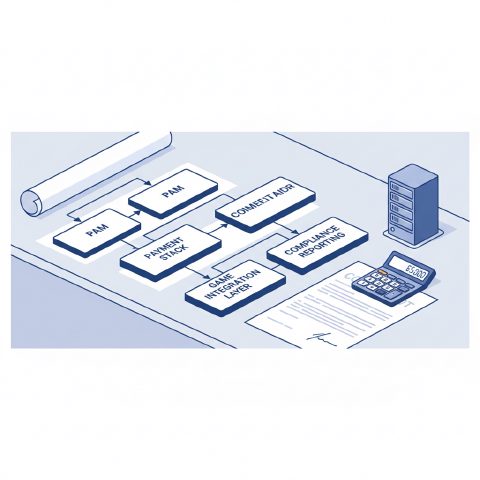
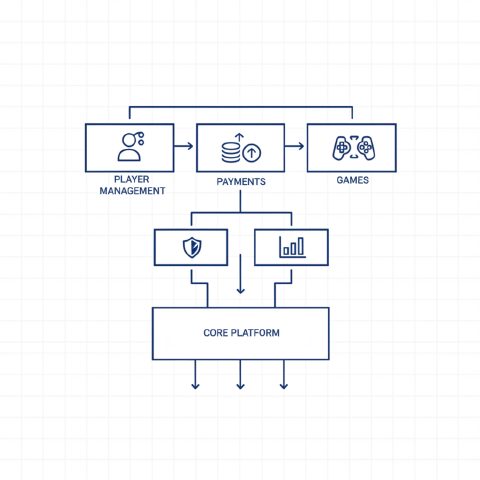
A production-ready custom casino platform requires a Player Account Management system, a multi-currency wallet with transaction ledger, a bonus and promotions engine, a game aggregation layer, a KYC/AML workflow, a reporting and BI backend, and a CMS for content management. Each of these is a non-trivial engineering project in its own right — and each has regulatory requirements attached.
The PAM is the heart of the system. It handles player registration, authentication, session management, responsible gambling controls (deposit limits, session limits, self-exclusion), and the player data model that everything else references. Regulatory requirements here are specific: MGA's Remote Gaming Regulations require real-time responsible gambling tool enforcement; Curaçao's OGL framework (post-2023 reform) mandates documented player protection mechanisms; US state regulators require detailed technical specifications for every PAM function. Build this wrong and you'll be rebuilding it during a compliance audit.
The wallet layer is where most custom builds underestimate complexity. Multi-currency support sounds simple until you're handling simultaneous fiat and crypto deposits, real-time exchange rate management, bonus balance segregation (regulatory requirement in most EU jurisdictions), and reconciliation against multiple PSP settlement reports. This is not a weekend project. I've seen operators spend four months on the wallet alone in a custom build.
The bonus engine deserves its own paragraph because it's both a major revenue driver and a major compliance risk. Wagering requirements, game contribution weights, bonus abuse detection, and the audit trail for every bonus transaction — all of this needs to be configurable, auditable, and enforceable in real time. EveryMatrix's BonusEngine and SoftSwiss's in-platform bonus tools give you a sense of the feature depth required. Building an equivalent from scratch is a 3–5 month engineering effort at minimum.
Don't overlook the reporting and BI layer. Regulators in virtually every jurisdiction require real-time or near-real-time reporting capability — transaction logs, player activity reports, suspicious transaction flagging. The MGA requires operators to submit data to their central system. US state regulators require integration with their own reporting infrastructure. This isn't optional and it isn't simple to bolt on after the fact. Design for it from day one.
| Component | Build Complexity | Regulatory Requirements | Estimated Dev Time (team of 6) |
|---|---|---|---|
| Player Account Management (PAM) | High | RG tools, data protection, session mgmt | 4–6 months |
| Multi-currency wallet | High | Balance segregation, AML reporting | 3–5 months |
| Bonus & promotions engine | Medium–High | Wagering audit trail, T&C enforcement | 3–5 months |
| Game aggregation layer | Medium | RNG cert, game integrity logging | 2–3 months |
| KYC/AML workflow | Medium | eIDV integration, SAR reporting | 2–3 months |
| Reporting & BI backend | Medium | Regulator data feeds, audit logs | 2–4 months |
| CMS & front-end | Low–Medium | Responsible gambling messaging | 2–3 months |
| Fraud & risk engine | High | Transaction monitoring rules | 3–6 months |
How does licensing jurisdiction affect your custom casino software development strategy?
Your target license shapes your entire technical architecture. Curaçao and Anjouan have lighter technical requirements and allow faster custom builds to reach market. MGA and UKGC impose detailed RTS (Remote Technical Standards) that require extensive pre-launch testing. US state licenses are the most demanding — source code review, hardware specifications, and ongoing system change approvals are standard.
Operators building for Curaçao under the post-2023 OGL framework face a more structured environment than the old master license era, but the technical bar is still far lower than EU regulators. You need documented RNG certification, a responsible gambling framework, and AML procedures — but there's no mandatory technical audit of your platform source code before launch. This makes Curaçao a reasonable jurisdiction for a custom build MVP: you can launch, iterate, and accumulate operational data before pursuing a more demanding license.
The MGA (Malta Gaming Authority) is a different story. Their Remote Technical Standards (RTS) v7 is a detailed document covering game integrity, player fund protection, responsible gambling tooling, and data security. Before you receive an MGA license, your platform undergoes a technical audit — either by the MGA's own team or an approved testing lab. If your custom platform has gaps in its RG tooling or its transaction logging doesn't meet RTS specifications, you're looking at remediation work that delays your license. Budget an extra 3–6 months of compliance-focused development if MGA is your target.
US state licensing is the most operationally demanding environment for custom software. New Jersey's Division of Gaming Enforcement (DGE) requires operators to submit a complete technical standards compliance document, and their technical staff will review your system architecture in detail. Pennsylvania's PGCB has similar requirements. Any significant system change post-license — a new game type, a major PAM update, a new payment method — requires advance notification and sometimes pre-approval. This means your custom platform needs a robust change management and documentation process baked in from day one, not retrofitted later.
What are the most common mistakes operators make when commissioning bespoke casino software?
The most expensive mistakes are: scoping the MVP too narrowly and hitting expensive change orders mid-build; failing to negotiate IP ownership upfront; underestimating the time and cost of regulatory certification; and building a platform that can't scale its payment stack. Every one of these is predictable — and every one of them gets glossed over in vendor proposals.
Scope creep is the budget killer. A vendor quotes a 'custom casino platform' for $400K. Halfway through the build, you realize the quote didn't include a fraud detection module, multi-currency support beyond EUR/USD, or an affiliate management system. Each of these is a legitimate addition — but each one triggers a change order. I've watched projects double in cost between initial contract and launch. The fix is simple in principle: write a detailed technical specification document before you sign anything. Not a feature list — a proper technical spec with data models, API contracts, and regulatory requirements mapped to each component. If a vendor won't engage with that level of detail during the sales process, that tells you something.
IP ownership is the other silent killer. Some casino software development companies build on proprietary frameworks they own — they'll build your casino on top of their core engine, and while they'll call it 'custom,' you don't actually own the underlying code. If you want to switch vendors or bring development in-house later, you can't. Always have a lawyer review the IP assignment clauses in any development contract. Source code escrow — where the full codebase is held by a neutral third party and released to you if the vendor fails to meet obligations — is a reasonable ask for any contract over $200K.
Payment stack scalability is a technical problem that manifests as a business problem. Early-stage custom platforms often integrate one or two PSPs and call it done. Then the platform grows, the primary PSP drops the account (this happens — iGaming is a high-risk category), and the operator has no fallback. Build your payment abstraction layer to support multiple PSPs from day one, even if you only activate one initially. The architectural cost of doing this upfront is minimal; the cost of retrofitting it after launch is significant.
How long does custom casino software development actually take from contract to live launch?
Realistically, 14–20 months from contract signing to a licensed, live launch in a regulated market. Offshore jurisdictions like Curaçao can compress this to 10–14 months. US state markets should be planned at 24–36 months, accounting for the licensing process itself. Any vendor promising a full custom platform in under 9 months is either scoping an MVP or overselling.
The timeline breaks down roughly as follows: technical specification and architecture design takes 4–8 weeks if done properly. Core platform development — PAM, wallet, bonus engine — runs 6–10 months depending on team size and scope. Game aggregator integration and front-end development runs concurrently but adds 2–3 months. QA, penetration testing, and pre-certification remediation adds another 6–10 weeks. Then regulatory submission and approval: 4–8 weeks for Curaçao, 3–6 months for MGA, and 12–24 months for US states (the licensing process itself, not just the technical submission).
The phases that most commonly blow up timelines are QA and regulatory remediation. Operators treat QA as a final step rather than an ongoing process, and they end up discovering architectural issues — in the transaction ledger, in the RG tooling, in the session management logic — that require significant rework. Running QA sprints in parallel with development, and engaging a testing lab for preliminary review of core components before the full certification submission, compresses this phase significantly. It costs more upfront but saves months at the back end.
If you're targeting multiple jurisdictions simultaneously — say, an MGA license plus a Curaçao OGL — the technical requirements can conflict. MGA's player fund protection requirements, for example, may require architectural changes to your wallet that affect how you handle crypto deposits for your Curaçao operation. Map your target jurisdictions and their technical requirements before you finalize your architecture, not after. This is the kind of thing a good compliance architect catches early; it's expensive to discover in month 15 of a build.
How does custom development compare to using a turnkey casino software solution for a mid-market operator?
For a mid-market operator — say, targeting $2M–$8M GGR in year one — a turnkey solution from a provider like SoftSwiss, EveryMatrix, or BetConstruct almost always delivers better ROI than a custom build. The platform cost is lower, time to market is faster, and the compliance infrastructure is already built. Custom only wins if the business model genuinely can't run on existing infrastructure.
SoftSwiss's SOFTSWISS Casino Platform (formerly known under various product names) is a mature turnkey option that includes PAM, bonus engine, game aggregator access to 20,000+ titles, and payment processing support. EveryMatrix offers a modular approach — their CasinoEngine, PlayerEngine, and MoneyMatrix products can be licensed separately or as a suite, which gives more flexibility than a pure white-label. BetConstruct's Spring Platform is popular in emerging markets. All of these come with Curaçao or MGA-compatible technical architectures already certified.
The honest comparison: a turnkey platform on EveryMatrix will cost you $50K–$120K in setup fees plus a revenue share of 15–22% of GGR (figures vary by contract and volume). A custom build at $1.2M, assuming you hit $5M GGR in year one, breaks even on the revenue share savings in roughly 18 months — but that ignores the 12–18 months you spent building instead of earning, and the ongoing maintenance cost. The NPV of the custom build doesn't look good until you're projecting sustained GGR well above $5M annually.
Where turnkey platforms genuinely fall short is in differentiation. If you're building a casino that competes on price or game selection, you're in a commodity market and a turnkey platform is fine. If your edge is product — a unique UX, a proprietary loyalty mechanic, a data-driven personalization engine — you'll hit the ceiling of what a turnkey platform's API surface allows within 18 months. That's when operators typically start planning a migration to custom infrastructure. Building that migration path into your initial architecture (clean data exports, documented player data schemas) is worth doing even if you launch on a turnkey platform.
What should operators look for when evaluating a casino software development company?
Prioritize vendors with verifiable regulated-market deployments, a compliance-aware development process, and contracts that assign full IP to the operator. Ask for references from operators who have gone through a regulatory technical audit on the vendor's platform. Technical domain knowledge — not just general software capability — is the differentiator that matters most.
The evaluation process should start with a technical due diligence questionnaire, not a demo. Ask the vendor: what jurisdictions have your platforms been licensed in, and when? Can you provide a reference from an operator who has passed an MGA or US state technical audit on your platform? What testing labs have you worked with — GLI, BMM, eCOGRA? What's your process for handling regulatory change notifications (e.g., when MGA updates its RTS)? A vendor who can answer these questions specifically and with references is a fundamentally different proposition from one who talks about 'cutting-edge technology' and shows you a polished demo.
Evaluate the team structure, not just the company. Who will be the lead architect on your project? What's their background in gambling-specific systems? Have they personally worked through a GLI-19 or RTS compliance review? The iGaming platform domain has specific technical requirements — transaction atomicity in the wallet, game round integrity logging, responsible gambling enforcement in real time — that a talented general software engineer can learn, but that a domain-experienced engineer already knows. The difference shows up in the architecture decisions made in month two of a build, not in the final demo.
Finally, evaluate the exit. What does the handover package include? Full source code, database schemas, API documentation, deployment scripts, and a documented runbook for operations? Is the codebase written in a mainstream language and framework (not a proprietary internal framework the vendor controls)? Can you interview the engineers who will work on your project before signing? These questions feel awkward in a sales process, but they're the ones that determine whether you have a real asset at the end of the engagement or a dependency.




Comments
No comments yet, be the first.