Casino API Integration: The Operator's Complete Technical and Commercial Guide for 2026
What exactly is casino API integration and why does the architecture decision matter so much?
Casino API integration is the process of connecting your operator platform — whether white-label, turnkey, or custom-built — to external game engines, payment processors, and back-office tools via standardized API protocols. The architecture you choose at this stage determines your content library depth, transaction latency, compliance flexibility, and the marginal cost of every new market you enter afterward.
At its most basic, a casino API works on a request-response model: your platform sends a game-launch request with a session token, the Remote Gaming Server (RGS) validates it, returns a game URL or iframe, and then posts callback events — bet, win, rollback — back to your wallet endpoint. That sounds simple. In practice, the wallet callback logic is where most operator launches hit their first production incident. If your server takes more than 800ms to respond to a bet callback, most RGS providers will either reject the transaction or enter a rollback state, which means real money in limbo and players hitting support.
The architectural decision that matters most is whether you integrate through an aggregator API or negotiate direct studio contracts. An aggregator like EveryMatrix's GameHub, SoftSwiss's Game Aggregator, or Relax Gaming's Silver Bullet program gives you a single API contract that unlocks thousands of certified titles. The trade-off is a revenue-share layer — typically 1–3% of GGR on top of what studios charge — that compounds painfully at scale. A $5M GGR month at 2% aggregator override is $100K you're paying for the convenience of one integration. Direct studio deals with Pragmatic Play, Evolution, or NetEnt remove that layer, but each studio runs its own API spec, certification process, and compliance documentation. Most operators under $10M annual GGR should default to aggregator-first and revisit direct deals at growth milestones.
There's a third architecture worth naming: platform-native integration, where your white-label or turnkey provider (SoftSwiss SOFTGAMINGS, Digitain, IncredibleCMS) has already completed the studio integrations and you're simply activating content through their back-office. This is the fastest path to launch but the least flexible — you're bound to their content catalog, their wallet logic, and their uptime SLAs. I've seen operators on white-label platforms discover 18 months post-launch that a major studio they need for a new market isn't in their provider's catalog and won't be for another two quarters. That's a market entry delay that costs real revenue.
What are the main types of casino APIs operators need to integrate?
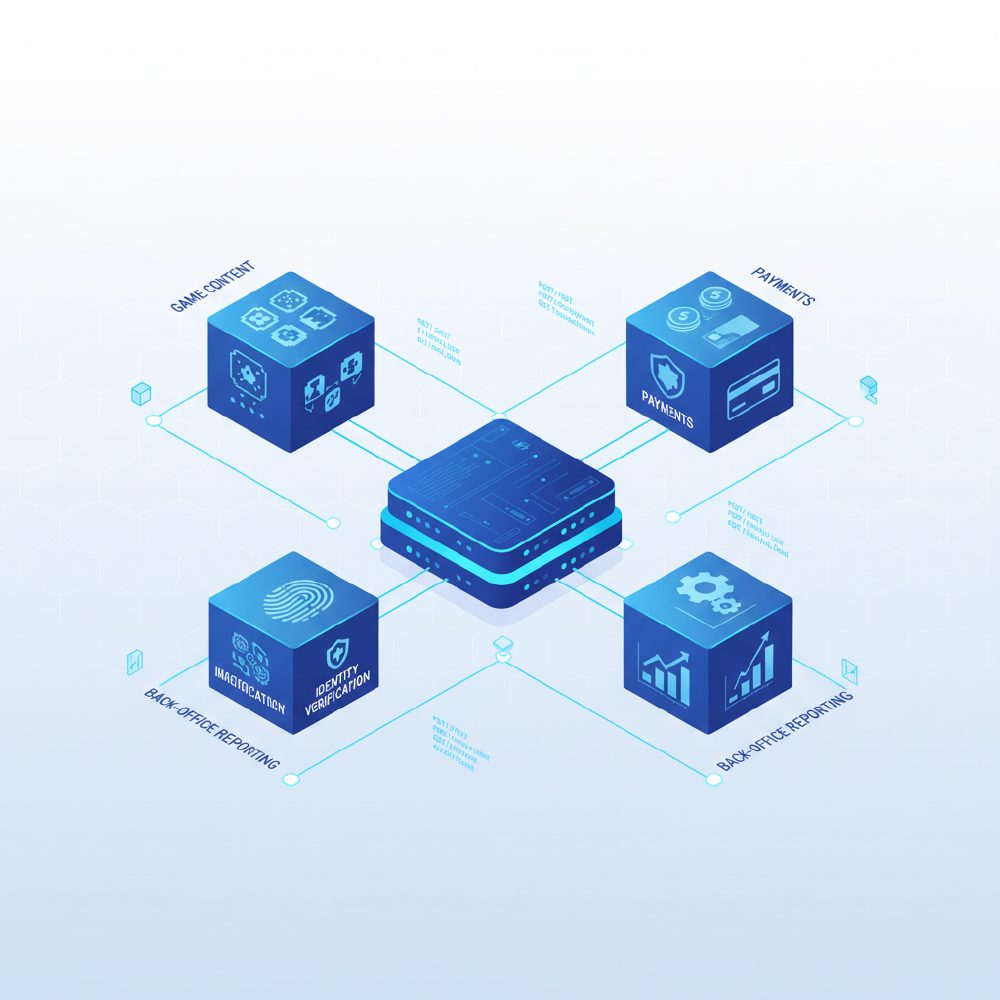
There are four core API categories every operator must account for: Game/RGS APIs for content delivery, Payment Gateway APIs for deposits and withdrawals, KYC/AML APIs for identity verification, and Back-Office/CRM APIs for player management and reporting. Most operators underestimate the integration complexity of the latter two, which are where regulatory compliance actually lives.
Game APIs are the most discussed but often the most standardized. The majority of studios and aggregators have converged on REST or JSON-RPC over HTTPS, with OAuth2 or HMAC-SHA256 for request signing. The Seamless Wallet integration model — where the RGS calls your wallet directly on every bet and win — is now the default for serious operators because it keeps the ledger of truth on your side. Transfer Wallet models, where the player's balance is temporarily moved to the RGS, are simpler to implement but create reconciliation headaches and are increasingly disfavored by regulators who want the operator to maintain the authoritative balance record at all times.
Payment Gateway APIs are where the real complexity lives for operators entering markets like LATAM or Southeast Asia. Integrating Stripe or a single card processor is straightforward; building a payment stack that handles PIX in Brazil, OXXO in Mexico, PSE in Colombia, and crypto simultaneously requires either a payment orchestration layer (Nuvei, Praxis Cashier, PaymentIQ) or a lot of custom middleware. Payment orchestration APIs abstract the underlying PSP routing, retry logic, and currency conversion — they add another integration layer but dramatically reduce the time to add new payment methods in new markets. Budget 3–6 weeks for a clean payment API integration even with a well-documented provider.
KYC/AML APIs — Onfido, Jumio, Sumsub — are non-negotiable for MGA, UKGC, and increasingly for Curaçao under the new Gaming Control Board framework that came into force in 2024. These APIs need to sit inside your registration and deposit flows, not bolted on afterward. The integration involves webhook events for verification status changes, document classification callbacks, and — critically — a data retention and audit trail that regulators can query. I've reviewed operator compliance setups where KYC was integrated as a manual back-office step rather than an API-driven flow, and the result was both a compliance risk and a conversion killer: players abandoning registration because verification took 24 hours instead of 90 seconds.
| API Type | Examples | Integration Complexity | Typical Timeline | Key Risk |
|---|---|---|---|---|
| Game / RGS | Pragmatic Play, Evolution, EveryMatrix GameHub | Medium | 2–4 weeks | Wallet callback latency / rollback handling |
| Payment Gateway | Nuvei, PaymentIQ, Praxis Cashier | High | 3–6 weeks | PSP routing logic, currency conversion errors |
| KYC / AML | Sumsub, Jumio, Onfido | Medium | 2–3 weeks | Webhook reliability, data retention compliance |
| Back-Office / CRM | Smartico, FastTrack, BonusEngine | Medium–High | 2–5 weeks | Event schema mismatches, bonus abuse vectors |
| Affiliate / Tracking | Income Access, MyAffiliates, Cellxpert | Low–Medium | 1–2 weeks | Postback deduplication, revenue attribution |
How does the Seamless Wallet integration actually work, and what can go wrong?
In a Seamless Wallet integration, the RGS calls your operator wallet endpoint directly on every game event — bet, win, refund, rollback. Your platform is the single source of balance truth. This is the preferred model for compliance and player experience, but it demands sub-800ms server response times and bulletproof idempotency logic to handle duplicate callbacks without double-crediting wins.
The flow looks like this: player launches a game, your platform generates a session token and passes it to the RGS. The RGS stores that token and uses it to authenticate every subsequent wallet call. When the player places a €10 bet, the RGS sends a Debit request to your wallet endpoint with the session token, bet amount, currency, round ID, and a transaction ID. Your wallet deducts the balance, returns the new balance and a success status, and the RGS proceeds with the game round. When the round resolves, a Credit request arrives with the win amount. If your wallet returns an error or times out, the RGS issues a Rollback — crediting the bet back to the player's balance as if the round never happened.
The idempotency requirement is where I see the most production bugs. The RGS may send the same transaction ID multiple times — network retries, failover scenarios — and your wallet must recognize duplicate transaction IDs and return the original response without processing the transaction again. If you don't implement this correctly, you get double-credited wins or double-debited bets, both of which are catastrophic. Every major studio's integration documentation specifies this, but I've reviewed codebases where developers missed it because they were under launch deadline pressure. Build your idempotency layer first, before anything else in the wallet implementation.
Latency is the other killer. Most RGS providers document a 3–5 second timeout before they issue a rollback, but in practice some studios — particularly live casino providers like Evolution — have much tighter thresholds during high-traffic periods. Your wallet endpoint needs to be geographically co-located with or very close to the RGS servers. If your platform is hosted in Frankfurt and you're integrating a studio whose RGS is in Malta, you need to test round-trip latency under load, not just in a sandbox. A p99 latency of 600ms in staging can easily hit 1,200ms in production during a football match peak. Use a CDN or edge caching for session validation, and make sure your database reads for balance checks are hitting a replica, not the primary write node.
Aggregator API vs. direct studio integration: which should operators choose?
For operators under $10M annual GGR or launching in fewer than three markets, an aggregator API is almost always the right call. It compresses a 6–12 month multi-studio integration project into 4–8 weeks and gives you certified content across jurisdictions. The revenue-share premium is real but predictable — and it's far cheaper than the engineering cost of maintaining 20+ direct integrations.
The aggregator model works because studios like Pragmatic Play, Play'n GO, and Hacksaw Gaming have already certified their content with the aggregator's technical layer. When you integrate EveryMatrix's GameHub or SoftSwiss's Game Aggregator, you're not just getting API access — you're getting pre-negotiated content licenses, certified RNG documentation, and in many cases jurisdiction-specific game catalogs that have already cleared local regulatory review. For a new operator entering, say, Colombia under Coljuegos, this means you can launch with a certified game library in weeks rather than running individual studio certifications that each take 2–4 months.
Direct studio deals make financial sense at scale, but the operational overhead is significant. Each studio has its own API specification, its own sandbox environment, its own commercial team, its own compliance documentation requirements, and its own SLA for technical support. Evolution's Live Casino API is genuinely different in structure from Pragmatic Play's API, which is different from Relax Gaming's. Your development team needs to maintain all of these integrations, handle breaking changes when studios push API updates, and manage separate reconciliation feeds for each studio's transaction logs. That's a real engineering cost that aggregator-first operators don't pay.
There is a hybrid path that sophisticated operators use: integrate via aggregator for the long tail of content (slots, virtual sports, crash games), and negotiate direct deals only with the studios that drive the majority of your GGR. In most markets, 3–5 studios account for 60–70% of slot revenue. Identify those studios from your early aggregator data, then approach them directly once you have 12 months of volume to show. You keep the aggregator for everything else and eliminate the override on your highest-revenue content.
| Factor | Aggregator API | Direct Studio Integration |
|---|---|---|
| Integration timeline | 4–8 weeks for full catalog | 4–12 weeks per studio |
| Content volume | 3,000–10,000+ titles via one contract | One studio's catalog per contract |
| Revenue-share cost | 1–3% GGR override on top of studio rates | Studio rate only (typically 10–18% GGR) |
| Jurisdiction certification | Often pre-certified per market | Operator must manage per-studio certification |
| API maintenance | Single endpoint, aggregator handles studio updates | Each studio's API changes require operator dev work |
| Best for | Operators under $10M GGR, new market entry | Operators above $10M GGR with established tech teams |
| Key risk | Aggregator outage affects entire catalog | Integration backlog limits content roadmap speed |
What does a realistic casino API integration timeline look like end to end?
A realistic end-to-end casino API integration — from signed contracts to a compliant, live product — runs 8–16 weeks for most operators. The variance comes from three factors: your platform's existing connector library, the complexity of your payment stack, and whether your target jurisdiction requires pre-launch regulatory testing of the integrated system.
Week 1–2 is almost always commercial and legal: finalizing the aggregator or studio contract, getting sandbox credentials, and reviewing the integration documentation. Don't underestimate this phase — I've seen operators lose 3 weeks because their legal team flagged data processing clauses in a studio contract that required renegotiation. Get your legal review running in parallel with technical scoping, not sequentially.
Weeks 3–6 cover the core technical integration: wallet endpoint implementation, session management, game launch flow, and the bet/win/rollback callback handlers. If you're using a platform with pre-built connectors (SoftSwiss, Digitain, EveryMatrix's own back-office), this phase compresses significantly — you're configuring rather than building. If you're on a custom platform, budget the full 4 weeks and add a week for load testing. Your QA process needs to cover the rollback scenario explicitly: simulate a wallet timeout, confirm the RGS issues a rollback, confirm your wallet processes it correctly, confirm the player's balance is intact.
Weeks 7–10 typically cover payment integration, KYC flow embedding, and back-office reporting setup. These run partly in parallel with game integration but have their own dependencies — your payment provider's sandbox environment, your KYC vendor's test document set, and your compliance team's review of the data flow. If you're entering a regulated market like Peru (MINCETUR) or Mexico (SEGOB), factor in 4–8 additional weeks for the regulatory technical audit, which reviews your integrated system against the jurisdiction's technical standards. This is not optional and it's not fast — build it into your launch timeline from day one.
Weeks 11–14 should be a structured UAT period with real-money test transactions, bonus flow testing, and a full reconciliation check between your wallet ledger and the studio's or aggregator's transaction reports. Discrepancies found here are cheap to fix. Discrepancies found in production, after a Curaçao or MGA audit, are expensive in both money and license risk. Allocate this time properly — operators who try to compress UAT to two weeks to hit an aggressive launch date almost always regret it.
How do compliance and regulatory requirements shape the casino API integration architecture?
Regulatory requirements don't just affect what content you can offer — they dictate specific technical behaviors inside your API architecture. Responsible gambling hooks, session time limits, self-exclusion checks, and real-time reporting feeds to regulators must be built into the API data flow, not added as a UI layer. Getting this wrong post-launch means costly remediation or license suspension.
Under the MGA framework, your platform must implement a Real-Time Reporting (RTR) interface that feeds player activity data — session events, transaction records, self-exclusion status changes — to the MGA's central system in near real-time. This is an API integration in its own right, separate from your game and payment APIs. The MGA publishes a technical specification for the RTR feed, and your platform must pass a conformance test before you go live. Operators who treat this as an afterthought and try to retrofit it onto an existing data architecture spend 6–10 weeks on remediation work that should have been a 2-week greenfield build.
Curaçao's new Gaming Control Board framework, which replaced the old sublicense model starting in 2024, now requires operators to maintain an auditable transaction log accessible to the regulator on request. This means your API integration architecture needs to write immutable event logs — bet, win, rollback, deposit, withdrawal, KYC status change — to a tamper-evident store. It's not enough to have this data in your operational database; you need a separate audit log that cannot be modified by application code. This is a backend architecture decision that affects your game API integration, your payment API integration, and your KYC API integration simultaneously.
For US state markets — New Jersey, Pennsylvania, Michigan, Connecticut — the technical compliance requirements are the most demanding in the world. The DGE in New Jersey, for example, requires that your RGS integration uses only approved and certified game titles, that your wallet integration passes a source code review, and that your system architecture diagram is submitted and approved before go-live. Operators entering US markets through a B2B platform partner (like Scientific Games OpenSports or IGT's platform) get some of this compliance infrastructure included, but you still own the integration certification for any third-party APIs you add.
What should operators look for when evaluating a casino API integration service?
The most important criteria are jurisdiction coverage of certified content, wallet integration model flexibility (seamless vs. transfer), documented SLAs for API uptime and callback response times, and the quality of sandbox and testing environments. A vendor with a polished sales deck but a poorly documented sandbox will cost you weeks of integration time and launch delays.
Jurisdiction coverage is the first filter. If you're launching in Colombia, you need a casino API integration service whose game catalog includes Coljuegos-certified titles. If you're targeting Peru, you need MINCETUR-compliant content. Ask the vendor for a specific list of certified titles per jurisdiction, not a general claim of 'regulatory compliance.' Some aggregators have strong European certification coverage but thin LATAM catalogs — that's fine if Europe is your market, but it's a problem if you're building a regional LATAM operator. EveryMatrix and SoftSwiss both have solid European coverage; for LATAM-specific certification depth, operators often look at providers like Altenar (sports-focused but expanding) or local aggregators with direct regulator relationships.
Uptime SLAs matter more than most operators realize pre-launch. A game aggregator with 99.5% uptime sounds excellent until you calculate that it means roughly 44 hours of potential downtime per year. During a major sporting event or a promotional campaign, even 30 minutes of game unavailability costs real revenue and player trust. Ask for historical uptime data, not just contractual SLAs. Ask specifically about their incident response time and their communication protocol during outages. The best providers have a status page with real-time API health metrics and a direct Slack or PagerDuty channel for enterprise clients.
The sandbox environment quality is a proxy for the overall quality of the integration experience. A good sandbox mirrors production behavior exactly — including rollback scenarios, currency rounding edge cases, and error response codes. A bad sandbox works fine for happy-path testing but doesn't surface the edge cases that will bite you in production. Before signing a contract, have one of your developers spend a day in the sandbox and report back. If they can't trigger a rollback scenario, if the documentation doesn't match the actual API behavior, or if sandbox support takes 48 hours to respond to a technical question — those are signals about what post-launch support will look like.
What are the real costs of casino API integration that operators discover too late?
Beyond the headline integration fee or revenue-share rate, operators consistently underestimate four cost categories: engineering time for edge-case handling and load testing, ongoing API maintenance as studios push updates, reconciliation infrastructure to catch discrepancies between your ledger and provider reports, and the compliance middleware required by regulators that no vendor includes in their base package.
Engineering time is the most consistently underestimated cost. Vendors quote a 'simple REST integration' and operators budget 2 weeks of developer time. The reality for a production-grade, compliance-ready integration is 6–12 weeks of senior backend engineering time, depending on your existing platform architecture. The wallet idempotency layer, the audit logging system, the load testing suite, the reconciliation job that runs nightly and flags discrepancies — none of these are in the vendor's integration guide, but all of them are mandatory for a serious operator. At $150–250/hour for senior backend engineering, that's $90K–$300K in engineering cost that doesn't appear in the vendor's pricing sheet.
Ongoing maintenance is the cost that compounds over time. Studios push API updates, deprecate endpoints, change their callback payload schemas. Each update requires your team to test, adapt, and redeploy. With a single aggregator integration, the aggregator absorbs most of this — it's one of the things you're paying the override for. With 15 direct studio integrations, your team is handling 15 separate update cycles. I've seen operators with mature direct integration stacks spend 20–30% of their backend engineering capacity on maintenance rather than new features. That's a real opportunity cost.
Reconciliation infrastructure is unglamorous but critical. Your wallet says you paid out €847,293 in wins last Tuesday. The studio's transaction report says €849,104. That €1,811 discrepancy needs to be investigated, explained, and resolved — and it needs to happen daily, not quarterly. Building a reconciliation pipeline that ingests transaction feeds from multiple providers, normalizes currencies and time zones, and flags discrepancies automatically requires real engineering investment. Operators who don't build this discover the discrepancies during a regulatory audit instead of during a morning ops review, which is a much more expensive discovery.
How do payment API integrations connect to the broader casino API architecture?
Payment APIs are the revenue-critical layer of your casino API stack — they handle deposits that fund player wallets and withdrawals that drive retention. The integration must handle currency conversion, fraud scoring, PSP routing, and regulatory reporting simultaneously. A payment orchestration layer like PaymentIQ or Praxis Cashier is almost always worth the added complexity for operators targeting more than one market.
The connection between your payment API and your game wallet API is where operators most often introduce reconciliation risk. The canonical flow is: player deposits via payment API, funds clear to your platform wallet, player uses those funds in game sessions via the RGS wallet API, player requests withdrawal via payment API. Each of these steps generates transaction records in different systems — your payment provider's ledger, your platform wallet, the RGS transaction log. If these three ledgers don't reconcile to the cent, you have a problem that grows over time.
For LATAM markets specifically, the payment API integration is often more complex than the game integration. Brazil's PIX instant payment system, Colombia's PSE bank transfer network, Mexico's SPEI interbank transfer system — each has its own API spec, its own settlement timing, its own failure modes. Payment orchestration platforms like Nuvei, PaymentIQ (owned by Everymatrix), and Praxis Cashier have pre-built connectors for most of these local payment methods, which is why they're worth the platform fee for operators entering multiple LATAM markets. Building direct PSP integrations for each country's payment infrastructure is a 6–12 month project in its own right.
Crypto payment APIs add another dimension. If you're operating under a Curaçao or Anjouan license and accepting crypto, you need a blockchain payment processor (CoinsPaid, B2BinPay, Coinspaid) that handles wallet address generation, transaction confirmation monitoring, and automatic fiat conversion if your game wallet operates in fiat. The API integration for crypto payments is technically straightforward — these providers have well-documented REST APIs — but the compliance layer is not. You need a crypto transaction monitoring tool (Chainalysis, Elliptic) integrated into the deposit flow to screen for sanctioned addresses and high-risk wallet histories. This is a regulatory requirement under Curaçao's new framework and a practical necessity for any operator that doesn't want to become a money laundering vector.
What are the most common casino API integration mistakes that delay launches?
The five mistakes that most reliably delay operator launches are: skipping load testing on the wallet endpoint, treating KYC integration as a post-launch task, underestimating sandbox-to-production behavioral differences, failing to implement proper rollback handling, and not validating the regulatory compliance of integrated game content before signing commercial terms.
Skipping wallet endpoint load testing is the single most common technical mistake. Developers test the integration in a sandbox with sequential, low-volume requests and everything works fine. In production, during a bonus promotion or a major sports event, you get hundreds of concurrent game sessions each generating multiple wallet callbacks per second. If your wallet endpoint isn't architected for horizontal scaling — if it's hitting a single database node without connection pooling, if it's not behind a load balancer — it will fall over. The RGS starts issuing rollbacks, players see their bets disappear and reappear, and your support queue fills up. Test your wallet endpoint at 10x your expected peak load before you go live, not after.
Treating KYC integration as a post-launch task is a mistake I see repeatedly with operators who are under pressure to hit a launch date. The logic is: 'We'll launch with manual KYC review and automate it later.' The problem is that manual KYC is a conversion killer — players abandon the registration flow if verification takes more than a few minutes — and it's also a compliance risk in most regulated jurisdictions that require automated, real-time identity verification. Sumsub and Jumio both have well-documented APIs that can be integrated in 2–3 weeks. Do it before launch.
The sandbox-to-production gap is a subtler problem. Some studios and aggregators run their sandbox on different infrastructure from production, with different timeout thresholds, different error response codes, and different behavior under load. I've seen integrations that passed all sandbox tests fail in production because the production RGS had a 2-second callback timeout versus the sandbox's 5-second timeout. Always ask your integration partner explicitly: 'Does your sandbox mirror production behavior exactly, including timeout thresholds and error codes?' If the answer is vague, build extra margin into your production testing phase.




Comments
No comments yet, be the first.