iGaming Payment Processing Explained: How the Stack Really Works in 2026
What exactly is iGaming payment processing and how does it differ from standard e-commerce?
iGaming payment processing is the end-to-end infrastructure that authorizes deposits, holds funds in a player wallet, and executes withdrawals, all inside a heavily regulated, high-chargeback-risk environment that most mainstream payment providers refuse to touch. The core mechanics resemble e-commerce, but the risk classification, compliance requirements, and acquirer relationships are fundamentally different.
In standard e-commerce, a Stripe or Adyen integration takes you live in a weekend. In iGaming, those two companies will decline your application outright, gambling is explicitly excluded from their acceptable use policies. You are in MCC code 7995 territory, which card networks (Visa, Mastercard) treat as a restricted merchant category requiring pre-approval at the acquirer level. That approval process alone can take 4-12 weeks and requires a licensed entity, proof of responsible gambling controls, and often a rolling reserve of 5-10% of monthly volume held for 180 days.
The iGaming payment stack has layers that don't exist in retail: a player wallet or gaming wallet that holds balances between deposit and wager, a bonus engine that may restrict withdrawal of certain funds, a KYC/AML checkpoint that can block a withdrawal mid-flow, and a fraud-scoring layer that sits upstream of the acquirer. Each of these layers can introduce latency or failure points. Operators who treat payments as a commodity and bolt on a single gateway at launch typically see 20-35% deposit failure rates in their first month, a conversion disaster that is entirely avoidable with proper stack design.
The other structural difference is the withdrawal obligation. E-commerce merchants rarely send money back to customers at scale. iGaming operators do, constantly, and the withdrawal experience is arguably more important than the deposit experience for player retention. A player who wins and waits four days for a payout will not come back. That means your payment stack needs outbound rails, bank wires, e-wallet payouts, crypto sends, that are just as robust as your inbound acquiring.
How does the money actually flow from a player's deposit to an operator's bank account?
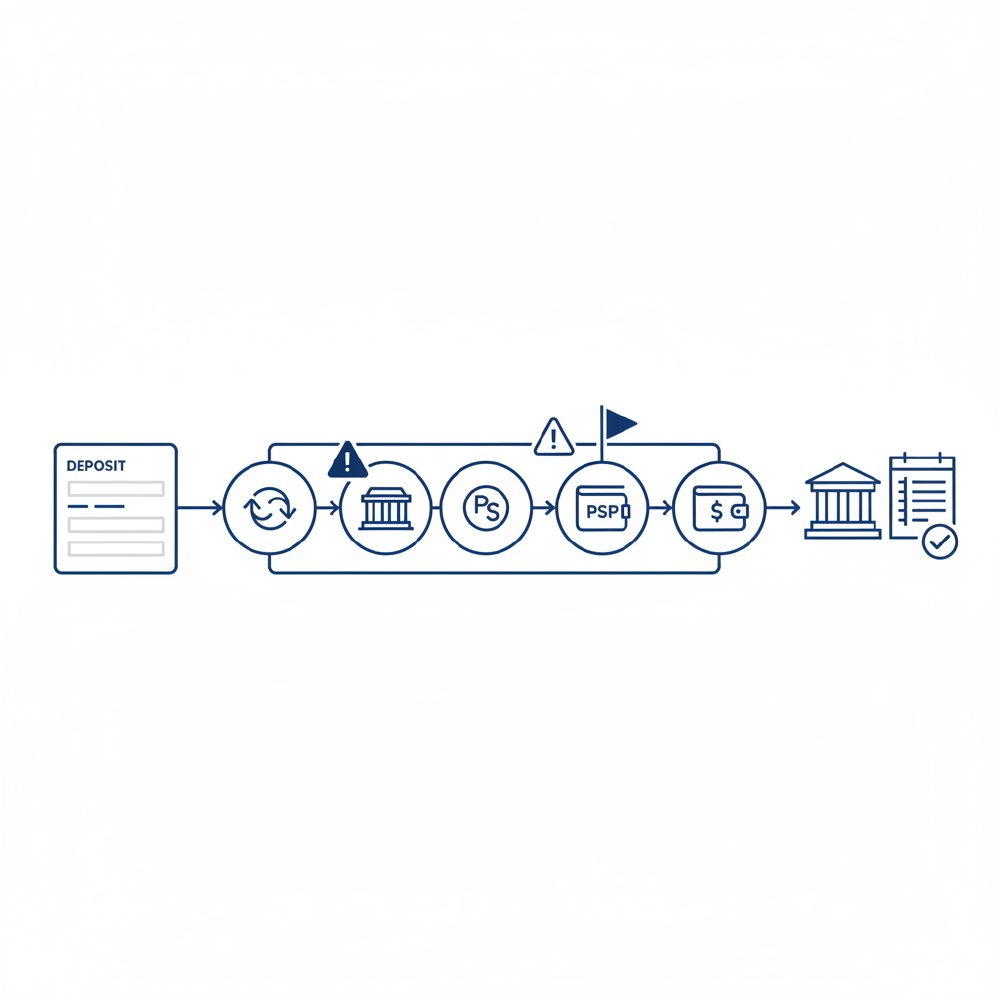
A player deposit triggers a chain of six to eight handoffs: card network authorization, acquirer settlement, PSP reconciliation, gaming wallet credit, potential bonus application, and eventually a sweep to the operator's merchant account, usually on a T+2 to T+5 settlement cycle. Understanding each handoff is where operators find hidden fees and failure points.
Let's trace a €100 card deposit on a European-licensed casino. The player enters card details; the casino's payment page (hosted by the PSP or the operator's own checkout) sends an authorization request through the card network to the issuing bank. If 3DS2 authentication passes, the issuer approves, and the acquirer captures the funds. The PSP reconciles this against its merchant account and credits the operator's gaming wallet in near real-time, but the actual cash settlement to the operator's bank account happens on the acquirer's settlement cycle, typically T+2 for EU acquirers, sometimes T+5 for offshore processors.
During that settlement window, the acquirer holds the gross transaction amount minus its processing fee (say 4.5%) and minus any rolling reserve contribution (say 7.5% of gross, held for 180 days). So on that €100 deposit, the operator might see €88 hit their account on day two, with €7.50 locked in reserve for six months. Multiply this across thousands of transactions and the rolling reserve becomes a significant working capital drag, one that catches undercapitalized operators off guard in months two and three when the reserve pool is still building.
On the withdrawal side, the flow reverses but the rails are often different. Card refunds back to the original payment method are cleanest from a compliance standpoint (following the money back to source), but acquirers increasingly limit refund windows to 30-60 days. After that, operators need alternative payout rails: bank transfers via SEPA or SWIFT, e-wallet payouts through Skrill or Neteller (both owned by Paysafe), or crypto sends. Each of these has its own fee structure and settlement timeline, and each requires a separate integration or a payout-capable PSP that aggregates them.
| Stage | Who handles it | Typical fee/cost | Timing |
|---|---|---|---|
| 3DS2 authentication | Card network / issuer | Included in interchange | ~1-2 seconds |
| Authorization & capture | Acquirer | Interchange + acquirer margin (total ~3.5-5.5%) | Real-time |
| PSP reconciliation | PSP / gateway | €0.10-0.30 per transaction flat fee | Near real-time |
| Rolling reserve deduction | Acquirer | 5-10% of gross, held 90-180 days | At settlement |
| Settlement to operator bank | Acquirer → operator | FX fee if cross-currency (0.5-1.5%) | T+2 to T+5 |
| Player wallet credit | Gaming platform | Internal, platform licensing cost | Near real-time |
Which payment providers actually work with iGaming operators in 2026?
The specialist iGaming PSP market is dominated by a handful of players: Nuvei, Paysafe, Payneteasy, Safecharge (now part of Nuvei), Praxis Tech, and Skrill/Neteller on the e-wallet side. For crypto, CoinsPaid and B2BinPay lead. The right choice depends on your license, target markets, and monthly volume, there is no single best provider.
Nuvei is the most commonly recommended all-in-one iGaming PSP right now, and for good reason, they acquired Safecharge specifically to dominate this vertical, they hold their own acquiring licenses in multiple jurisdictions, and their iGaming-specific features (bonus wallet integration, responsible gambling flags) are genuinely mature. Pricing starts high (expect 4-5% for card processing without significant volume), but the breadth of payment methods they aggregate, cards, bank transfers, 700+ local methods, means you can enter multiple markets without stacking integrations. The trade-off is dependency: if Nuvei has a processing outage or decides to reprice your contract at renewal, you have limited leverage.
Paysafe's ecosystem (Skrill, Neteller, paysafecard, and their direct acquiring arm) remains dominant in Europe, particularly for the UK, German, and Scandinavian markets. Skrill and Neteller are genuinely preferred payment methods for experienced gamblers, players who use them are often higher-value and lower-chargeback. The catch is that Paysafe has been tightening their merchant onboarding since 2023; unlicensed or newly licensed operators often get declined or placed on restrictive terms. Budget 6-10 weeks for Paysafe onboarding if you're starting from scratch.
For crypto, CoinsPaid processed over $7 billion in crypto transactions for iGaming operators in 2023 (their own published figure) and offers a purpose-built gaming wallet with auto-conversion to fiat. B2BinPay is a strong alternative, particularly for operators who want to hold crypto balances rather than auto-convert. The practical advantage of crypto rails in 2026 is that they sidestep card network restrictions entirely, no MCC 7995 problem, no rolling reserve, settlement in minutes. The operational risk is volatility (mitigated by USDT/USDC settlement) and the growing regulatory scrutiny of crypto-to-gambling flows in EU jurisdictions post-MiCA.
Local payment methods deserve a dedicated integration budget. In Brazil, Pix is non-negotiable, operators without Pix are invisible to the market. In Mexico, SPEI and OXXO cash vouchers matter. In India (offshore operators), UPI and net banking integrations drive conversion. Providers like PayRetailers, Localpayment, and Pagsmile specialize in LATAM local methods and are worth evaluating alongside your primary PSP if LatAm is in your roadmap.
| Provider | Category | Best for | Approx. card processing fee | Key limitation |
|---|---|---|---|---|
| Nuvei (incl. Safecharge) | Full-stack PSP + acquirer | Multi-market operators, EU/NA | 3.8-5.5% | High minimum volume requirements |
| Paysafe (Skrill/Neteller) | E-wallet + acquiring | European markets, experienced players | 1.9-2.9% (e-wallet) | Strict onboarding, slow approval |
| Praxis Tech | Payment orchestration hub | Operators aggregating multiple PSPs | Pass-through + platform fee | Not an acquirer itself |
| CoinsPaid | Crypto gateway | Offshore, crypto-native operators | 0.8-1.5% crypto | Regulatory risk in stricter EU markets |
| PayRetailers | LATAM local methods | Brazil, Mexico, Colombia operators | Varies by method | Limited outside LATAM |
| Trustly | Open banking / bank transfer | Nordics, UK, Germany | 0.5-1.2% + fixed | Geography-limited |
| B2BinPay | Crypto gateway | Operators holding crypto treasury | 0.5-1.0% crypto | Less iGaming-specific tooling |
How does your gambling license affect which payment processors will approve you?
Your license jurisdiction is the single biggest factor in acquirer access. MGA (Malta) and UKGC licensees get the widest choice of mainstream and specialist processors. Curaçao eGaming and Anjouan licensees are limited to specialist high-risk processors and crypto rails. This isn't a technicality, it directly determines your deposit conversion rates and processing costs.
Card networks set the rules here, not the processors. Visa and Mastercard both require that merchants in MCC 7995 hold a gambling license in a jurisdiction they recognize. They maintain lists of approved jurisdictions, and Curaçao, despite being the most popular offshore license, has historically sat in a gray zone. Post-2023, Curaçao's new Gaming Control Board (GCB) framework has improved this slightly, but many Tier 1 acquirers still won't touch Curaçao-licensed operators. You'll end up with processors like Payneteasy, Fonix, or various boutique offshore acquirers who charge 5-7% and hold larger reserves.
An MGA license changes the conversation entirely. Malta is an EU member state; its regulator is respected by card networks and mainstream acquirers. With an MGA license, you can approach Nuvei, Worldpay (for iGaming), and even some regional banks for merchant accounts. Processing fees drop to 3-4.5% and rolling reserves are often negotiable down to 5% or eliminated after 12 months of clean chargeback history. The MGA license costs roughly €25,000 in application fees plus ongoing compliance costs, but the payment economics alone can justify that premium over a Curaçao license within 18 months of operation.
US state licenses (New Jersey DGE, Pennsylvania PGCB, Michigan MGCB) sit in their own category. State-regulated operators can access US-domestic acquirers and even some mainstream processors, but the geographic restriction is strict, you can only process payments from players physically located in that state. Geofencing and IP verification become part of your payment compliance stack. ACH and debit card are the dominant deposit methods in US iGaming; credit cards for gambling are banned in several states and restricted by card network rules federally.
What are the real costs of iGaming payment processing that vendors don't advertise upfront?
The headline processing rate is only part of the cost. Rolling reserves, chargeback fees, refund costs, currency conversion margins, monthly minimums, and integration fees stack up to make the true cost of payments 30-50% higher than the quoted rate. Operators who don't model the full cost structure before signing contracts routinely run into cash flow problems in months three to six.
Rolling reserves are the biggest hidden cost. An acquirer holding 7.5% of gross volume for 180 days means that at $1 million per month in deposits, you have $450,000 locked up in reserve at any given time. That's working capital you cannot use for marketing, bonuses, or operations. Some acquirers will negotiate the reserve percentage down for licensed operators with clean processing history, but you won't get those terms on day one. Model this before you sign, and make sure your launch capital accounts for it.
Chargeback fees are another line item that compounds painfully. Most acquirers charge $25-$50 per chargeback regardless of outcome, plus the reversed transaction amount. iGaming chargeback rates run higher than most verticals, 1-2% is common, and some operators see 3%+ in markets with weak fraud prevention. At 1.5% chargeback rate on $500K monthly volume, you're looking at $7,500+ in chargeback fees alone, before any threshold penalties. Acquirers typically terminate or reprice contracts when chargeback rates exceed 1% (Visa's threshold) or 1.5% (Mastercard's). Fraud tooling, 3DS2, velocity checks, device fingerprinting, is not optional; it's a cost of staying in the program.
Then there are the costs operators forget entirely: PCI DSS compliance (if you're handling card data, which you should avoid by using hosted payment pages, but even then, you need a SAQ-A assessment at minimum), monthly minimum fees from PSPs (typically $500-$2,000/month even in low-volume months), FX conversion margins on cross-currency settlements (0.5-2% per conversion, which adds up fast in multi-currency operations), and API integration costs if you're building the connection in-house rather than using a platform like Praxis or Corefy that already has the integrations built.
What role does payment orchestration play and do you actually need it?
Payment orchestration, routing transactions intelligently across multiple PSPs based on conversion probability, cost, and availability, is overkill for a single-market launch but becomes essential once you operate in three or more markets or process above roughly $500K per month. Platforms like Praxis Tech, Corefy, and Payrails sit between your casino platform and your PSPs, handling routing logic, failover, and reconciliation.
The core value proposition of an orchestration layer is intelligent routing. If your primary card acquirer has a 15% decline rate on German Visa cards on a given afternoon, an orchestration platform can automatically reroute those transactions to a secondary acquirer with better approval rates for that BIN range, without the player seeing anything. Over a month, this kind of smart routing can improve overall deposit conversion by 5-12 percentage points. At meaningful volume, that's a significant revenue impact.
Praxis Tech is the most purpose-built iGaming orchestration platform, they've been in this space since 2015 and have pre-built integrations with 400+ payment providers. Their cashier product handles the front-end payment page, the routing logic, and the reconciliation reporting in one package. The cost is typically a per-transaction fee (around $0.10-0.20) plus a monthly platform fee, which is well worth it once you're past the startup phase. Corefy is a newer entrant with a cleaner API and stronger open banking integrations, worth evaluating if you're building a tech-forward stack.
For a single-market white-label launch on SoftSwiss or EveryMatrix, you likely don't need a standalone orchestration layer, those platforms have built-in cashier modules with multi-PSP routing. The argument for adding an independent orchestration layer comes when you need PSP relationships that your platform provider doesn't have, or when you want to own the payment data and routing logic rather than being dependent on your platform vendor's relationships. That independence matters if you ever plan to migrate platforms, your payment integrations and player payment history stay with you.
How do crypto payments work in iGaming and are they worth the operational complexity?
Crypto payments in iGaming work through a dedicated gateway (CoinsPaid, B2BinPay, NOWPayments) that generates unique deposit addresses per player, confirms on-chain transactions, and credits the gaming wallet, often with auto-conversion to USDT or fiat to eliminate volatility. For offshore operators, they're not optional complexity; they're often the primary revenue channel.
The mechanics are straightforward: a player selects Bitcoin, Ethereum, or USDT at the cashier; the gateway generates a unique wallet address for that deposit session; the player sends funds; the gateway monitors the blockchain for confirmation (1-3 confirmations for Bitcoin, faster for ETH or TRON-based USDT); and the gaming wallet is credited. Modern gateways handle this in under 10 minutes for most chains. CoinsPaid supports 50+ cryptocurrencies and handles the conversion internally, so operators can settle in EUR or USD without holding crypto on their balance sheet.
The operational argument for crypto is compelling for offshore operators. No card network restrictions, no rolling reserves, no chargebacks (blockchain transactions are irreversible), and near-instant settlement. Processing fees are 0.8-1.5%, well below card rates. For operators on Curaçao or Anjouan licenses who struggle to get quality card acquiring, crypto can represent 40-60% of total deposit volume, it's not a niche. The players who prefer crypto also tend to have higher average deposits and lower bonus abuse rates, which improves the economics further.
The risks are real, though. Regulatory scrutiny of crypto-gambling flows is increasing in the EU post-MiCA, and several jurisdictions are beginning to require crypto transactions to be treated with the same AML rigor as fiat, meaning enhanced KYC for large crypto deposits, transaction monitoring, and blockchain analytics tools (Chainalysis, Elliptic) to screen for wallet risk. Budget for this compliance infrastructure if you're taking crypto seriously. The other risk is player-side: crypto-native players sometimes have sophisticated bonus abuse strategies; make sure your bonus terms and fraud tooling cover crypto deposit patterns.
How do you handle AML and KYC compliance within the payment stack?
AML and KYC compliance in iGaming payments means verifying player identity before allowing withdrawals (and often before large deposits), monitoring transaction patterns for suspicious behavior, and filing suspicious activity reports with your regulator. The payment stack and the compliance stack must be integrated, they cannot be separate silos.
The standard flow for a licensed operator: a player can deposit and play up to a threshold (often €150-€500 depending on jurisdiction) before triggering a KYC verification requirement. Once triggered, the player must submit ID documents; the platform holds withdrawal requests until verification is complete. This is where many operators lose players, a clunky KYC flow at the withdrawal stage is a conversion killer. Integrating an automated eKYC provider (Jumio, Onfido, Sum&Substance) directly into the cashier flow, rather than routing players to a separate portal, reduces drop-off significantly.
On the transaction monitoring side, your payment stack should be feeding data to an AML monitoring system that flags unusual patterns: rapid deposit-withdrawal cycles with no play, structuring (multiple deposits just below KYC thresholds), or deposits from high-risk jurisdictions. SoftSwiss's back office has basic transaction monitoring built in; EveryMatrix's CRM can be configured for alerts. For MGA or UKGC operators, a dedicated AML tool (ComplyAdvantage, Napier) is expected and will be reviewed during audits.
Source of funds checks are increasingly required for high-value players, MGA guidance and UKGC rules both require operators to understand where large deposits come from. This isn't just a compliance checkbox; it's a practical protection against being used for money laundering and the regulatory penalties that follow. Build the source of funds request workflow into your payment operations process from day one, not as an afterthought when your compliance audit flags it.
What should an operator's payment stack look like at launch versus at scale?
At launch, three to four payment methods covering your primary market is sufficient: one card acquirer, one local e-wallet or bank transfer option, and crypto if you're offshore. At scale, multiple markets, $1M+ monthly volume, you need redundancy, regional optimization, and an orchestration layer. Building the scale architecture from day one wastes money; ignoring it until you need it costs more to retrofit.
A sensible launch stack for a European-licensed operator in 2026 looks like this: Nuvei or a comparable specialist acquirer for Visa/Mastercard, Trustly or Volt for open banking (especially for UK, Germany, Netherlands), Skrill/Neteller via Paysafe for the experienced gambler segment, and CoinsPaid for crypto. That's four integrations, which is manageable. If your platform is SoftSwiss or EveryMatrix, several of these will be pre-integrated via their cashier module, reducing your technical lift to configuration rather than development.
As you scale into LATAM, you need to add regional specialists. Brazil alone probably justifies a dedicated PIX integration, PayRetailers or Localpayment can handle this alongside other LatAm methods. Mexico needs SPEI and OXXO. Colombia, where Coljuegos licenses are required for legal operation, has its own local payment ecosystem. Each market adds integration complexity and ongoing compliance overhead. This is the point where a payment orchestration layer starts earning its keep, managing eight PSP relationships manually across five markets is a full-time job for a payments operations team.
The scaling mistake I see most often: operators add payment methods reactively, in response to player complaints, without a coherent strategy. You end up with a patchwork of integrations, inconsistent reconciliation, and no clear failover logic. The right approach is to define your market roadmap 12 months out and build the payment architecture to support it, even if some integrations sit dormant for a few months. Retrofitting payment infrastructure into a live casino is painful and expensive.
| Dimension | Launch (0-6 months) | Scale (12+ months, multi-market) |
|---|---|---|
| Card acquiring | 1 specialist acquirer (e.g., Nuvei) | Primary + backup acquirer, BIN-level routing |
| E-wallets | Skrill/Neteller (EU) or regional equivalent | Multiple e-wallets per market, auto-routing |
| Bank transfer / open banking | 1 provider (e.g., Trustly for EU) | Regional providers per market (Trustly, Volt, Pix, SPEI) |
| Crypto | CoinsPaid or B2BinPay (if offshore) | Multi-chain, stablecoin settlement, blockchain analytics |
| Orchestration layer | Platform cashier module (SoftSwiss, EveryMatrix) | Dedicated orchestration (Praxis, Corefy) for routing control |
| Fraud & AML tooling | Basic 3DS2 + platform fraud rules | Dedicated AML platform (ComplyAdvantage), eKYC automation |
| Reconciliation | Manual or semi-automated | Automated via orchestration layer or finance middleware |
What are the most common payment processing failures that kill operator launches?
The three most common payment failures at launch are: choosing an acquirer that can't actually deliver (approved in principle, then limited in practice), underestimating the rolling reserve's impact on working capital, and building a checkout flow that creates friction at the deposit step. All three are preventable with due diligence that most operators skip because they're focused on the product.
Acquirer bait-and-switch is more common than vendors admit. An operator gets approved by a mid-tier processor, integrates the API, goes live, and then finds that approval rates on their actual player traffic are 55% because the acquirer's bank sponsorship doesn't support the BIN ranges common in their target market. Or the acquirer imposes a volume cap at $200K/month that wasn't clearly disclosed, throttling growth at exactly the wrong moment. Due diligence here means asking for approval rate data on comparable merchants, understanding the bank sponsorship behind the acquirer, and getting volume caps and pricing tiers in writing before you integrate.
The rolling reserve cash flow problem is predictable but still catches operators. If you're launching with $300K in capital, $50K of that goes to platform setup, $80K to marketing, $40K to license and compliance, and then your acquirer starts pulling 7.5% of gross into reserve, you can find yourself cash-constrained within 60 days of launch even if the business is performing well. The solution is to model the reserve accumulation explicitly in your financial projections and ensure your launch capital includes a reserve buffer. Some operators negotiate a reduced reserve (5% for 90 days) in exchange for a higher processing rate; that trade-off can make sense early on.
Checkout friction is a product problem that manifests as a payment problem. A hosted payment page that redirects players three times, requires them to re-enter card details on a domain that doesn't match the casino, and fails 3DS2 challenges silently, that's a 30-40% deposit abandonment rate waiting to happen. The fix is to use a modern hosted payment page from your PSP (Nuvei's SmartCheckout, for example), test the full deposit flow on real devices in your target markets before launch, and instrument the funnel so you can see exactly where drop-off occurs. This is basic product management, but it's shocking how often it gets skipped in the rush to go live.


Comments
No comments yet, be the first.