What Is a Casino Aggregator? The Operator's Complete Guide for 2026

What is a casino aggregator and how does it differ from a game studio?
A casino aggregator is a technology intermediary that packages game content from multiple independent studios into a single, unified API. Operators integrate once and gain access to the aggregator's entire portfolio. A game studio, by contrast, creates original titles and licenses them either directly to operators or through aggregators — it is a content producer, not a distribution layer.
The cleanest analogy I've used with clients is a streaming distributor versus a film studio. Netflix doesn't make every show it carries; it licenses content from hundreds of producers and delivers it through one interface. A casino aggregator does the same thing with slot, table, and live-dealer content. You sign one master services agreement, complete one technical integration, and you're live with — depending on the aggregator — anywhere from 3,000 to 20,000+ game titles.
The distinction matters operationally because studios and aggregators have fundamentally different commercial relationships with you. A studio like Pragmatic Play or Play'n GO will negotiate a direct revenue-share agreement, handle their own game certification, and push updates to their own remote game server (RGS). An aggregator like EveryMatrix CasinoEngine or SoftSwiss Game Aggregator sits between you and those studios, normalizing the wallet calls, managing the certifications across jurisdictions, and billing you a consolidated invoice — in exchange for a margin on top of whatever the studios charge.
Some studios operate their own aggregation arms. Relax Gaming is the clearest example: they produce original titles but also run Silver Bullet and Platinum, a two-tier aggregation program that distributes third-party content through their RGS. Pragmatic Play has a similar model with its aggregation layer. This blurs the line, and it's worth asking any prospective partner whether you're talking to the content owner or a reseller — the answer changes your negotiating leverage significantly.
How does a casino content aggregator actually work technically?
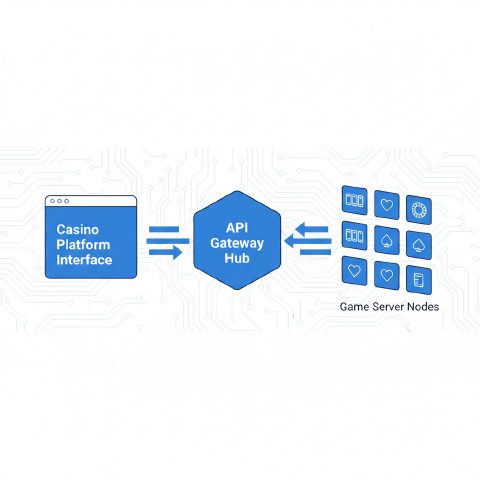
An aggregator hosts a remote game server (RGS) or a game launch API that your platform calls when a player opens a title. The aggregator handles session management, bet/win callbacks, and currency conversion, then routes those calls to the relevant studio's own RGS. From your back office, it looks like one unified game library with a single wallet integration.
The core technical artifact is the aggregator's integration API — almost universally REST or JSON-RPC over HTTPS in 2026, though a handful of legacy providers still run SOAP endpoints. Your platform sends a 'game launch' request with a session token, the aggregator authenticates it, spins up a session on the studio's RGS, and returns a launch URL. The game iframe loads directly from the studio's CDN, but every bet and win event is logged through the aggregator's transaction layer before hitting your wallet. That transaction layer is where the aggregator earns its keep: it normalizes wildly different studio callback formats into a consistent schema your back office can process.
Wallet integration is the detail that trips up most first-time operators. There are two models: seamless wallet (the aggregator calls your wallet in real time on every bet and win) and transfer wallet (the aggregator maintains its own internal wallet and you reconcile periodically). Seamless is the industry standard for regulated markets because it gives you real-time balance visibility and simplifies AML reporting. Transfer wallet is faster to integrate and survives network latency better, but your compliance team will hate reconciling it against player accounts at month-end.
Certification is the other underappreciated function. Each jurisdiction — MGA, Curaçao Gaming Control Board, UKGC, New Jersey DGE — requires game math and RNG certification from an approved test lab like BMM, GLI, or Gaming Laboratories International. A good aggregator pre-certifies its entire portfolio per jurisdiction, so when you flip on a new market in your back office, the games are already legal to offer. Without that, you'd be managing lab submissions for every studio individually. I've seen operators underestimate this by six months on their launch timeline.
What does a casino aggregator cost — and what are the real all-in fees?
Expect to pay a platform or API access fee (often a monthly minimum of €1,000–€5,000), plus a revenue-share layer of 1–5% of GGR on top of each studio's own royalty. The studio royalty itself typically runs 10–18% of GGR. All-in, your content cost commonly lands between 12% and 25% of GGR, depending on deal size and negotiation.
The fee structure is the single thing operators most consistently misread in vendor sales decks. Aggregators quote their own margin — say, 3% of GGR — and that sounds cheap. What they don't lead with is that it stacks on top of the studio fee. Pragmatic Play, for example, might charge 12% of GGR as a direct deal. Route that same content through a mid-tier aggregator at 3%, and your effective cost is 15%. Across a €1M monthly GGR operation, that's €30,000 per month more than a direct deal with Pragmatic — roughly €360,000 a year for the convenience of a single integration. The math changes dramatically at scale.
Setup and integration costs vary. White-label platforms like SoftSwiss's SOFTSWISS Casino Platform or Turnkey solution from EveryMatrix typically bundle aggregator access into the platform fee, so you're not paying a separate integration cost. If you're building on a custom tech stack and integrating an aggregator's API directly, budget €15,000–€50,000 in development time depending on your team's familiarity with the aggregator's documentation and the complexity of your wallet architecture.
Minimum monthly guarantees are common and frequently glossed over in early conversations. Some aggregators require a minimum revenue commitment — I've seen floors as low as €500/month and as high as €10,000/month for premium portfolio access. If your casino is pre-revenue or in soft launch, those minimums burn cash before you've proven the product. Always negotiate a ramp period — six months at zero minimum is a reasonable ask for a new operator, and most aggregators will grant it rather than lose the deal.
There are also jackpot contribution fees if you opt into network progressives (typically 1–3% of bets on participating games), bonus tool fees if you use the aggregator's free-spin or bonus management layer, and in some cases a per-jurisdiction certification surcharge. Read the full commercial schedule, not just the headline revenue-share number.
| Fee Type | Typical Range | Notes |
|---|---|---|
| Aggregator revenue share | 1–5% of GGR | Stacks on top of studio royalty |
| Studio royalty (via aggregator) | 10–18% of GGR | Varies by studio tier and volume |
| All-in content cost | 12–25% of GGR | Blended rate across portfolio |
| Monthly minimum / floor | €500–€10,000/month | Negotiate a ramp period |
| Integration / setup fee | €0–€50,000 | Often waived on white-label platforms |
| Jackpot contribution (network) | 1–3% of bets | Only on enrolled progressive titles |
| Jurisdiction certification surcharge | Varies | Some aggregators charge per-market fee |
Which casino aggregators are the leading platforms in 2026?
The aggregators operators actually use at scale in 2026 are EveryMatrix CasinoEngine, SoftSwiss Game Aggregator, Relax Gaming (Silver Bullet/Platinum), Pariplay (part of Aristocrat Gaming), and Hub88. Each has a different portfolio depth, jurisdiction coverage, and commercial model — none is universally the right answer.
EveryMatrix CasinoEngine is the broadest-coverage option I've worked with — 20,000+ titles from 250+ studios as of early 2025, with pre-certified content for MGA, UKGC, Curaçao, Romania, Sweden, and a growing list of LatAm jurisdictions including Colombia (Coljuegos) and Peru (MINCETUR). Their API documentation is mature, the seamless wallet integration is well-tested, and they have a dedicated compliance team that tracks certification updates. The trade-off: they're not the cheapest, and their minimum commercial requirements can be a barrier for micro-operators.
SoftSwiss Game Aggregator is the natural choice if you're already on the SOFTSWISS Casino Platform, because the integration is native. Standalone, it covers 180+ studios and roughly 15,000 titles. Their strength is crypto-friendly jurisdictions — Curaçao and Anjouan — and they have deep experience with operators running BTC/ETH/USDT wallets. If you're building a crypto casino, this is the aggregator I'd start the conversation with.
Relax Gaming's aggregation programs deserve more attention than they get. Silver Bullet gives you access to Relax's own titles plus a curated third-party selection; Platinum adds a wider studio roster. The commercial model is different from pure aggregators — Relax is also a studio, so they have skin in the game on content quality. The portfolio is smaller than EveryMatrix but the curation is tighter, and I've seen operators convert better on a focused 5,000-title library than a bloated 20,000-title one.
Pariplay, acquired by Aristocrat Gaming in 2021, brings a strong land-based and regulated US-market pedigree. Their Fusion platform aggregates 10,000+ titles and has certifications in New Jersey, Michigan, and Pennsylvania — which is relevant if you're planning a US iGaming play. Hub88 is the newer entrant worth watching: founded by ex-EveryMatrix executives, it's been aggressive on commercial terms and has signed a number of Tier-1 studios quickly. For operators negotiating in 2025–2026, Hub88 creates useful competitive pressure in aggregator RFPs.
| Aggregator | Approx. Game Count | Key Jurisdictions | Best Fit For |
|---|---|---|---|
| EveryMatrix CasinoEngine | 20,000+ | MGA, UKGC, Curaçao, LatAm, Nordics | Mid-to-large operators, multi-market |
| SoftSwiss Game Aggregator | 15,000+ | Curaçao, Anjouan, crypto-friendly | Crypto casinos, SOFTSWISS platform users |
| Relax Gaming (Silver Bullet/Platinum) | 5,000–8,000 | MGA, UKGC, Sweden | Quality-focused, boutique operators |
| Pariplay (Aristocrat) | 10,000+ | MGA, NJ, MI, PA, LatAm | US-facing operators, regulated markets |
| Hub88 | 8,000+ | Curaçao, MGA, LatAm | Cost-sensitive operators, new launches |
When does a direct studio deal beat using an igaming solution aggregator?
A direct studio deal saves the aggregator's margin — typically 1–5% of GGR — but requires your own technical integration with each studio's RGS, separate commercial negotiations, and managing individual certification submissions. The break-even point varies, but most operators find direct deals worth the effort only when a single studio generates €400,000–€600,000+ in monthly GGR.
The calculation is straightforward in principle. If Pragmatic Play drives €500,000 GGR per month on your platform and your aggregator charges 3% on top of Pragmatic's 12% studio fee, you're paying €15,000/month — €180,000/year — to the aggregator just for that one studio's content. A direct Pragmatic integration eliminates that €15,000/month. The integration effort (developer time, legal review of the direct agreement, ongoing API maintenance) might cost €30,000–€60,000 one-time. You break even in two to four months and save six figures annually thereafter. At that volume, it's not a close call.
The complication is that most studios won't sign a direct deal with operators below a certain GGR threshold. Pragmatic Play, Evolution, and Play'n GO all have minimum volume requirements for direct partnerships — they don't publish them, but from conversations with operators I'd estimate Pragmatic wants to see €200,000–€500,000 monthly GGR before they'll engage seriously on a direct contract. Below that, you're routed back to an aggregator. So for a new operator, aggregation isn't just convenient — it's often the only option available.
There's also a certification complexity argument for staying with an aggregator longer than the pure math suggests. When you go direct with a studio, you inherit responsibility for ensuring their content is certified in every jurisdiction you operate. The aggregator was handling that quietly. Suddenly you're coordinating with GLI or BMM directly, tracking RNG certificate expiry dates, and managing studio update notifications. For operators with lean tech teams, that operational overhead can cost more than the aggregator's margin. I've seen operators go direct, save money on paper, and then spend it all on compliance management they didn't budget for.
How do regulatory requirements affect your choice of casino aggregator?
Your target jurisdiction determines which aggregators are viable, not the other way around. MGA-licensed casinos must use studios certified by approved test labs; UKGC requires specific responsible gambling tool integrations; US states like New Jersey and Michigan mandate state-level game certification. An aggregator without pre-certified content in your jurisdiction forces you to run that certification yourself — which can add six to twelve months.
Curaçao is the most permissive environment — the Gaming Control Board (GCB) under the new 2023 National Ordinance framework still accepts a broad range of aggregated content, and most aggregators have Curaçao-certified portfolios. Anjouan (AGCL) is similarly flexible. For operators launching quickly on an offshore license, almost any of the major aggregators will work. The problem comes when you want to expand into a regulated EU market or a US state later — you may find your aggregator's certification coverage stops at Curaçao.
MGA (Malta Gaming Authority) is the benchmark for EU licensing. The MGA requires that all game suppliers are either MGA-licensed themselves or hold a B2B Critical Gaming Supply license. EveryMatrix, SoftSwiss, and Pariplay all maintain MGA B2B licenses, so their aggregated content is generally MGA-compliant. But individual studios within an aggregator's portfolio may not be — and the aggregator's game count often drops noticeably when you filter to MGA-approved titles only. Always ask for a jurisdiction-filtered game list before signing.
US states are the hardest environment. New Jersey (DGE), Michigan (MGCB), Pennsylvania (PGCB), and Connecticut (CTDCP) each require game-level certification by a state-approved lab — GLI and BMM are the common choices. Pariplay is the aggregator with the deepest US footprint as of 2026, largely because Aristocrat's land-based relationships accelerated those certifications. If US iGaming is in your roadmap within three years, I'd weight US certification coverage heavily in your aggregator selection — retrofitting it later is painful and expensive.
LatAm regulated markets — Colombia (Coljuegos), Peru (MINCETUR), Argentina (ENREJA at the federal level, plus provincial regulators like LOTBA in Buenos Aires) — are increasingly requiring local server hosting or data residency alongside game certification. Some aggregators handle this through regional CDN nodes; others push it back to the operator. Ask the question explicitly. Mexico's SEGOB and Brazil's emerging federal framework (post-2023 regulation) are also worth tracking if you're building a LatAm strategy.
What should operators look for in an aggregator contract before signing?
The five contract clauses that cause the most operator pain are: exclusivity restrictions, termination notice periods, revenue-share audit rights, IP ownership of player data, and the definition of 'GGR' used for fee calculation. Get all five clarified in writing before you sign — renegotiating mid-operation is nearly impossible.
Exclusivity is rare in aggregator contracts but worth checking. More common is a 'most favored nation' clause that prevents you from getting better commercial terms from a competing aggregator for the same studio content. That limits your ability to use multiple aggregators as a negotiating lever — which is a real tactic, and one I'd recommend to any operator with enough volume to make it credible. Running EveryMatrix and Hub88 in parallel and playing them against each other on studio-specific deals is a legitimate strategy in 2025–2026.
Termination notice periods are frequently overlooked. I've seen contracts with 180-day termination notice requirements. If the aggregator's service degrades, their certification lapses in a key market, or you simply find a better commercial deal, you're locked in for six months. Negotiate this down to 30–60 days with cause, 90 days without. Also check whether termination triggers any clawback of the setup fee waiver or minimum guarantee credits — some contracts have provisions that make leaving expensive.
The GGR definition matters more than it sounds. Some contracts define GGR as gross bets minus gross wins (standard). Others subtract bonuses, free-spin wins, or jackpot payouts from the calculation. A contract that excludes jackpot payouts from GGR is more favorable to you as an operator — you're not paying the aggregator's margin on a €500,000 jackpot hit that came from a network progressive you contributed to separately. Get the formula in writing and model it against your projected game mix.
Player data ownership is the clause that quietly matters most long-term. The aggregator's RGS sees every bet and win event for every player on your platform. Make sure the contract explicitly states that player behavioral data belongs to you, cannot be used by the aggregator for their own analytics products, and cannot be shared with competing operators. This is not hypothetical — aggregators with large multi-operator footprints have a structural incentive to aggregate (pun intended) cross-operator player data, and not all contracts prohibit it clearly.
How do casino aggregators handle live dealer content differently from slots?
Live dealer content is almost never aggregated through the same API layer as slots. Evolution Gaming, Pragmatic Play Live, and Ezugi operate their own proprietary RGS and streaming infrastructure, and they typically require direct operator agreements even when slots are routed through an aggregator. Some aggregators act as commercial intermediaries for live content but the technical integration remains separate.
The reason is infrastructure, not policy. A slot is a lightweight JavaScript client pulling math results from an RGS. A live dealer game is a real-time video stream from a physical studio — Evolution's main facility in Riga is over 17,000 square meters — with sub-second latency requirements for bet placement. You can't normalize that through a generic aggregator API the way you can a slot callback. Evolution, Pragmatic Live, and Ezugi all run their own dedicated client SDKs and demand direct integration.
What aggregators can do for live content is handle the commercial relationship and billing. EveryMatrix, for example, will broker your Evolution deal, include Evolution's revenue share in the consolidated invoice, and provide a single point of contact for contract management. But the technical integration with Evolution's Game Launch API still happens separately. This means your live dealer integration timeline is largely independent of your aggregator choice — budget for it as a separate workstream, typically four to eight weeks of additional development.
There are a handful of second-tier live dealer providers — Vivo Gaming, BetGames, Atmosfera — where the aggregator does handle the full technical layer. If you're launching in a market where Evolution pricing is prohibitive (they're not cheap — expect 12–18% GGR on live dealer), these providers offer a lower-cost entry point and can be genuinely aggregated. For operators targeting LatAm or African markets where bandwidth constraints make HD streaming challenging, BetGames' low-bandwidth live products are worth a look and are available through several aggregators.
Can a casino aggregator help with compliance tools and responsible gambling features?
Some aggregators bundle responsible gambling tools — session limits, loss limits, reality checks, self-exclusion hooks — into their platform layer. This is useful but rarely sufficient on its own. Regulated markets like UKGC and Sweden's Spelinspektionen require operator-level RG controls, not just game-level ones, so aggregator-provided tools typically need to be supplemented by your platform's own compliance stack.
EveryMatrix's CasinoEngine includes configurable RG parameters per jurisdiction — you can set default session time limits, mandatory break intervals, and loss limit prompts at the game level. SoftSwiss has similar functionality in their Game Aggregator layer. These are genuinely useful: they mean a player hitting a session limit gets a consistent experience regardless of which studio's game they're playing, because the control sits at the aggregator layer rather than inside each studio's RGS. That's a real operational advantage over managing RG settings studio-by-studio.
The limitation is that aggregator-level RG tools operate on game session data, not on the player's full account history. A player who has set a €200 daily loss limit on your platform needs that limit enforced at the wallet level — not just within a single game session. That enforcement has to live in your platform's wallet and account management layer. The aggregator can surface the right UI prompts inside the game, but the actual limit check happens in your back office. Make sure your platform vendor and aggregator have tested this handshake; I've seen operators go live with a gap between the two systems that allowed limit overrides.
For UKGC-licensed operators specifically, the requirements around affordability checks, enhanced due diligence triggers, and the new financial vulnerability indicators (introduced under the 2023 White Paper framework) go well beyond what any aggregator provides. You'll need a dedicated RG toolset — GamStop integration, Gamban API, and increasingly a third-party affordability data provider like CATO or Open Banking solutions. Aggregator RG features are table stakes; they don't replace a proper compliance stack.
What is the typical timeline to integrate a casino aggregator and go live?
On a white-label platform with a pre-built aggregator connector, you can be live with aggregated content in four to eight weeks. On a custom tech stack integrating an aggregator API from scratch, budget twelve to twenty weeks — longer if you're targeting a regulated jurisdiction that requires game certification review before launch.
The fastest path is a white-label platform that has already integrated the aggregator natively. SoftSwiss Casino Platform connects to SoftSwiss Game Aggregator out of the box; EveryMatrix's OddsMatrix and CasinoEngine are designed to work together. In those setups, aggregator integration is essentially configuration, not development — you're selecting your game portfolio, setting jurisdiction filters, and testing the wallet handshake rather than writing API integration code. Four to six weeks is realistic, with the bulk of that time spent on KYC setup, payment provider integration, and regulatory onboarding rather than the aggregator itself.
Custom stack integrations are a different story. The aggregator's API is typically well-documented, but the wallet integration — especially seamless wallet — requires careful engineering. You're building real-time callbacks that need to handle network timeouts, duplicate transaction prevention, and currency conversion without dropping bets or crediting wins twice. These edge cases take time to test properly. Budget six to ten weeks of development, then four to six weeks of QA and load testing. Skipping the load testing is a common mistake; aggregator APIs can behave differently under concurrent session load than in sandbox testing.
Jurisdiction-specific certification adds the most unpredictable time. If you're launching in New Jersey and the aggregator's studio portfolio isn't yet DGE-certified, you're waiting on the lab submission queue — which at GLI or BMM can run eight to sixteen weeks depending on backlog. Pariplay's US pre-certified portfolio is one reason operators targeting New Jersey pay a slight commercial premium for it; the certification timeline savings are worth real money in deferred revenue. Always ask for a certification status report per jurisdiction before committing to a launch date.
| Scenario | Estimated Timeline | Key Variables |
|---|---|---|
| White-label platform, bundled aggregator | 4–8 weeks | Payment integration, KYC setup, regulatory onboarding |
| Custom stack, aggregator API from scratch | 12–20 weeks | Wallet architecture, QA depth, team experience |
| Custom stack + new jurisdiction certification | 20–36 weeks | Lab queue at GLI/BMM, regulator review time |
| Adding a second aggregator to existing platform | 4–10 weeks | Depends on wallet normalization complexity |
| Live dealer integration (direct, parallel) | 4–8 weeks additional | Evolution/Pragmatic Live SDK, streaming testing |
What are the biggest risks operators discover too late with casino aggregators?
The four risks that consistently blindside operators are: revenue-share stacking that erodes margins beyond projections, game portfolio overlap that makes the aggregator fee redundant once direct deals are signed, certification gaps that block market expansion, and data portability limitations that make switching aggregators operationally painful after launch.
Revenue-share stacking is the most common financial surprise. Operators model their unit economics with the studio royalty in mind but forget the aggregator's layer until the first invoice arrives. At 15–20% all-in content cost, you're giving up a significant chunk of GGR before paying for your platform, payments, marketing, and operations. I've seen operators with 85% bonus-heavy player bases discover that their effective margin after content costs, bonus costs, and payment fees was negative. Model the full cost stack before you commit to a content strategy, not after.
Portfolio overlap catches operators who sign multiple aggregators to maximize game variety, then realize that 70% of the titles in Aggregator B are already available through Aggregator A. You're paying two minimum fees and two revenue-share layers for marginal incremental content. Before adding a second aggregator, do a SKU-level overlap analysis. Most aggregators will provide a full game list in CSV format — it takes an afternoon in Excel to identify the unique titles and decide whether they justify the additional commercial relationship.
Data portability is the risk that only becomes visible when you want to leave. Your player game history, session data, and bonus transaction records are often stored in the aggregator's system, not yours. When you migrate to a new aggregator or platform, extracting that data in a usable format can be contractually restricted or technically complex. Before signing, confirm in writing that you have the right to export all player-level transaction data in a standard format (CSV, JSON) with no exit fee. This is a non-negotiable clause that most aggregators will accept if you ask for it explicitly.





Comments
No comments yet, be the first.