Online Casino Games API Integration Explained: The Operator's Real Playbook for 2026
What exactly is an online casino games API and how does it work?
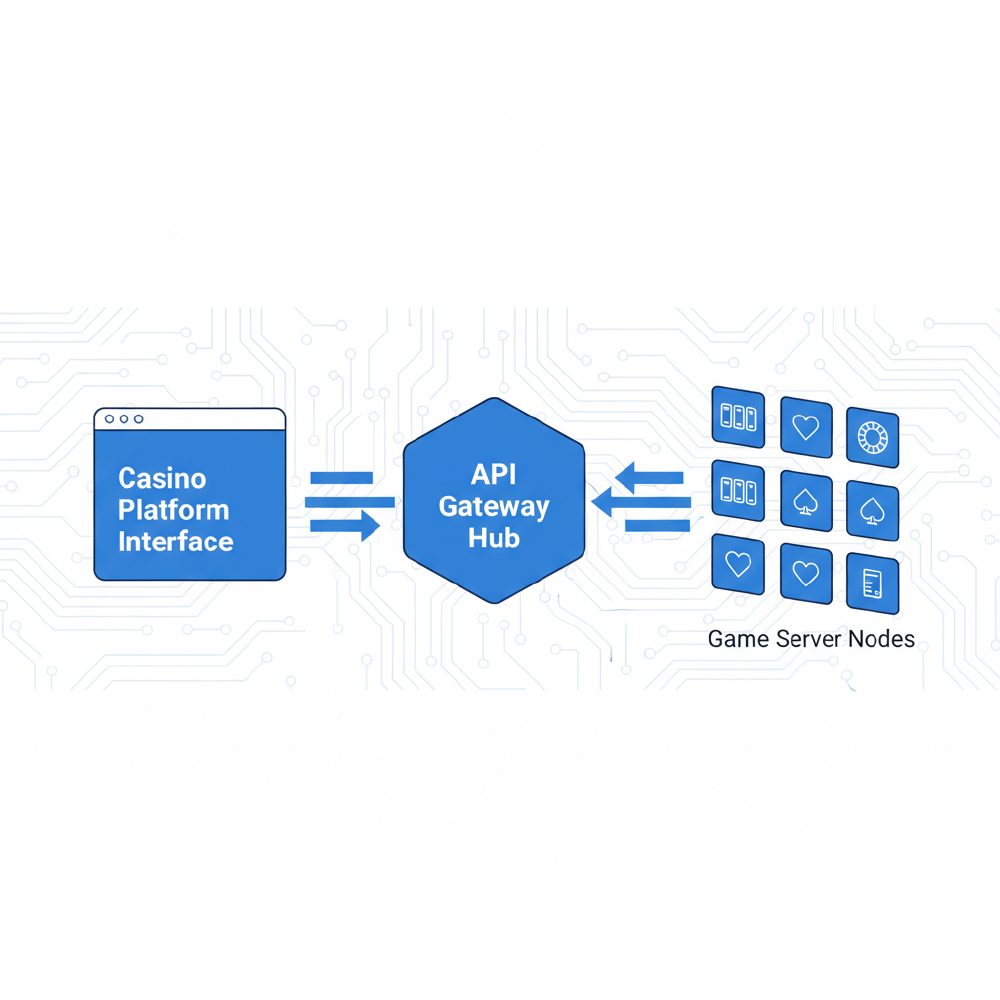
An online casino games API is a standardized interface that lets your casino platform request game launch URLs, exchange player session tokens, and send real-time wallet callbacks to a remote game server (RGS). The RGS runs the game logic and RNG; your platform handles the player account and funds. The two systems talk via HTTPS REST or, in some older integrations, SOAP.
Every time a player clicks 'Play' on a slot, your platform hits the provider's API with a launch request containing a session token, the player's currency, their balance (or a wallet endpoint URL), and the game identifier. The RGS validates the token, renders the game in an iframe or dedicated window, and from that point on communicates bet and win events back to your wallet endpoint — not the player's browser. That callback chain is where most integration failures actually live.
The two dominant wallet models are seamless and transfer. In a seamless integration, every bet and win triggers a real-time debit or credit against your main player wallet via callbacks. In a transfer (or dedicated) wallet model, the player moves funds into a game wallet first, and reconciliation happens in batch. Seamless is the modern standard — Evolution, Pragmatic Play and virtually every tier-1 studio require it — but it demands sub-200ms response times from your wallet endpoint or the RGS will reject the transaction and the game session will error out. I've seen operators underestimate this latency requirement badly when their wallet logic is sitting behind a slow database query.
Authentication between your platform and the game server is handled by an API key and secret pair, sometimes supplemented by IP whitelisting. The provider issues these during onboarding. Session tokens are short-lived — typically 15 to 60 minutes — so your platform also needs a token-refresh mechanism for long game sessions, especially relevant for live casino tables where a player might sit for hours. Miss that and you'll get player complaints about mid-session disconnects that look like payment failures but are actually auth timeouts.
Aggregator vs. direct studio deal: which integration route should you take?
For most operators launching their first or second brand, a game aggregator is the right starting point — one contract, one technical integration, access to hundreds of studios. Direct studio deals make financial sense only once your GGR volume is large enough that the aggregator's margin layer costs more than the integration overhead of managing separate contracts and codebases.
Aggregators like SoftSwiss Game Aggregator, EveryMatrix CasinoEngine, Pariplay (now part of Aspire Global), and Relax Gaming's Silver Bullet program sit between your platform and the studios. You integrate once to their unified API, and they handle the individual studio agreements, certification uploads, and RGS-level compliance reporting. The trade-off is their fee layer — typically 1 to 3 percentage points of GGR on top of whatever the studio charges. On a €200k GGR month, that's €2,000–€6,000 leaving the building purely for the aggregation service.
Direct deals require you to integrate each studio's API individually. Pragmatic Play, Evolution, Play'n GO, NetEnt (now part of Evolution), and Hacksaw Gaming all have their own API specs, certification requirements, and account management processes. Each integration takes 2–6 weeks of developer time depending on how well-documented the provider's spec is. Evolution's API documentation is genuinely solid; some smaller studios hand you a PDF from 2019 and a Skype contact. Beyond the dev hours, most tier-1 studios impose minimum guarantee clauses — monthly minimums ranging from a few thousand to tens of thousands of euros depending on your jurisdiction and brand size. Miss the minimum and you're paying it anyway.
The crossover point where direct deals become cheaper than aggregator margin depends on your game mix and volume. A rough heuristic: if a single studio accounts for more than €300k–€500k GGR per month, run the math on going direct. Below that, the aggregator's operational value — unified reporting, single compliance contact, faster new-game releases — outweighs the margin cost. Many mature operators run a hybrid: aggregator for the long tail of content, direct contracts for their top three or four studios by revenue.
| Factor | Aggregator Route | Direct Studio Deal |
|---|---|---|
| Integration effort | Single API, 2–6 weeks | Per-studio, 2–6 weeks each |
| Content breadth | 5,000+ titles immediately | One studio's portfolio per deal |
| Revenue share overhead | +1–3% GGR aggregator layer | Studio fee only (typically 10–20% GGR) |
| Minimum guarantees | Usually none or low | Per-studio, can be €5k–€50k/month |
| Compliance reporting | Aggregator handles RGS certs | Operator must manage per studio |
| Best for | New operators, <€500k GGR/month | Established brands, high-volume studios |
What does online casino games API integration actually cost?
Budget €15,000–€60,000 in development and setup costs for a first aggregator integration, plus ongoing rev-share. Direct studio integrations add €5,000–€20,000 per studio in developer time. Those figures assume competent in-house developers; outsourcing to a specialist iGaming dev shop typically runs 30–50% higher but cuts timeline risk.
The cost breakdown has several distinct buckets operators routinely conflate. First is the technical integration itself: developer hours to map the provider API to your platform's wallet and game-launch flow, write the callback handlers, build error logging, and run QA across game types (slots, live, table games all behave differently at the API level). For a well-documented aggregator API with good sandbox tooling, a competent backend developer needs 3–8 weeks. At €100–€150/hour for a mid-level iGaming dev, that's €12,000–€48,000 before you've touched certification.
Certification and compliance add another layer. Most regulators — MGA, UKGC, Curaçao eGaming — require that games be tested by an approved lab (BMM, GLI, eCOGRA, Gaming Labs) before going live. The aggregator typically handles RGS-level certification, but if you're going direct with a studio that isn't already certified in your target jurisdiction, expect €3,000–€15,000 per studio in lab fees and 4–12 weeks of calendar time. This is the timeline killer operators most consistently underestimate.
Then there are the contractual costs: setup fees (some aggregators charge €5,000–€20,000 onboarding fees; others waive them for volume commitments), monthly platform fees if you're on a white-label or turnkey solution that bundles the aggregator access, and the ongoing revenue share. Over a 12-month period at €300k GGR/month, a 2% aggregator layer costs €72,000. That's real money, and it's the reason experienced operators revisit their aggregator contracts annually rather than treating them as set-and-forget.
Which game aggregators and API providers are actually worth evaluating in 2026?
SoftSwiss Game Aggregator, EveryMatrix CasinoEngine, Pariplay, and Relax Gaming Silver Bullet are the four aggregators most operators seriously evaluate. Each has a different studio mix, fee structure, and jurisdictional coverage. The right choice depends on your target markets and whether you need live casino content bundled or separate.
SoftSwiss Game Aggregator (now part of the broader SoftSwiss ecosystem) covers 10,000+ games from 200+ studios and has strong coverage across EU, LATAM, and crypto-friendly jurisdictions. Their API documentation is mature, and their back-office reporting tools are among the better ones I've reviewed. The downside: their pricing can be opaque until you're deep in commercial negotiations, and their live casino offering routes through third-party studios rather than proprietary content.
EveryMatrix CasinoEngine is the aggregator arm of a full-stack platform provider, which matters if you're also evaluating their PAM (Player Account Management) and sportsbook. Tight integration between the game layer and the PAM reduces wallet callback latency — a genuine technical advantage. Their studio count is slightly lower than SoftSwiss but their tier-1 coverage (Evolution, Pragmatic Play, Play'n GO) is solid. Worth noting: EveryMatrix has MGA and multiple EU licenses themselves, which simplifies your compliance chain if you're targeting those markets.
Pariplay, acquired by NTG (now Aspire Global, itself acquired by Paysafe and then separated — the corporate history is genuinely confusing), brings a strong proprietary studio alongside aggregation. Their Fusion platform is technically clean. Relax Gaming's Silver Bullet is a different model: it's a distribution program for Relax's own content plus a curated set of partner studios, not a full aggregator. If Relax titles are key to your game mix, Silver Bullet is the integration path; otherwise it's too narrow.
For operators targeting the US market specifically, the aggregator landscape looks completely different. Scientific Games (now Light & Wonder), IGT, and Everi dominate land-based-linked content. For online, GAN and Kambi handle aggregation in regulated states, and the studio list is constrained by state-level approvals — not every EU studio is certified in New Jersey or Michigan. Don't assume your EU aggregator contract travels to the US; it almost certainly doesn't.
| Aggregator | Game Count (approx.) | Key Strength | Jurisdictional Focus | Live Casino Included |
|---|---|---|---|---|
| SoftSwiss Game Aggregator | 10,000+ | Breadth + crypto-friendly | EU, LATAM, offshore | Via partner studios |
| EveryMatrix CasinoEngine | 8,000+ | PAM integration, low latency | EU, MGA, UKGC | Via Evolution & others |
| Pariplay (Fusion) | 6,000+ | Proprietary + aggregated content | EU, offshore | Via partner studios |
| Relax Gaming Silver Bullet | ~200 curated | Relax IP + premium partners | EU, MGA | No |
| GAN / Kambi (US) | Varies by state | US regulated market access | NJ, MI, PA, WV, etc. | Via Evolution US |
How does licensing jurisdiction affect which casino games API you can use?
Your license jurisdiction is a hard filter on which studios and aggregators will sign with you. MGA and UKGC licenses open nearly every door. Curaçao eGaming and Anjouan cover most aggregators and studios, with a handful of tier-1 holdouts. Some studios — notably Play'n GO — have publicly stated they won't supply operators without an MGA or equivalent white-listed license.
This is the single most consequential decision operators make before touching API documentation, and it's the one most often made for the wrong reasons (cost, speed) rather than the right ones (market access, studio availability). An MGA license (Malta Gaming Authority) costs roughly €25,000 in application fees plus ongoing compliance costs, takes 4–6 months, and unlocks virtually every studio and aggregator. A Curaçao eGaming license runs €15,000–€25,000 and can be obtained in 6–12 weeks, but you'll find that Evolution, Play'n GO, and a few other tier-1 studios won't supply you. For some operators targeting specific markets, that's an acceptable trade-off. For others, it's a business-model problem they discover after launch.
The Curaçao reform of 2023–2024 added a new licensing framework (Curaçao Gaming Control Board replacing the master license system) that changed the compliance requirements significantly. Operators on old sub-licenses had to migrate. Some studios used the transition as an opportunity to tighten their supply policies. If you're evaluating Curaçao in 2026, make sure you're talking to studios and aggregators about the new GCB license specifically, not the legacy framework — the answer you get may differ.
Anjouan (Comoros) emerged as an alternative offshore option around 2022–2023, cheaper and faster than Curaçao, but studio acceptance is even more restricted. I'd treat it as a last resort or a bridge license while pursuing something more substantial. For LATAM markets, jurisdiction gets more nuanced: Colombia requires a Coljuegos license for local operators, Peru requires MINCETUR approval, and Mexico's SEGOB licensing is notoriously slow. In each case, check which studios have local certification before assuming your EU aggregator contract applies — it usually doesn't without additional studio-level approvals.
What are the technical steps to integrate a casino games API end-to-end?
A complete casino games API integration runs through five distinct phases: commercial agreement and API access, sandbox environment setup and wallet endpoint development, game launch and callback testing, certification and compliance sign-off, and staged production rollout. Skipping or rushing any phase creates problems that are expensive to fix after launch.
Phase 1 — Commercial agreement: Before you see a single line of API documentation, you need a signed contract. For aggregators, this covers rev-share rates, minimum commitments, restricted territories, and data processing terms. Read the territory restrictions carefully — some aggregators exclude specific jurisdictions at the contract level even if the studio technically allows them. Get legal review on the indemnification clauses; aggregator contracts routinely push compliance liability back to the operator.
Phase 2 — Sandbox setup: Every reputable aggregator and studio provides a sandbox environment with test credentials. Your developers should build and test the wallet endpoint here first — specifically the debit, credit, rollback, and balance-check methods. The rollback call (used when a bet is placed but the game result is never returned, typically due to network failure) is the one most developers implement incorrectly. Test it explicitly with simulated timeouts, not just happy-path scenarios. SoftSwiss and EveryMatrix both have decent sandbox tooling; some smaller studios give you a staging URL and a prayer.
Phase 3 — Game launch and callback testing: Test every game type you plan to offer — RNG slots, live casino, virtual sports, table games — because their callback patterns differ. A live casino table sends callbacks continuously during a round; a slot sends them per spin. Your wallet endpoint needs to handle concurrent callbacks correctly, especially if you expect high-traffic peaks. Load test the endpoint at 2–3x your expected peak concurrent sessions before going live. I've watched operators skip load testing and then have their wallet endpoint fall over on a Friday evening bonus campaign.
Phase 4 — Certification: Submit game certificates to your regulator or have your aggregator confirm which titles are already approved in your jurisdiction. For MGA operators, the aggregator typically manages this, but you're still responsible for ensuring only certified games appear on your platform. Build a game-availability flag into your back-office so you can instantly disable a game if a certification lapses. Phase 5 — staged rollout: launch with a subset of studios and game types, monitor callback success rates and wallet reconciliation daily for the first two weeks, then expand. Don't launch 5,000 games on day one.
What wallet integration model should operators choose — seamless or transfer?
Choose seamless wallet integration. The transfer (dedicated game wallet) model is largely a legacy approach that tier-1 studios are phasing out. Seamless integration gives players a frictionless experience, reduces abandoned sessions, and is required by Evolution and most modern studios. The operational complexity of seamless is real but manageable with proper endpoint design.
In a seamless wallet integration, your platform exposes three core endpoints: balance (returns the player's current balance), debit (deducts a bet amount and returns a transaction ID), and credit (adds a win amount). The game server calls these in real time during gameplay. You also need a rollback endpoint for failed transactions. The entire callback chain must respond within the provider's timeout threshold — Evolution requires sub-500ms; some studios are stricter. If your database query for balance takes 300ms on average, you're already at risk of timeouts under load.
The transfer wallet model, where players move chips into a game-specific wallet before playing, introduces friction that visibly hurts conversion. Players who have to 'fund' a game wallet before spinning abandon at measurably higher rates. The only scenario where transfer wallets make sense today is if your core platform architecture genuinely can't support real-time callbacks — for example, some older sports betting platforms that were never designed for casino integration. In that case, transfer is a temporary bridge while you rebuild, not a permanent solution.
One nuance worth flagging: bonus wallet logic adds complexity to seamless integration. If you're running a bonus engine that separates real-money and bonus balances, your debit/credit endpoints need to correctly sequence which wallet is drawn from and report the split back to the RGS for wagering contribution tracking. This is where I see the most reconciliation errors in newly launched casinos — the bonus engine and the game wallet aren't talking to each other correctly, and you end up with player balance discrepancies that are a regulatory nightmare to explain.
How do revenue share and fee structures work across casino games API contracts?
Casino games API contracts layer multiple fee types: the studio's base revenue share (typically 10–20% of GGR), the aggregator's margin (1–3% of GGR), and sometimes a platform fee if you're on a white-label. Understanding how these stack determines your actual content cost — and it's almost always higher than the headline number in the sales deck.
Studio revenue share is calculated on GGR — Gross Gaming Revenue, meaning total bets minus total wins before any bonuses are deducted. The standard range is 10–20% depending on the studio's leverage (Pragmatic Play and Evolution command closer to 20%; smaller studios hungry for distribution might accept 12–15%). Some studios offer a flat CPR (cost per round) model instead of rev-share, which can be advantageous for high-frequency, low-stake players but risky if you attract high-rollers on those titles.
The aggregator adds their layer on top. If you're paying 15% to the studio and 2% to the aggregator, your effective content cost is 17% of GGR from those titles. On €1M GGR/month across aggregated content, that's €170,000 leaving the business monthly before any other costs. Over a year, the aggregator's 2% alone is €240,000. That math is why volume operators go direct on their top titles.
White-label platforms that bundle game aggregation into a platform fee complicate the picture further. SoftSwiss's white-label product, for example, includes game aggregation within a broader platform fee structure. The bundled price can look attractive early on, but you lose visibility into the actual per-studio cost, which makes it harder to optimize your game mix by margin. When evaluating white-label deals, always ask for the unbundled cost breakdown — what you'd pay for the platform alone versus the aggregated content. Vendors are reluctant to provide this, which tells you something.
What are the most common integration failures and how do operators avoid them?
The five integration failures I see most often are: rollback endpoint not implemented correctly, wallet endpoint latency exceeding provider thresholds, currency mismatch between platform and RGS, bonus balance not correctly separated in debit callbacks, and missing or malformed session token refresh logic. All five are preventable with proper pre-launch testing.
The rollback problem deserves its own paragraph because it's genuinely misunderstood. A rollback is triggered when a bet is debited from the player's wallet but the game server never receives confirmation — typically due to a network timeout. The RGS sends a rollback request to reverse the debit. If your endpoint doesn't handle this correctly (returning a success response even if the original transaction wasn't found, for example), you'll either over-credit players or create balance discrepancies that compound over time. Test rollbacks explicitly, with deliberate timeouts in your sandbox environment, before going anywhere near production.
Currency handling is a subtler failure mode. Your platform might store balances in EUR but the player's display currency is SEK. If your wallet endpoint returns balances in the wrong currency or without the correct ISO 4217 code, the RGS will either reject the session or — worse — silently use the wrong conversion rate. Always confirm with the provider exactly what currency format and decimal precision their API expects. Some providers use minor currency units (cents, not euros); others use decimal. Mixing them up produces bets that are 100x too large or too small, which is both a player-experience disaster and a regulatory incident.
Session token refresh is the failure mode players notice most visibly. A player sitting at a live baccarat table for two hours hits the token expiry window. If your platform doesn't refresh the token before it expires, the game session drops and the player sees a connection error. For live casino, this is particularly damaging because the player may have an active bet on the table when the session drops. Build token refresh logic that triggers at 80% of the token's lifetime, not at expiry.
How does casino games API integration differ for crypto casinos versus fiat operators?
The API integration mechanics are largely identical — the RGS doesn't know or care whether you're settling in EUR or ETH. The differences live in your wallet layer: crypto casinos need to handle multi-currency balance management, real-time conversion rates, and blockchain confirmation delays in ways that fiat operators don't. Aggregator and studio acceptance also varies for crypto-native operators.
Most crypto casinos operate a fiat-equivalent internal accounting model — player balances are stored in a fiat reference currency (usually EUR or USD) and the crypto amount is calculated at the point of deposit and withdrawal using a live rate. This means the seamless wallet integration to the RGS looks identical to a fiat casino: the balance endpoint returns EUR, the debit and credit callbacks process EUR amounts. The crypto complexity is upstream of the game API, in your payment processing layer. Providers like CoinsPaid or B2BinPay handle the crypto-to-fiat conversion and feed a fiat balance to your wallet, which then talks to the RGS normally.
Where crypto casinos face genuine API-level differences is in studios that offer crypto-denominated games — Hacksaw Gaming, BGaming, and a handful of others have developed games with crypto-native bet sizes and display. Integrating these requires your platform to support the relevant currency codes and bet-size ranges, which differ from fiat norms. A €0.10 minimum bet in fiat terms translates to a very different BTC denomination depending on the day, so dynamic bet-size display logic becomes important.
On the aggregator side, SoftSwiss has historically been the most crypto-friendly, partly because their white-label product was built with crypto operators in mind from early on. EveryMatrix has expanded crypto support. Some aggregators still restrict crypto-native operators or require additional KYC documentation before onboarding. And as noted earlier, the studio acceptance question matters: Play'n GO won't supply crypto-only operators regardless of which aggregator you're using. Map your studio wishlist against your operator model before committing to a licensing and aggregation strategy.






Comments
No comments yet, be the first.