Casino Games Aggregator: The Complete Operator Guide for 2026

What exactly is a casino games aggregator and how does it work?
A casino games aggregator is a B2B middleware layer that connects an online casino platform to game content from dozens or hundreds of studios through a single, standardized API. Instead of negotiating and integrating each studio separately, the operator signs one contract with the aggregator and gets access to the aggregator's entire certified content library.
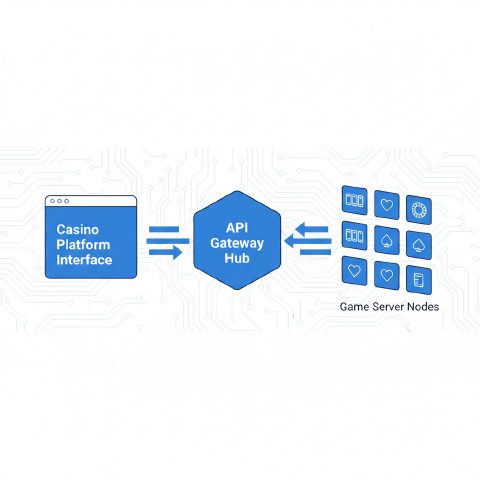
The mechanics are straightforward but worth understanding at the plumbing level. The aggregator maintains live integrations with each studio — handling protocol translation, wallet connectivity, currency conversion, and the RNG certification paperwork that regulators demand. When a player launches a slot, the request flows from your front end to the aggregator's gateway, which routes it to the correct studio server and returns the game session. Your platform never talks directly to the studio.
What this buys you is speed and simplicity. Integrating a single major studio like Pragmatic Play directly takes three to six months of technical work, compliance documentation, and commercial negotiation. Through an aggregator, that same studio's content can go live in days once the master agreement is signed. For a new operator trying to launch with 2,000+ titles, there is no realistic alternative to an aggregator — at least not at the start.
The trade-off is an extra commercial layer. Aggregators charge a revenue share — typically 1–4% of GGR — that sits on top of whatever the underlying studio takes. Studios usually take 10–15% of GGR on their content. So your blended content cost through an aggregator could realistically land at 13–19% of GGR before you've paid for your platform, payment processing, or marketing. On a site doing €500k GGR per month, that aggregator margin is €5k–€20k monthly you could eventually reclaim by going direct. That math is why large operators eventually negotiate direct deals with their top ten studios and use the aggregator only for the long tail.
Which casino game aggregators dominate the market in 2026?
The leading casino aggregators by operator adoption are SoftSwiss Game Aggregator, EveryMatrix CasinoEngine, Relax Gaming Silver Bullet, Pariplay Fusion (Everi), and Slotegrator. Each has a different strength: SoftSwiss on crypto and offshore markets, EveryMatrix on regulated EU markets, Relax on premium studio curation, Pariplay on LATAM and emerging markets, Slotegrator on entry-level operators.
SoftSwiss Game Aggregator connects operators to 23,000+ games from 300+ studios and is deeply embedded in the crypto casino segment. Their infrastructure handles multi-currency wallets including BTC and ETH natively, which is a genuine differentiator for Curaçao-licensed or Anjouan-licensed operators targeting crypto audiences. The downside: their regulated-market certification coverage for jurisdictions like UKGC or Swedish Spelinspektionen is thinner than EveryMatrix's, so verify the cert matrix carefully if you're going regulated EU.
EveryMatrix CasinoEngine is the aggregator I'd recommend first for MGA or UKGC-licensed operators. Their compliance infrastructure is genuinely mature — they maintain certifications across 30+ regulated jurisdictions and their responsible gambling tooling is built to the standard that MGA auditors actually expect. They also offer a content management layer that lets operators configure game lobbies, bonus eligibility, and jurisdiction-specific exclusions without developer involvement, which saves real operational hours.
Relax Gaming's Silver Bullet program takes a different angle entirely. Rather than maximizing studio count, Relax curates a smaller roster of studios and distributes their own original content alongside partner titles. If your brand positioning is premium slots rather than volume, Relax is worth a serious look. Pariplay Fusion has built strong traction in LATAM — they hold certifications in Colombia (Coljuegos), Peru (MINCETUR), and several other regulated LatAm markets where other aggregators have gaps. For operators targeting those jurisdictions, Pariplay's local compliance work alone can justify the choice.
| Aggregator | Studio / Title Count | Key Regulated Markets | Crypto Support | Best Fit |
|---|---|---|---|---|
| SoftSwiss Game Aggregator | 300+ studios, 23,000+ games | Curaçao, Anjouan, some EU | Native BTC/ETH/stablecoins | Crypto & offshore operators |
| EveryMatrix CasinoEngine | 250+ studios, 20,000+ games | MGA, UKGC, SE, DK, DE, NL | Limited | Regulated EU operators |
| Relax Gaming Silver Bullet | 100+ studios, 5,000+ games | MGA, UKGC, SE | No | Premium/boutique brands |
| Pariplay Fusion (Everi) | 170+ studios, 12,000+ games | MGA, Coljuegos, MINCETUR, UKGC | Limited | LATAM-focused operators |
| Slotegrator | 120+ studios, 10,000+ games | Curaçao, MGA | Yes | Entry-level / startup operators |
How much does a casino games aggregator actually cost?
Aggregator pricing has two components: a setup or integration fee (typically €5,000–€30,000 one-time) and an ongoing revenue share of 1–4% of GGR. Some aggregators also charge monthly minimums ranging from €1,000–€5,000. The exact rate depends on your projected volume, the jurisdictions you're licensed in, and how much negotiating leverage you have at signing.
The setup fee is usually negotiable, especially if you're bringing a meaningful revenue projection or if you're signing a multi-year agreement. I've seen operators get setup fees waived entirely in exchange for a slightly higher ongoing rev-share — that trade makes sense early when cash is tight, but run the numbers over a 24-month horizon before agreeing to it. A 0.5% higher rev-share on €300k monthly GGR is €18k per year, which pays for a lot of integration work.
Monthly minimums are the clause operators miss until it's too late. If your site is in soft launch or a new market and GGR is low, a €3,000/month minimum means you're paying for content access whether players are spinning or not. Push for a minimum waiver for the first six months, or at least a ramp-up structure. Some aggregators will agree to this, especially for operators who can demonstrate a credible marketing plan.
The deeper cost question is what the aggregator layer does to your total content cost. Studio royalties vary — casual slots from smaller studios might be 8% GGR, premium Pragmatic Play or Evolution content can be 15%+. Add 2% aggregator margin on top and your content cost on a high-performing game could be 17% of GGR. Compare that to a direct deal with Pragmatic at 12% once you have volume, and you can see why the aggregator model is a launch tool, not necessarily a forever tool. Operators doing €1M+ monthly GGR should be actively renegotiating or going direct on their top five studios.
| Cost Component | Typical Range | Negotiable? | Notes |
|---|---|---|---|
| One-time setup / integration fee | €5,000 – €30,000 | Yes | Often waived for high-volume commitments |
| Ongoing revenue share | 1% – 4% of GGR | Yes, above ~€200k/mo GGR | Stacks on top of studio royalties |
| Monthly minimum fee | €1,000 – €5,000 | Partially | Push for 6-month waiver on launch |
| Studio royalties (via aggregator) | 8% – 15%+ of GGR per studio | No (set by studio) | Blended rate depends on game mix |
| Total blended content cost | 12% – 19% of GGR | Partially | Direct deals reduce this at scale |
What's the difference between a casino aggregator and a direct studio deal?
A direct studio deal means your platform integrates and contracts with each game provider individually — no middleware, lower ongoing cost, but 3–6 months per integration and direct compliance obligations per studio. An aggregator trades a permanent rev-share margin for speed and simplicity. The right answer depends entirely on your launch timeline, technical resources, and revenue scale.
Direct studio deals make economic sense once you have volume and know which studios are actually driving your GGR. Most operators discover that 80% of their game revenue comes from 10–15 studios. At that point, paying an aggregator 2% on Pragmatic Play spins when you could go direct is a real cost. The problem is that 'going direct' isn't just a commercial conversation — it means your tech team owns the integration, your compliance team handles the certification paperwork for each studio's content in each jurisdiction, and you manage the relationship when something breaks at 2am on a Saturday.
Aggregators also provide a service that's easy to undervalue: they absorb the ongoing maintenance burden. Studios update their game clients, change API endpoints, and release new content constantly. The aggregator handles all of that silently. When you go direct, your dev team is on the hook for every update. For a lean operation with a small tech team, that hidden labor cost can easily exceed the aggregator margin.
My honest recommendation: launch with an aggregator, use the first 12–18 months to identify your top revenue-generating studios, then negotiate direct deals with those studios while keeping the aggregator for everything else. This hybrid model is what most mid-market operators settle on by year two, and it's a reasonable target to plan for from day one rather than discovering it by accident.
How do jurisdiction and licensing requirements affect which aggregator you can use?
Every regulated market requires game content to be certified by an approved testing lab (GLI, BMM, eCOGRA) and in some cases specifically licensed or registered in that jurisdiction. If the aggregator doesn't hold the right certifications for your target market, you simply cannot offer that content to players there — regardless of what the sales deck says.
This is the spec that operators most consistently under-scrutinize. An aggregator might claim 20,000 games but only 8,000 of those titles are certified for MGA play, and only 3,000 are approved for UKGC. In New Jersey, the DGE requires each game to be individually approved, which is a process that takes months and that most offshore-focused aggregators haven't prioritized. If you're planning a New Jersey launch, EveryMatrix and a few others have done the work; most haven't.
LATAM is its own maze. Colombia's Coljuegos requires local server infrastructure or approved remote hosting arrangements, and game content must be certified by an approved lab under Colombian standards. Peru's MINCETUR has similar requirements. Pariplay has invested heavily in this compliance work specifically for LATAM, which is a real competitive advantage in those markets. SoftSwiss, for all its strengths in crypto, has historically been weaker here.
The US state-by-state picture is the most complex. Michigan, Pennsylvania, New Jersey, and Connecticut each have their own approval processes for game content. No single aggregator covers all four comprehensively — some studios have done the state-by-state certification work, others haven't. If you're building a US-facing operation, you need to map your target states to the aggregator's specific certified content list, not just their total title count. A claim of '15,000 games' is meaningless if 200 of them are approved for your state.
What technical integration does a casino games aggregator require?
Most modern aggregators offer a REST or JSON-RPC API with a wallet integration layer — either a seamless (transfer) wallet or a single wallet model. Integration complexity ranges from two weeks for a platform with existing aggregator connectors to three months for a custom build starting from scratch. The wallet model you choose has downstream implications for bonus systems and accounting.
The two wallet architectures matter more than most operators realize at the start. A seamless wallet (also called a transfer wallet) keeps the player balance on the casino platform side and transfers funds in and out of the game session as needed. A single wallet model means the aggregator's system holds the balance during the session. Seamless wallets give you more control over bonus logic and make it easier to run cross-product promotions, but they require more robust API infrastructure on your side to handle the real-time balance calls without latency. Single wallet is simpler to integrate but gives the aggregator more visibility into your player data — something worth thinking about contractually.
Beyond the wallet, you'll need to implement the game launch flow (generating authenticated session tokens), the back-office reporting feed (transaction logs, RTP reports, session data), and the responsible gambling controls that regulators require — session limits, reality checks, self-exclusion flags. Most reputable aggregators provide these as configurable parameters in their API, but you need to confirm that the implementation actually satisfies your specific regulator's technical standards, not just the aggregator's generic documentation.
For operators on white-label platforms like SoftSwiss's BGCS or EveryMatrix's OGS, the aggregator is already embedded and the integration is handled by the platform. The operator-facing work is configuration, not engineering. For turnkey builds or custom platforms, budget 6–12 weeks of engineering time for a clean integration, plus additional time for QA and the testing lab certification that some regulators require before you can go live.
How do casino aggregators handle responsible gambling and compliance tooling?
Mature aggregators like EveryMatrix and SoftSwiss provide configurable responsible gambling parameters — session limits, loss limits, reality check intervals, self-exclusion flags — that operators can set per player or per jurisdiction. The quality of this tooling varies significantly and is often the deciding factor for operators targeting UKGC or MGA licenses.
UKGC is the most demanding regulator on this front. Their requirements include mandatory reality checks, stake limits for certain player segments, and integration with GAMSTOP — the UK's national self-exclusion scheme. If your aggregator's API doesn't support GAMSTOP exclusion checks at game launch, you have a compliance gap that will get flagged in your UKGC audit. EveryMatrix has built this into their CasinoEngine; verify explicitly whether any other aggregator you're evaluating has done the same.
MGA's requirements under their 2023 and 2024 updated player protection directives are nearly as detailed. Operators need to be able to demonstrate that responsible gambling controls are enforced at the game level, not just at the account level. An aggregator that can push session limit parameters directly to the game client — so the game itself enforces the limit rather than relying on a post-session account check — is meaningfully more compliant than one that leaves that logic entirely to the operator's back office.
One practical issue that comes up in audits: aggregator transaction logs need to be accessible to the regulator on demand, with timestamps and session data that can be reconciled against your platform's records. Make sure your aggregator contract specifies data retention periods (MGA requires seven years), data format, and your right to export complete transaction histories. Some aggregators treat this data as theirs; that's a negotiating point you want resolved before signing, not during a regulatory inquiry.
Should you use an aggregator if you're launching a white-label or turnkey casino?
White-label operators almost never have a choice — the platform provider bundles their aggregator and the content library is what you get. Turnkey operators have more flexibility but less than they think. Custom build operators have full choice and full responsibility. The real question isn't whether to use an aggregator but whether the aggregator baked into your platform covers the markets and studios your business model depends on.
White-label platforms from providers like SoftSwiss (BGCS), EveryMatrix, or Digitain bundle their own aggregator infrastructure. The content library is a selling point in the pitch, and it's usually genuinely deep — SoftSwiss's white-label clients get access to their 23,000+ title library on day one. The catch is you have limited ability to negotiate aggregator terms separately, and if the platform's aggregator has a gap — say, it doesn't cover a studio your target audience specifically wants — you have limited recourse. Read the content exclusivity clauses carefully; some white-label agreements restrict you from going direct with studios even after you've grown.
Turnkey builds — where you own the platform but buy it as a configured package from a provider — typically include an aggregator integration but give you more contractual flexibility. You can often negotiate to add a second aggregator or negotiate direct studio deals that bypass the aggregator for specific titles. This is the model I'd recommend for operators who have a clear market focus and expect to scale past €500k monthly GGR within 18 months.
Custom builds are for operators with serious technical resources and a clear long-term vision. You choose your aggregator, negotiate your own terms, and own the entire stack. The upside is control and margin. The downside is that you're spending 12–18 months and €500k+ before your first player logs in. Unless you have a very specific market angle that existing platforms can't serve, the custom build case is harder to justify in 2026 than it was five years ago — the white-label and turnkey options have matured considerably.
What are the biggest risks operators miss when signing an aggregator contract?
The most costly aggregator contract risks are perpetual revenue-share lock-ins with no volume-based renegotiation triggers, data ownership clauses that let the aggregator retain player game data, and jurisdiction exclusivity provisions that prevent you from going direct with studios in markets where the aggregator has exclusive deals.
Revenue-share lock-ins without renegotiation triggers are the most common expensive mistake. A standard aggregator contract runs two to three years. If you sign at 3% GGR and your operation grows to €2M monthly GGR, you're paying €60k/month for a service that should cost €20k at that volume. Negotiate a volume-tiered rate schedule into the contract from day one — something like 3% below €100k GGR, 2.5% at €100k–€500k, 2% above €500k. Aggregators will push back, but this is a reasonable commercial ask and most will agree to some version of it.
Data ownership is a sleeper issue. Some aggregator contracts include clauses that give the aggregator rights to aggregate (no pun intended) anonymized game performance data across their operator clients. That's mostly fine commercially. What's not fine is language that gives them rights to player-level behavioral data, which could theoretically be used to inform their own products or shared with studios. Have a lawyer review the data processing addendum, not just the main commercial terms.
Studio exclusivity provisions are rare but real. A handful of aggregators have exclusive distribution agreements with certain studios for specific regions. If you sign with that aggregator, you get the studio's content — but you also can't go direct with that studio in that region even after you have the volume to justify it. This is most common in LATAM where some aggregators have negotiated exclusive regional distribution with local studios. It's not a dealbreaker, but you should know about it before you're locked in.
How do casino aggregators manage game content for multiple currencies and crypto?
Most tier-one aggregators support multi-currency natively, including fiat and major cryptocurrencies, through either native crypto wallet integrations or real-time conversion layers. Crypto support quality varies sharply — SoftSwiss handles it natively at the infrastructure level; most EU-focused aggregators treat crypto as an afterthought.
For fiat multi-currency, the standard approach is that the aggregator handles currency conversion at the game session level, presenting the game in the player's currency and settling with the operator in a base currency (usually EUR or USD). This works cleanly for most regulated markets. The operator needs to confirm that the conversion rates and settlement timing match their treasury management needs — some aggregators settle weekly, others daily, and the difference matters for cash flow on high-volume operations.
Crypto is where the aggregators diverge significantly. SoftSwiss built their infrastructure specifically to handle crypto-native casino operations — their wallet layer supports BTC, ETH, USDT, and a range of altcoins natively, meaning game sessions can be denominated in crypto without a fiat conversion step. This matters for player experience on crypto-first sites because it avoids the conversion friction that crypto players notice and dislike.
Most EU-focused aggregators — EveryMatrix, Relax, Pariplay — treat crypto as a payment method rather than a native currency, meaning they convert to EUR at the point of game session initiation. That's fine for operators who want to accept crypto deposits but run a fundamentally fiat operation. It's not suitable for operators building a crypto-native brand. If crypto is central to your positioning, SoftSwiss or a specialist like Slotegrator is the more honest choice, even if their regulated-market compliance coverage is thinner.
What questions should you ask before signing with a casino games aggregator?
Before signing, you need concrete answers on certified title counts per target jurisdiction, exact revenue-share tiers, wallet architecture options, data ownership terms, SLA uptime guarantees with penalty clauses, and the process for adding new studios post-launch. Generic sales deck answers are not sufficient — get specifics in writing.
Start with the jurisdiction certification matrix. Ask for a spreadsheet — not a marketing page — showing which studios and which specific game titles are certified for each jurisdiction you're targeting. If they can't produce this, that's a red flag. Then ask how long it typically takes for a new studio they add to become certified in your key markets. The answer reveals how seriously they treat compliance operations versus just signing studio agreements.
On commercials, ask for the full rate card including studio pass-through rates, not just the aggregator margin. Some aggregators present their fee as the only cost and obscure the studio royalty layer — you want to see the blended cost per studio before you can compare options meaningfully. Also ask explicitly: what happens to your rate if you go direct with a studio that's currently in their network? Some contracts include a penalty or a minimum volume commitment that effectively prevents you from going direct without financial consequences.
SLA terms deserve more attention than they get. An aggregator SLA that promises 99.9% uptime sounds impressive until you read the exclusions — planned maintenance windows, third-party studio outages, and 'force majeure' clauses that cover a surprisingly broad range of scenarios. Ask for their actual uptime record over the past 12 months, not their contractual commitment. Ask what the compensation mechanism is if they miss the SLA. And ask who you call at 3am when games are down during a weekend peak — not the account manager's email, the actual escalation path with phone numbers.





Comments
No comments yet, be the first.