NFT Casino and Blockchain Gaming Explained: What Operators Need to Know Before Building in 2026
What exactly is an NFT casino and how does it differ from a standard crypto casino?
An NFT casino is an online gambling platform where in-game assets, loyalty credentials or game outcomes are represented as non-fungible tokens on a blockchain. Players own those assets in their own wallets rather than in a custodial operator database. A standard crypto casino simply accepts cryptocurrency as a payment method, the back-end ownership model is identical to a fiat casino.
The distinction matters operationally because it changes who controls the asset. At a crypto casino running on SoftSwiss or Softgamings infrastructure, a player's balance and bonus credits live in the operator's database. Crypto is just the deposit rail. At a true NFT casino, a player's avatar skin, tournament ticket or even a fractional stake in a table game is a token in their MetaMask or Sequence wallet. The operator cannot unilaterally burn it, freeze it or roll it back without an on-chain transaction that is publicly auditable.
That audibility is the genuine product differentiator. A player can verify that a jackpot NFT has a fixed supply of 500, that a loyalty badge was earned legitimately, and that a game outcome was determined by a verifiable random function rather than an opaque RNG sitting on the operator's server. For a certain segment of the crypto-native audience, that transparency is worth a higher house edge or a clunkier UX. For mainstream recreational players, it mostly adds friction.
The practical implication for an operator considering the model: you are building two products simultaneously. One is a gambling platform with all the normal requirements around payments, game content, customer support and compliance. The other is a lightweight token economy with its own minting schedule, secondary market dynamics and smart-contract audit requirements. Underestimating the second half is where most NFT casino projects stall six months post-launch.
What are the core technical components of a blockchain casino build?
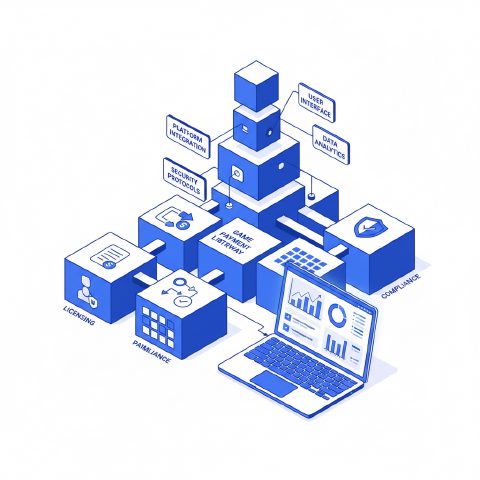
A functional blockchain casino requires five layers working together: a smart-contract game logic layer, an oracle for verifiable randomness, a wallet authentication system, a blockchain indexer for real-time state reads, and a traditional back-office for KYC, payments and CRM. Most operators bolt the first two onto an existing platform and discover the integration debt only after go-live.
Smart contracts handle the game rules and asset ownership. For a slots-style game this means a contract that accepts a wager in ERC-20 tokens, calls a randomness oracle, resolves the outcome on-chain and either mints a reward NFT or transfers tokens back to the player. Ethereum mainnet is prohibitively expensive for high-frequency micro-wagers, so most operators in 2025-2026 are deploying on Polygon, Arbitrum or Avalanche, where transaction costs are fractions of a cent rather than dollars. Immutable X and Ronin are also in use for gaming-specific chains with near-zero fees.
Chainlink VRF (Verifiable Random Function) is the dominant oracle solution for provably fair outcomes. It generates randomness off-chain, posts a cryptographic proof on-chain, and allows anyone to verify that the result was not manipulated. Competing solutions include API3's QRNG and custom commit-reveal schemes, but Chainlink has the deepest integration support and the most audited track record. If a vendor pitches you a proprietary randomness layer without a public audit, that is a red flag worth raising explicitly in contract negotiations.
Wallet authentication replaces the traditional username-and-password login. Players connect a wallet (MetaMask, WalletConnect, Coinbase Wallet) and sign a message to prove ownership. This creates a frictionless onboarding for crypto-native users but a significant barrier for everyone else. Sequence by Horizon offers an embedded wallet SDK that abstracts the complexity behind an email or social login, which is worth evaluating if your target market is not exclusively DeFi-native. The trade-off is that embedded wallets reintroduce custodial risk, partially undermining the self-custody value proposition.
The indexer is the component operators most often forget to budget for. Blockchain nodes do not serve fast, filtered queries the way a PostgreSQL database does. To show a player their NFT inventory, transaction history and real-time balance without a five-second lag, you need an indexing layer like The Graph, Moralis or a self-hosted solution. This adds ongoing infrastructure cost and a single point of failure that needs its own SLA and redundancy planning.
| Layer | Common Solutions | Approx. Build/Integration Cost | Ongoing Cost Driver |
|---|---|---|---|
| Smart Contract (game logic) | Custom Solidity, OpenZeppelin templates | $15,000-$60,000 per game type + audit | Re-audit on each upgrade |
| Randomness Oracle | Chainlink VRF, API3 QRNG | $5,000-$15,000 integration | Per-request oracle fees (fractions of cent at scale) |
| Wallet Auth | MetaMask/WalletConnect, Sequence SDK | $8,000-$25,000 | SDK licensing if using Sequence embedded wallet |
| Blockchain Indexer | The Graph, Moralis, self-hosted | $10,000-$30,000 setup | $500-$5,000/month depending on query volume |
| Traditional Back-Office | SoftSwiss, EveryMatrix, custom | $20,000-$150,000+ | Rev-share or monthly SaaS fee |
What does casino NFT games development actually involve and who are the real studios?
Casino NFT game development means building gambling mechanics where the game assets, outcomes or both are represented as on-chain tokens. It requires smart-contract engineers alongside traditional game math designers and HTML5 developers. The studio landscape is small and fragmented: a handful of crypto-native studios exist, most traditional aggregators have limited NFT capability, and many operators end up commissioning bespoke builds.
The traditional iGaming studio model (a game math team designs a slot, a front-end team builds it in HTML5, a certification lab tests the RTP and volatility) does not map cleanly onto NFT game development. You need an additional smart-contract engineer who understands both Solidity and game math, a security auditor who can assess the contract for exploits, and a UX designer who has shipped wallet-connected interfaces. That is a rare combination and it commands a premium. Expect to pay $150-$250 per hour for senior Solidity engineers with gaming experience in 2025-2026, though I would flag that rates shift with crypto market cycles.
On the studio side, Elixir Games has built a PC gaming distribution platform with NFT asset support and has worked with casino-adjacent titles. Horizon's Sequence is more of an infrastructure provider than a studio, but their toolkit is what several NFT casino projects are building on. Alchemy and Thirdweb provide developer SDKs that accelerate smart-contract deployment without requiring operators to write everything from scratch. For traditional slot content with an NFT rewards layer bolted on, a small number of studios including Spinomenal and BGaming have experimented with NFT loyalty integrations, though neither has a fully on-chain game product as of mid-2025.
The more pragmatic approach many operators are taking in 2026 is a hybrid build: run the core game logic on a proven RNG-certified platform (SoftSwiss, EveryMatrix, Softgamings) and issue NFTs as a loyalty or reward layer on top. A player earns an NFT trophy for hitting a jackpot, or holds an NFT that grants VIP access to a tournament. The gameplay itself stays off-chain and certified; the NFT layer adds collectibility and secondary market potential without requiring the entire game to pass a blockchain security audit. It is less ideologically pure but dramatically faster to market and easier to license.
Which blockchain networks are operators actually deploying NFT casinos on in 2026?
Polygon and Arbitrum dominate for cost and developer tooling reasons. Ethereum mainnet is impractical for high-frequency wagering due to gas costs. Immutable X and Ronin are gaining traction for gaming-specific use cases. Solana is fast and cheap but has a different developer ecosystem that most iGaming contractors are less familiar with.
The network choice has direct downstream effects on licensing, user experience and operating costs. Polygon (now branded as the AggLayer ecosystem) has the largest pool of iGaming-adjacent developers, the most mature NFT tooling (OpenSea compatibility, ERC-721 and ERC-1155 standards), and transaction costs that are negligible for casino-scale micro-transactions. Arbitrum offers similar EVM compatibility with stronger decentralization guarantees, which some operators prefer for marketing positioning around trustlessness.
Immutable X is purpose-built for gaming NFTs and offers zero gas fees for NFT mints and transfers through a ZK-rollup architecture. The trade-off is a more constrained ecosystem and less flexibility for custom token economics. Ronin, originally built for Axie Infinity, has rebuilt its security model after the 2022 bridge exploit and now positions itself as a gaming chain with a track record. The exploit history is worth disclosing to investors and licensing bodies even though it predates most current operators.
Solana deserves a mention because its throughput and fee structure are genuinely superior for high-frequency gaming, and projects like Rollbit built significant volume on Solana-native mechanics. However, the developer tooling diverges from EVM and most iGaming contractors are Solidity-first. Unless you have a Solana-native technical team, the recruitment cost of bridging that gap usually outweighs the performance benefits for a first launch.
| Network | Tx Cost (approx.) | EVM Compatible | NFT Standard Support | Best For |
|---|---|---|---|---|
| Ethereum Mainnet | $2-$50+ per tx | Yes | ERC-721, ERC-1155 | High-value NFT drops only, not wagering |
| Polygon (PoS / AggLayer) | <$0.01 per tx | Yes | ERC-721, ERC-1155 | General NFT casino deployment |
| Arbitrum One | <$0.05 per tx | Yes | ERC-721, ERC-1155 | Operators prioritizing decentralization story |
| Immutable X | $0 for NFT mint/transfer | Partial (StarkEx) | ERC-721 via IMX | Gaming NFT platforms, zero-fee UX |
| Ronin | <$0.001 per tx | Yes (EVM fork) | ERC-721 compatible | Gaming-focused chains with existing community |
| Solana | <$0.001 per tx | No (Rust/SVM) | Metaplex standard | High-throughput, Solana-native teams only |
How do you license an NFT casino and which jurisdictions are realistic in 2026?
Curaçao and Anjouan (Comoros) are the two most accessible licensing paths for NFT and crypto-native casinos targeting non-regulated markets. The MGA (Malta) and UKGC are technically possible but impose requirements around player fund segregation and AML that are difficult to reconcile with pseudonymous wallet play. Most NFT casino operators start offshore and layer on regulated market access later.
Curaçao completed a long-delayed gaming law overhaul in 2023-2024, replacing the old master license sublicense model with direct operator licenses issued by the Gaming Control Board of Curaçao. The new framework explicitly requires KYC on all players, which creates immediate tension with the wallet-only onboarding model many NFT casinos prefer. In practice, operators are implementing tiered verification: unverified wallets can play up to a low deposit threshold, full KYC unlocks higher limits. Whether this satisfies the new Curaçao requirements is still being tested in practice as of early 2025, so build compliance flexibility into your platform architecture from day one.
Anjouan (Union of the Comoros) has emerged as a faster and cheaper alternative to Curaçao for crypto-focused operators, with licensing fees that are meaningfully lower and a lighter-touch regulatory posture. The trade-off is lower brand credibility with payment processors and B2B suppliers who scrutinize license quality. If you are targeting a sophisticated crypto-native audience who will verify your license on-chain anyway, Anjouan can work. If you need to integrate with tier-one PSPs or major aggregators, Curaçao or MGA is a stronger foundation.
The MGA has not issued clear guidance on NFT casino mechanics as of mid-2025. Its existing framework for crypto casinos requires fiat conversion at the point of deposit and certified RNG for all game outcomes, which effectively rules out fully on-chain game logic under current rules. An operator wanting MGA coverage would need to run the hybrid model described earlier: traditional certified games with an NFT loyalty layer, where the NFTs are cosmetic or access-granting rather than representing game outcomes.
US market access remains a separate, state-by-state question. No US state that has legalized online casino gambling (New Jersey, Pennsylvania, Michigan, Connecticut, West Virginia, Delaware) has a framework for NFT casino games as of 2025. Operating an NFT casino targeting US players without state licensure is a federal Wire Act and Unlawful Internet Gambling Enforcement Act exposure that no offshore license resolves. Do not let a vendor tell you otherwise.
What does it actually cost to build and launch an NFT casino from scratch?
A minimum viable NFT casino with a hybrid model (certified games plus an NFT rewards layer) realistically costs $150,000-$400,000 to launch, excluding licensing and marketing. A fully on-chain native build with custom smart-contract games starts closer to $500,000 and can exceed $1 million before you acquire a single player. The ongoing cost structure is also heavier than a standard white-label.
Breaking the budget down: platform licensing or white-label setup with a provider like SoftSwiss or EveryMatrix runs $20,000-$80,000 upfront plus a revenue share of 15-25% on GGR. Smart-contract development for a basic NFT rewards layer (minting, wallet connection, inventory display) adds $40,000-$100,000 depending on complexity and audit requirements. A security audit from a reputable firm like Trail of Bits, OpenZeppelin or Hacken costs $15,000-$50,000 per contract suite. You cannot skip the audit if you are holding player funds in smart contracts.
The Curaçao license application under the new framework costs approximately $15,000-$30,000 in fees plus $10,000-$20,000 in legal preparation. Anjouan runs lower, around $5,000-$15,000 all-in, but factor in the bank account challenges that come with a less recognized license. Payment integration for a crypto-native casino is cheaper than fiat (no acquiring bank negotiations) but you still need a KYC provider: Sumsub, Veriff and Onfido are the standard choices at $1-$4 per verification depending on volume.
The costs that surprise operators post-launch are the operational ones. Gas fee subsidization (if you are covering network fees for players), blockchain indexer hosting, smart-contract upgrade deployments (each upgrade to a live contract requires a new audit), and player support for stuck or failed on-chain transactions. Budget at least $15,000-$30,000 per month in operational overhead before staff, which is 30-50% higher than a comparable fiat white-label operation at the same player volume.
What are provably fair games and why do they matter for an NFT casino's value proposition?
Provably fair games use cryptographic techniques, typically a blockchain oracle like Chainlink VRF, to generate game outcomes that any third party can independently verify were not manipulated. For an NFT casino, provably fair mechanics are the technical foundation of the trust argument. Without them, the NFT wrapper is cosmetic and the operator's RNG is still a black box.
The traditional casino RNG model requires players to trust that the operator has not tampered with the certified RNG and that the certification lab is independent. Most players accept this on faith, the same way they accept that a licensed brick-and-mortar casino is not running loaded dice. The provably fair model removes that trust requirement by making the randomness generation publicly auditable on-chain. Chainlink VRF works by generating a random number off-chain using a cryptographic key, posting both the result and a proof on-chain, and allowing anyone to verify that the proof is valid using the oracle's public key.
For marketing purposes, provably fair is a genuine differentiator in the crypto-native segment. Players who have been burned by opaque offshore casinos respond to the ability to verify their own game history. This is why operators like Stake and Roobet built their early brand equity around provably fair mechanics even before NFT assets entered the picture. Adding NFT ownership on top of provably fair outcomes creates a coherent product story: you own the assets, you can verify the outcomes, and neither the operator nor the platform can retroactively alter either.
The operational implication is that provably fair is not a feature you bolt on at the end. It has to be architected into the game logic from the start. Retrofitting a traditional RNG-based game with a Chainlink VRF integration after build is expensive and often requires a full re-audit. If you are commissioning custom game development, specify provably fair oracle integration in the initial scope document and make the audit a contractual deliverable, not an optional add-on.
How should operators handle KYC and AML for a wallet-based NFT casino?
Wallet-based onboarding does not exempt an operator from KYC and AML obligations under any current licensing framework. The practical approach in 2026 is tiered verification: a wallet connection enables limited play, full KYC via a provider like Sumsub or Veriff unlocks full access. On-chain analytics tools like Chainalysis or Elliptic handle transaction monitoring for crypto flows.
The tension is real and worth acknowledging directly. A core part of the NFT casino value proposition to crypto-native users is pseudonymity: connect a wallet, play, withdraw. Full KYC with a passport scan and selfie undermines that positioning. But every jurisdiction that issues a gambling license in 2025-2026 requires identity verification, and payment processors and banking partners require it regardless of what the license says. The tiered model is the industry's working compromise.
Practically, a tiered structure might look like this: wallet connection alone allows $50-$100 in cumulative deposits (enough to try the product), email verification extends that to $500, and full document KYC removes limits entirely. The thresholds need to be calibrated to your license requirements. Under the new Curaçao framework, the regulator expects full KYC before a player can make meaningful deposits. Do not set thresholds that would embarrass you in a regulatory audit.
For transaction monitoring, traditional casino AML tools are not built for on-chain flows. Chainalysis KYT (Know Your Transaction) and Elliptic both offer APIs that flag wallets associated with sanctioned entities, mixers, darknet markets and ransomware addresses. Integrating one of these at the deposit wallet stage is standard practice for any serious crypto casino operator and is increasingly expected by licensing bodies. The cost is roughly $1,000-$5,000 per month depending on transaction volume, which is not optional if you want to maintain a banking relationship or a Curaçao license in good standing.
What are the biggest risks operators discover too late when building an NFT casino?
The three risks that consistently blindside operators are smart-contract exploits after launch, secondary market dynamics that create regulatory liability, and the reality that most players do not want to manage a crypto wallet. Each one can kill a project that looked viable on paper.
Smart-contract exploits are the existential risk. Unlike a software bug in a traditional casino back-end, a vulnerability in a smart contract holding player funds can be exploited in a single transaction before anyone detects it. The Ronin bridge hack ($625 million in 2022) and the Euler Finance exploit ($197 million in 2023) are the scale markers that should inform your security budget. A $20,000 audit from a reputable firm is not optional risk management; it is the minimum viable insurance policy. And unlike software patches, fixing a live smart contract often requires a full migration to a new contract address, which means communicating to players that their existing NFTs need to be migrated, a UX nightmare that causes significant churn.
Secondary market dynamics are a regulatory risk most operators do not model. If your casino NFTs trade on OpenSea or Blur and appreciate in value, regulators in some jurisdictions will argue that the NFTs are securities or that the secondary market constitutes unlicensed financial activity. The UK FCA and US SEC have both signaled interest in gaming NFTs with financial return characteristics. If your NFT design includes any mechanic where holding the token generates passive income (staking rewards, revenue shares), you are in securities territory in most regulated markets. Keep casino NFTs as access credentials and cosmetic items, not yield-bearing instruments, unless you have explicit securities counsel clearance.
Player adoption is the commercial risk. Crypto-native players represent a real but limited market. The friction of wallet setup, gas fees (even small ones require the player to hold native tokens), and the mental overhead of managing private keys keeps the mainstream gambling audience away. Operators who build a full NFT-native experience and then try to reach a broad acquisition audience discover their conversion funnel is broken at the registration step. The hybrid model, where the NFT layer is optional and the core casino experience works with a credit card and a username, is a more defensible commercial position for 2026.
How do NFT casino revenue models compare to traditional and crypto casino models?
NFT casinos have three revenue streams a traditional casino does not: primary NFT sales, secondary market royalties and potential token economics from a native currency. These can meaningfully supplement GGR but they also introduce volatility and regulatory complexity. The core house edge on games remains the most reliable revenue line regardless of the NFT layer.
Primary NFT sales are the upfront revenue from selling in-game assets: avatar skins, VIP passes, tournament tickets, limited-edition collectibles. These are one-time sales with high margin if the collection sells out, but they require a marketing campaign, a community (typically Discord and X/Twitter), and a mint event that has its own technical and PR risks. A failed mint (gas wars, smart-contract bugs, poor demand) is damaging to brand credibility in the crypto community in a way that a bad bonus promotion is not.
Secondary market royalties are a percentage (typically 2.5-10%) of each resale transaction on a marketplace like OpenSea or a custom marketplace. ERC-2981 is the royalty standard, but enforcement has weakened as marketplaces like Blur made royalties optional to attract volume. In practice, operators should model secondary royalties as upside rather than baseline revenue. Some marketplaces enforce them; many do not.
Native token economics (issuing a platform token that players earn through play and spend on NFTs or in-game benefits) add another layer of complexity. A native token is almost certainly a security in the US under current SEC guidance unless it has no investment expectation, which is hard to argue when you are marketing token staking. Outside the US, the regulatory picture varies but is tightening. The operators who have done this successfully (Rollbit with RLB, for example) have done so in offshore jurisdictions and with significant legal spend. For a first-time operator, a native token launch is a distraction from the core casino build and a regulatory liability worth deferring.
| Revenue Stream | Traditional Casino | Crypto Casino | NFT Casino |
|---|---|---|---|
| House edge on games (GGR) | Primary revenue | Primary revenue | Primary revenue |
| Payment processing fees | Cost center | Lower cost (crypto) | Lower cost (crypto) |
| Bonus/promotion cost | Significant | Significant | Significant |
| NFT primary sales | N/A | N/A | High margin, one-time |
| Secondary market royalties | N/A | N/A | Ongoing, variable |
| Native token appreciation | N/A | Rare | Optional, high risk |
| Regulatory overhead | Medium-high | Medium | Medium-high + securities risk |
Comments
No comments yet, be the first.