Start Your Own Online Casino for Free in 2026: Separating the Myth from the Expensive Reality
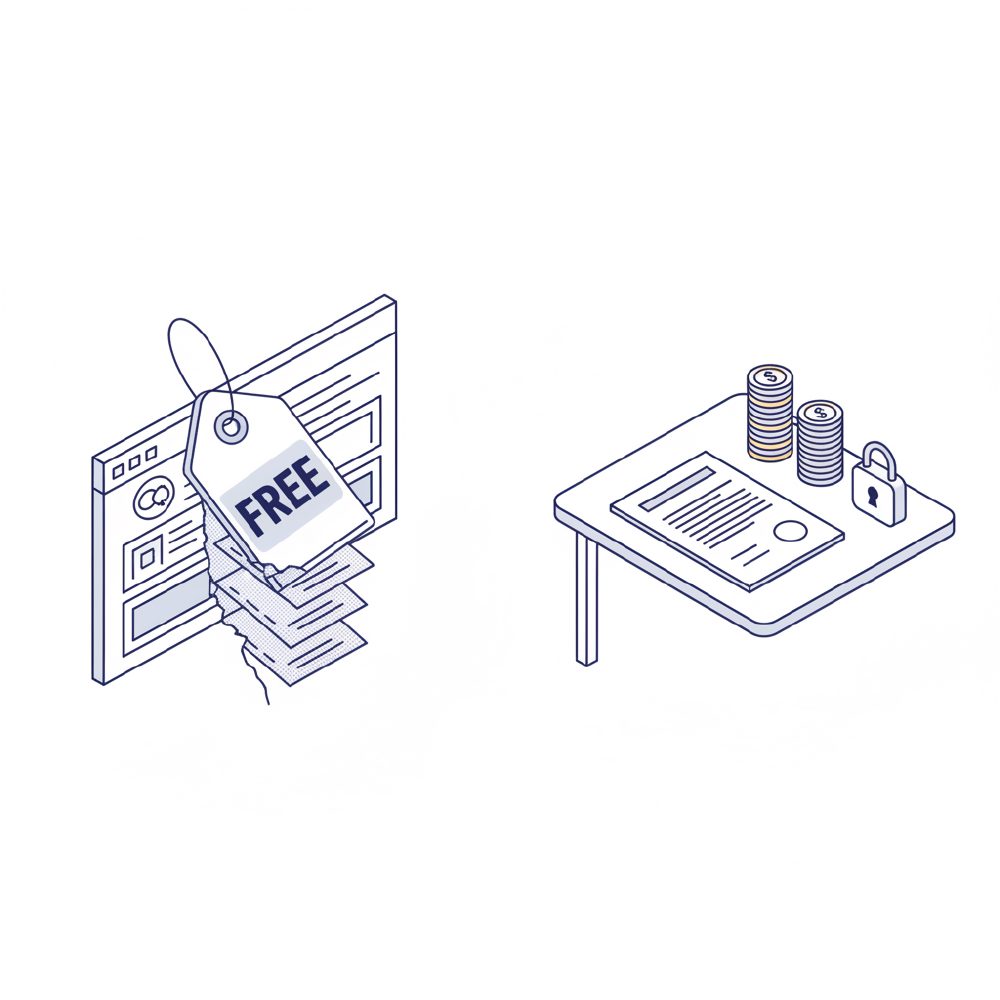
What does 'start your own online casino for free' actually mean?
In practice, 'free' means one of three things: a white-label deal where setup fees are waived in exchange for a revenue share, a sub-license arrangement where the master licensee absorbs upfront costs but takes a cut of GGR, or outright misleading vendor marketing. There is no scenario where a compliant, operational casino costs zero dollars to launch.
I've reviewed probably forty vendor decks over the years that use the phrase 'start your online casino for free' or some variation of it. Every single one buries the real cost structure two or three pages in. The 'free' part refers exclusively to the platform setup fee being waived — and that fee is often $5,000–$15,000, so the waiver is genuinely valuable. What they don't headline is the 30–50% GGR revenue share that runs in perpetuity, the payment processing reserves that can lock up $10,000–$50,000 in escrow, and the compliance costs you're on the hook for regardless of who built the platform.
The second common interpretation is a sub-license model. A master licensee — typically holding a Curaçao eGaming license or, increasingly, an Anjouan license — lets you operate under their umbrella. You skip the $25,000–$35,000 cost and 4–6 month timeline of getting your own license. But you're operating inside someone else's regulatory relationship, which means their compliance failures become your problem, and your business has no standalone regulatory standing if you ever want to sell, raise investment, or move to a better jurisdiction.
The third scenario is operators who find open-source casino software on GitHub, spin it up on a VPS, and call it a casino. This is not a business — it's a liability. Without licensing, payment processing is impossible through any legitimate PSP, and you're operating illegally in virtually every market. The 'free' launch costs nothing until it costs everything.
What are the real minimum costs to start an online casino in 2026?
The absolute floor for a compliant, operational white-label casino in 2026 sits around $15,000–$30,000 in first-year costs, assuming you use a sub-license, a white-label platform on revenue share, and lean affiliate marketing. A standalone Curaçao license plus turnkey platform pushes that to $80,000–$150,000 before you acquire a single player.
Let me break this down component by component, because operators consistently underestimate the non-platform costs. The platform itself — whether you go with SoftSwiss's white-label product, EveryMatrix's CardsChat-era stack, or a smaller provider like Slotegrator — will run either a setup fee ($5,000–$20,000) plus monthly SaaS ($2,000–$5,000), or a revenue share of 30–50% GGR with setup waived. Neither is free. The revenue share model defers cash outlay but is far more expensive over a 24-month horizon if your casino performs.
Licensing is the cost that surprises operators most. A Curaçao eGaming license (now operating under the updated GCB framework as of 2023) runs roughly $25,000–$35,000 in the first year including application fees, registered agent, and compliance setup. Anjouan (ACGC) is cheaper at around $10,000–$15,000 but carries less market acceptance. An MGA license in Malta starts at €25,000 in application fees alone and requires a physical presence, a compliance officer, and typically 12–18 months to obtain. Sub-licensing under an existing master license cuts this to $5,000–$15,000 annually but, as noted, with significant trade-offs.
Then there's the stack nobody puts in the pitch deck: KYC/AML tooling (Sumsub, Onfido, or Shufti Pro will cost $0.50–$3.00 per verification), responsible gambling modules, SSL and security infrastructure, a payment gateway setup (most PSPs require a reserve of 5–10% of monthly processing volume held in escrow), and legal review of your T&Cs and bonus terms. Budget a minimum of $5,000–$10,000 for this layer. Add $3,000–$8,000 for a basic website build if your white-label provider doesn't include it. You're at $30,000–$70,000 before marketing spend, which is where most new operators actually run out of runway.
| Cost Component | Sub-License + WL Rev-Share | Own Curaçao License + WL SaaS | Own MGA License + Turnkey |
|---|---|---|---|
| Licensing / Sub-license fee | $5,000–$15,000/yr | $25,000–$35,000/yr | $50,000–$100,000+/yr |
| Platform setup fee | $0 (waived for rev-share) | $5,000–$15,000 | $20,000–$60,000 |
| Platform monthly / GGR share | 30–50% GGR | $2,000–$5,000/mo | $3,000–$8,000/mo |
| KYC/AML tooling | $2,000–$5,000 | $2,000–$5,000 | $5,000–$15,000 |
| Payment processing reserve | $10,000–$30,000 | $10,000–$50,000 | $20,000–$100,000 |
| Legal, T&Cs, compliance setup | $3,000–$8,000 | $5,000–$15,000 | $15,000–$40,000 |
| Website / UX (if not included) | $2,000–$6,000 | $3,000–$10,000 | $10,000–$50,000 |
| Realistic Year 1 total (ex-marketing) | $22,000–$64,000 | $52,000–$130,000 | $120,000–$373,000+ |
Can you legally start an online casino without a license?
No. Operating an online casino without a license is illegal in every regulated market and most offshore jurisdictions. Beyond the legal exposure, unlicensed operators cannot access legitimate payment processing, cannot partner with reputable game studios, and build a business with no exit value. The risk-reward calculation is straightforwardly bad.
I want to be direct here because some vendor content implies you can 'test the market' before getting licensed. You cannot. In the US, online gambling without state authorization is a federal violation under the Wire Act and potentially UIGEA. In the EU, operating without a local license in markets like Germany (DSWV framework), Sweden (Spelinspektionen), or the Netherlands (KSA) exposes you to criminal prosecution and bank account seizures — not just fines. Even in offshore markets, operating without at least a sub-license from a recognized authority means no legitimate PSP will touch your merchant account.
The practical consequence is that an unlicensed casino is forced into grey-market payment processing — typically crypto-only or through high-risk processors charging 8–15% per transaction with no chargebacks protection. That's not a business model; it's a cash drain that makes player acquisition economics impossible. Game studios like Play'n GO, Pragmatic Play, and NetEnt won't supply content to unlicensed operators, which means you're stuck with cloned or pirated games — another legal exposure.
Licensing also matters for your exit. If you ever want to sell the business, raise institutional capital, or migrate to a better jurisdiction, a properly licensed operation has standalone value. A sub-licensed or unlicensed operation is essentially worthless to any sophisticated buyer because the regulatory relationship doesn't transfer. Operators who cut this corner in year one spend years trying to fix it later, usually at far greater cost than doing it right from the start.
What do white-label casino providers actually offer 'for free'?
White-label providers waive setup fees in exchange for a long-term GGR revenue share, typically 30–50%. What you get: a pre-built back office, game aggregation, basic payment integrations, and a license sub-license in some cases. What you don't get: ownership of the platform, direct game studio relationships, or the ability to negotiate your own payment terms.
SoftSwiss, EveryMatrix, Slotegrator, and BetConstruct all offer some version of a white-label product where the upfront cost is either zero or minimal in exchange for a revenue share. This is a legitimate and often sensible model for first-time operators — the platform risk is lower, time-to-market is 4–12 weeks versus 6–18 months for a custom build, and you're inheriting a proven compliance framework. But 'free setup' is a marketing frame, not an economic reality.
The revenue share compounds fast. If your casino generates $100,000 GGR in month six, a 40% platform share means $40,000 leaves before you've paid for marketing, customer support, or your own salary. At $500,000 GGR monthly — a reasonable target by year two for a well-run operation — you're handing $200,000/month to the platform provider. Over 24 months, that dwarfs any setup fee you might have paid. Operators who model this out properly often find that a turnkey or custom build with a higher upfront cost breaks even by month 18–24.
There's also the question of what 'included' actually means. Most white-label packages include access to a game aggregator's catalog (Relax Gaming, Pariplay, Softswiss's own aggregator) but the individual studio rev-shares are still embedded in your GGR calculation. Payment integrations are typically pre-built for a handful of providers — Skrill, Neteller, maybe a crypto gateway — but adding a new PSP or a local payment method for a specific market costs extra. Responsible gambling tools like self-exclusion, deposit limits, and reality checks are often included at the basic level but advanced RG modules (required in MGA and UKGC jurisdictions) are add-ons.
My honest take: white-label on revenue share is the right starting point for operators with limited capital who want to validate a market before committing to a full build. Just go in with eyes open about the long-term GGR bleed and negotiate a buyout clause or a step-down in the revenue share percentage as your volume grows. Most providers will negotiate this if you push.
How does a sub-license arrangement compare to getting your own gambling license?
A sub-license lets you operate under a master licensee's regulatory umbrella for $5,000–$15,000 per year, avoiding the 4–12 month application process. Your own Curaçao or Anjouan license costs $20,000–$35,000 in year one but gives you full regulatory standing, direct relationships with payment processors, and a sellable business asset.
Sub-licensing is how most new operators enter the market, and it's not inherently bad — it's just a different risk profile. The master licensee (often the same company as your white-label platform provider) holds the Curaçao eGaming or Anjouan ACGC license, and you operate as a sub-licensee under their compliance framework. This means their AML policies, their responsible gambling procedures, and their relationship with the regulator all apply to you. If they have a compliance failure, your operation can be suspended. If they decide to exit the market or raise their sub-license fees, you have limited recourse.
The practical upside is speed and cost. You can be operational in 4–8 weeks versus 4–6 months for your own Curaçao license. The compliance burden is lighter because the master licensee handles the regulator relationship. And the entry cost is dramatically lower — $5,000–$15,000 annually versus $25,000–$35,000 for a standalone Curaçao license in year one, plus the ongoing registered agent, compliance officer, and audit costs that come with owning your own license.
The inflection point where your own license makes more sense is typically around $50,000–$100,000 monthly GGR. At that volume, the cost of your own license is a rounding error compared to the strategic value: direct PSP relationships (lower processing fees, higher volume limits), the ability to negotiate directly with game studios, and a business that has standalone regulatory value if you want to sell or raise capital. I generally advise operators to launch on a sub-license, prove the market, and migrate to their own license within 18–24 months.
| Factor | Sub-License | Own Curaçao License | Own MGA License |
|---|---|---|---|
| Year 1 cost | $5,000–$15,000 | $25,000–$35,000 | $50,000–$100,000+ |
| Time to operational | 4–8 weeks | 4–6 months | 12–18 months |
| Regulatory independence | None — dependent on master | Full | Full |
| PSP relationship | Via master licensee | Direct | Direct (premium terms) |
| Market acceptance | Limited (some PSPs/studios refuse) | Broad offshore acceptance | Full EU/regulated market access |
| Business sellability | Low | Medium | High |
| Compliance burden | Shared with master | Yours entirely | Yours entirely (heavy) |
| Best for | First-time operators, market validation | Established operators scaling | EU-regulated market entry |
What costs can you legitimately defer or minimize at launch?
You can defer platform ownership costs through revenue share, defer content costs through aggregator rev-share deals, and defer paid marketing by leading with affiliate partnerships. You cannot defer licensing, KYC/AML tooling, payment reserves, or legal review — these are non-negotiable from day one regardless of what a vendor's sales deck implies.
There's a meaningful difference between 'free' and 'deferred.' Smart operators minimize upfront cash outlay by choosing revenue share over setup fees where the economics make sense, by using a game aggregator (Pariplay, Relax Gaming, Hub88) instead of direct studio deals — aggregators handle the studio contracts and rev-share in exchange for a margin on GGR — and by launching affiliate-first rather than burning cash on paid media before you know your player LTV.
Affiliate marketing deserves more credit than it gets in the 'how to launch cheap' conversation. A well-structured CPA or rev-share affiliate program costs nothing upfront — you pay per depositing player or share a percentage of their lifetime GGR. The trade-off is slower ramp-up and the need to build affiliate relationships, which takes time. But for operators with limited capital, it's far more sustainable than spending $30,000/month on Google or Meta ads before you've proven your conversion funnel.
Crypto-native launches are another legitimate cost-reduction lever. Accepting Bitcoin, Ethereum, and stablecoins through a crypto payment gateway (Coinspaid, B2BinPay) eliminates the PSP reserve requirement — typically the single largest cash drain in a traditional launch — and reduces processing fees to 0.5–2% versus 3–8% for card payments. The trade-off is a narrower addressable market and, in some jurisdictions, additional regulatory scrutiny around crypto AML compliance.
What you genuinely cannot cut: a KYC/AML solution is required under every reputable license and every legitimate PSP's merchant agreement. Responsible gambling modules are legally mandated under Curaçao's updated GCB framework (effective 2023) and any EU license. Legal review of your T&Cs, bonus terms, and privacy policy is not optional — a poorly drafted bonus term has cost operators six figures in dispute resolutions. These are the costs that 'free launch' marketing never mentions.
What hidden costs do operators discover too late after a 'free' launch?
The costs that blindside operators post-launch are payment processing reserves and chargebacks, customer support infrastructure, fraud and bonus abuse losses, ongoing compliance audits, and game content licensing fees that weren't fully disclosed in the aggregator agreement. Budget for all of these before you go live, not after.
Payment reserves are the most common cash shock. When you onboard a PSP — whether it's a traditional acquirer or a high-risk processor — they typically hold 5–10% of your monthly processing volume in a rolling reserve for 90–180 days. If you're processing $200,000/month in deposits, that's $10,000–$20,000 locked up and unavailable. As volume grows, so does the reserve. Operators who didn't model this into their working capital requirements have found themselves operationally cash-positive but unable to pay suppliers because the reserve ate their liquidity.
Chargebacks are the second shock. Casino is a high-chargeback vertical — players who lose sometimes dispute transactions with their bank, and a chargeback rate above 1% will get your merchant account terminated. Preventing chargebacks requires investment in fraud detection tooling (Kount, Sift, or similar), manual review processes, and a responsive customer support team that can resolve disputes before they escalate. None of this is free, and none of it is typically included in a white-label 'free setup' package.
Bonus abuse is a cost that's almost impossible to quantify in advance but hits every new casino. Without proper bonus abuse detection — velocity checks, device fingerprinting, linked account detection — you will lose money to bonus hunters in the first 90 days. I've seen operators lose $20,000–$50,000 in bonus abuse before they tightened their systems. The tools to prevent this (most back-office platforms have basic versions; more sophisticated operators use dedicated fraud platforms) cost money, but far less than the alternative.
Finally, ongoing compliance costs are chronic and underestimated. Annual license renewals, quarterly compliance audits (required under Curaçao's updated framework), AML transaction monitoring, and keeping up with regulatory changes across your target markets — Germany's state treaty amendments, Netherlands KSA requirements, US state-by-state shifts — require either a dedicated compliance resource or an external consultant. Budget $1,500–$5,000/month for this layer once you're operational.
How does the 'free' model differ across US, EU, and offshore markets?
The 'free launch' pitch is almost exclusively an offshore phenomenon — Curaçao, Anjouan, Costa Rica. In the US, state licensing costs $500,000–$10M+ and requires a physical presence; there is no white-label rev-share shortcut. In the EU, MGA, UKGC, and national licenses require substantial capitalization and compliance infrastructure. Offshore is where the cost compression is possible, and even there, 'free' is a misnomer.
US iGaming is the most expensive regulated market to enter. States that have legalized online casino gambling — New Jersey, Pennsylvania, Michigan, Connecticut, West Virginia, and Delaware as of 2026 — all require operators to partner with a land-based licensee (a 'skin' model), pay application fees ranging from $100,000 to $500,000+, post a surety bond, and maintain minimum capitalization. The total cost of a legitimate US state license, including legal fees, compliance infrastructure, and the land-based partnership, is realistically $2M–$10M before you've acquired a player. There is no 'free' version of this. Any vendor claiming otherwise is selling you something that isn't a US license.
EU markets are similarly unforgiving. An MGA license in Malta is the most common choice for EU-facing operators — it's €25,000 in application fees, requires a physical Malta office, a locally resident compliance officer, and minimum share capital of €100,000. The UKGC is even more demanding: £17,000–£47,000 in application fees depending on license type, extensive due diligence on all key persons, and ongoing regulatory fees tied to gross gambling yield. Germany's DSWV framework (Interstate Treaty on Gambling, updated 2021) adds another layer with strict advertising restrictions and mandatory integration with OASIS, the national self-exclusion register.
Offshore markets — primarily Curaçao (GCB), Anjouan (ACGC), and to a lesser extent Isle of Man and Gibraltar for mid-tier operators — are where the 'free launch' narrative has any basis in reality. Sub-licensing and white-label revenue share deals exist here because the regulatory framework is lighter and the license costs are manageable for small operators. But even here, 'free' means deferred costs, not absent costs. The operators who succeed offshore are the ones who treat it as a proving ground, not a permanent home.
What should you actually budget for a realistic low-cost casino launch in 2026?
A realistic minimum budget for a compliant, operational online casino in 2026 — white-label platform on revenue share, sub-license, lean affiliate marketing, basic payment stack — is $25,000–$50,000 in working capital for the first six months. Below $25,000, you're either cutting compliance corners or not actually launching a real business.
Here's how I'd structure a lean but legitimate launch budget for 2026. Start with a sub-license under a Curaçao or Anjouan master licensee: $8,000–$12,000 for the first year. Choose a white-label platform on revenue share — SoftSwiss, Slotegrator, or a smaller provider like Digitain — with setup waived: $0 upfront, 35–45% GGR ongoing. Budget $3,000–$5,000 for legal review of your T&Cs, privacy policy, and bonus terms — don't skip this. KYC/AML tooling via Sumsub or Shufti Pro: $2,000–$3,000 for the first year at modest volume. Basic responsible gambling module: usually included in the white-label package, but verify this explicitly.
Payment processing is where you need to be realistic. If you're going crypto-first (Coinspaid, B2BinPay), your reserve requirement is near zero and setup fees are minimal — budget $1,000–$2,000 for integration and testing. If you want card payments from day one, budget $15,000–$25,000 in reserve capital that will be locked up by your PSP. This is the single biggest variable in your launch budget and the one most operators underestimate.
For marketing, an affiliate-first approach costs nothing upfront — you pay CPA ($150–$400 per depositing player is typical for casino) or rev-share (25–40% of player GGR to the affiliate) only when players convert. Budget $2,000–$5,000 for affiliate platform setup (Income Access, MyAffiliates, or Affilka by SoftSwiss) and initial outreach. Add $3,000–$5,000 for a customer support setup — at minimum, a ticketing system and 2–3 part-time agents. Total working capital requirement: $30,000–$55,000 for a six-month runway, excluding the GGR share that goes to the platform and affiliates.
The operators I've seen fail at this budget level almost always made the same mistake: they allocated too much to the platform and too little to working capital for the payment reserve and first-month operating costs. Get your payment stack sorted and funded before you spend a dollar on marketing.
What are the risks of choosing a 'free' white-label deal over a proper turnkey setup?
The primary risks are long-term GGR bleed, platform dependency, limited customization, and no exit value from the platform relationship. A 40% GGR share that looks manageable at $50K monthly GGR becomes a $200K/month cost at $500K GGR — at that point, you've funded the platform provider's business, not your own.
Revenue share dependency is the structural risk that most operators don't model properly at launch. When you're generating $20,000/month GGR, a 40% share costs $8,000 — tolerable. When you've grown to $300,000/month GGR, that same percentage costs $120,000/month, or $1.44M annually. At that point, you're almost certainly better off owning your own platform or negotiating a flat-fee arrangement. Most white-label contracts include a buyout clause or a step-down schedule, but only if you negotiated it upfront. If you didn't, you're locked in at the original rate until contract renewal.
Platform dependency also means you have limited control over the product roadmap. If your platform provider is slow to integrate a new payment method that's critical for your target market — say, PIX for Brazil or UPI for India — you're at their mercy. If they have a technical outage, your casino is down. If they decide to sunset a feature or change their API, you have to adapt on their timeline. Operators who've scaled to meaningful volume on white-label often describe this as the moment they realized they'd built their business on someone else's infrastructure.
Customization limits are a real competitive disadvantage. White-label platforms are designed to serve dozens or hundreds of operators simultaneously, which means the product is necessarily generic. Differentiating your casino through unique UX, proprietary bonus mechanics, or exclusive game integrations is either impossible or requires expensive custom development on top of the white-label base — at which point you're paying both the rev-share and development costs.



Comments
No comments yet, be the first.