How to Open an Online Casino in 2026: The Complete Stack, Platform & Provider Selection Guide
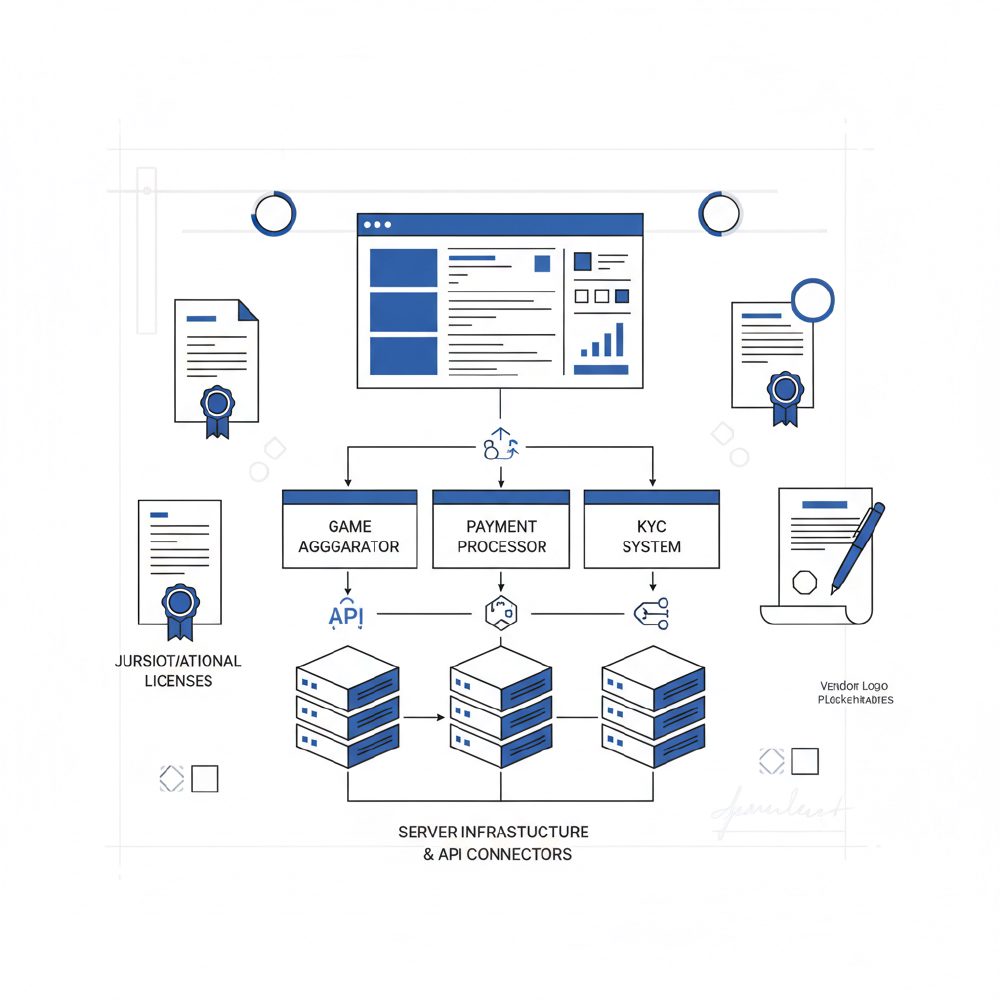
What are the real differences between white-label, turnkey and custom casino platforms?
White-label gets you live in 4–8 weeks under a master license, sharing revenue with the platform provider. Turnkey gives you your own license and more control, but takes 3–6 months and costs significantly more. A custom build means owning everything — and spending $500K+ before launch. The right choice depends on your capital, target market, and long-term margin goals.
White-label solutions — think SoftSwiss White Label, EveryMatrix's turnkey suite, or BetConstruct — bundle the platform, game content, and often a sub-license under the provider's master Curaçao or MGA license. You get to market fast, and the provider handles most compliance overhead. The trade-off is a revenue share that typically runs 15–30% of GGR on top of a monthly platform fee, and you're operating under someone else's license, which limits your banking options and brand independence. For operators testing a new market with under $150K in startup capital, this is often the only realistic path.
Turnkey casino software — from vendors like Softswiss (separate from their white-label), Digitain, or GamMatrix — gives you a licensed, feature-complete back-office that you deploy under your own regulatory license. You're buying the software outright or on a SaaS model, so the revenue-share obligation disappears or shrinks dramatically. The catch: you need your own license first, which adds 3–12 months to your timeline depending on jurisdiction, and you're responsible for integrating payments, KYC providers, and game content yourself. Budget $150K–$400K for a credible turnkey launch including license fees.
Custom builds are almost never the right first move. I've seen operators spend 18 months and $600K building proprietary platforms that still couldn't match the feature parity of a $30K/month SaaS platform. The only scenario where custom makes sense is if you have a genuinely differentiated product concept — a specific vertical, a novel mechanic — that no existing platform supports, and you have the engineering team to maintain it post-launch. Otherwise, you're paying to reinvent the back-office while your competitors are already acquiring players.
One thing vendors consistently undersell: migration cost. If you launch on a white-label and later want to move to your own license and platform, expect 3–6 months of parallel operation, potential player data portability issues, and a fresh KYC cycle for your entire player base. Build your exit strategy into the initial vendor contract, not as an afterthought.
| Model | Time to Market | Startup Cost Range | Revenue Share to Provider | License Required | Best For |
|---|---|---|---|---|---|
| White-Label | 4–8 weeks | $30K–$80K | 15–30% GGR | No (sub-license) | First-time operators, lean capital |
| Turnkey SaaS | 3–6 months | $150K–$400K | 0–5% (platform fee model) | Yes (your own) | Operators with funding and market clarity |
| Custom Build | 12–24 months | $500K+ | 0% | Yes (your own) | Funded operators with unique product differentiation |
Which online casino license should you get — Curaçao, MGA, or a US state license?
Curaçao is the fastest and cheapest entry point for offshore and crypto operations, but post-2023 reforms have tightened requirements considerably. The MGA license is the gold standard for EU markets and unlocks better payment rails, but costs €25,000+ in fees and takes 9–18 months. US state licenses are market-specific, expensive, and non-transferable — you need one per state you operate in.
The Curaçao Gaming Authority (CGA) overhauled its licensing framework in 2023, replacing the old master/sub-license model with direct operator licenses. A new CGA license now requires a local representative, AML/KYC policies, technical compliance checks, and runs $25,000–$35,000 in government fees, plus $15,000–$25,000 in legal and consultancy costs. Processing time is 3–6 months if your application is clean. The license still carries a reputational discount in regulated EU markets, but it's perfectly functional for LATAM, Asia, and crypto-focused operations. Many operators I've advised use Curaçao to launch fast, generate revenue, and then fund an MGA or UKGC application from operating cash flow.
The Malta Gaming Authority (MGA) license is a different animal entirely. The B2C Gaming Service License costs €25,000 in application fees, €25,000 annually in compliance contributions, plus a Player Protection Fund contribution based on GGR. Legal preparation and consultancy adds another €30,000–$80,000 before you've paid a single government fee. Timeline is realistically 12–18 months for a first-time applicant. What you get in return is significant: EU payment processing access, trust from major game studios who restrict content to licensed operators, and the ability to market in most EU member states. If your target market is Western Europe, there's no shortcut around this.
US state licenses are a category of their own. New Jersey, Pennsylvania, Michigan, and Connecticut each require a separate application, state-specific technical certification, and partnerships with a land-based licensee in most cases. New Jersey's Division of Gaming Enforcement (DGE) application alone can cost $100,000–$200,000 in fees and legal work, and that's before platform certification. The upside is access to a regulated, high-value player base with legitimate banking. Don't attempt a US state license without a specialized gaming attorney and a realistic 18–24 month runway.
Anjouan (Comoros) and Isle of Man licenses are worth mentioning as alternatives. Anjouan has become a popular low-cost option ($15,000–$20,000 range) for operators who want something cheaper than post-reform Curaçao, but payment processor acceptance is narrower. The Isle of Man license sits between MGA and Curaçao in terms of credibility and cost — respected by most EU processors but less recognized by players than Malta branding.
| Jurisdiction | Govt. Fee Range | Timeline | Annual Renewal | EU Payment Access | Best Market Fit |
|---|---|---|---|---|---|
| Curaçao (CGA) | $25K–$35K | 3–6 months | $10K–$15K | Limited | Offshore, LATAM, Crypto |
| Malta (MGA) | €25K + €25K/yr | 12–18 months | €25K contrib. | Full | EU, UK-adjacent markets |
| Anjouan | $15K–$20K | 2–4 months | $5K–$10K | Narrow | Crypto, emerging markets |
| Isle of Man | £5K–£35K | 6–12 months | £5K–£35K | Good | EU, UK operators |
| US State (NJ/PA) | $100K–$200K+ | 18–24 months | Variable | Full (domestic) | US regulated market only |
How do casino game aggregators work, and which ones should you evaluate first?
A game aggregator connects your platform to hundreds or thousands of game studios through a single API and revenue-share contract, replacing dozens of direct studio integrations. The major aggregators — SoftSwiss Game Aggregator, EveryMatrix CasinoEngine, Relax Gaming, Pariplay, and Hub88 — each have different studio rosters, certification coverage, and commercial structures. Your license jurisdiction determines which aggregators will actually work with you.
The aggregator model exists because direct studio integrations are expensive and slow. A direct deal with a studio like Pragmatic Play or Evolution typically requires a minimum monthly guarantee ($5,000–$20,000 depending on the studio), a separate technical integration (4–8 weeks of dev work), and jurisdiction-specific content certification. Multiply that across 20 studios and you're looking at 6+ months of integration work before you have a competitive game lobby. An aggregator compresses that into one API, one contract, and one revenue-share negotiation — typically 1–5% of GGR on top of the studio's own cut.
SoftSwiss Game Aggregator (SGGA) is worth evaluating first if you're on a SoftSwiss casino platform, since it's native to the ecosystem and reduces integration friction. It carries 14,000+ games from 200+ providers as of 2025. EveryMatrix CasinoEngine is strong if you need a standalone aggregator that works with third-party platforms — their certification coverage across MGA, UKGC, and Curaçao jurisdictions is broad. Relax Gaming operates a hybrid model: they're both a studio and a distribution network through their Silver Bullet and Powered By Relax programs, which is interesting if you want exclusive content alongside aggregated titles.
Hub88 and Pariplay (now part of Fortuna Entertainment Group) are worth considering for operators targeting LATAM and emerging markets — their local studio relationships and LatAm-specific content libraries are stronger than the European-focused aggregators. For live casino specifically, you'll likely need a direct deal with Evolution, Pragmatic Play Live, or Ezugi regardless of your aggregator, since live content is rarely aggregated under the same terms as slots.
The clause operators miss most often in aggregator contracts: the minimum monthly guarantee floor and the exclusivity restrictions on certain studio content. Some aggregators require you to route all traffic for specific studios through their platform even if you later secure a direct deal. Read the content exclusivity schedule carefully before signing, and make sure your platform provider's API is certified with your chosen aggregator — mismatched certifications have delayed launches by months.
What does it actually cost to open an online casino in 2026?
A lean offshore white-label launch runs $50,000–$120,000 all-in. A properly licensed turnkey operation targeting EU or LATAM markets costs $200,000–$500,000 before first deposit. US state market entry is $500,000–$1M+ minimum. The figures vendors quote in sales calls cover software and licensing — they rarely include payment deposits, marketing, and the 6–12 months of operating losses before profitability.
Let me break the actual cost buckets down the way I'd do it for an operator building a launch budget. Licensing is the most variable line: Curaçao adds $40,000–$60,000 (fees plus legal), MGA adds $80,000–$150,000, and a US state license is $150,000–$300,000 before you've touched the platform. Platform costs depend on your model: white-label setup fees run $10,000–$30,000 plus ongoing revenue share; turnkey SaaS platforms charge $15,000–$50,000 in setup and $5,000–$20,000/month in licensing fees. Game aggregator setup fees add another $5,000–$15,000.
Payment infrastructure is where budgets blow up. Acquiring banks for iGaming typically require a rolling reserve of 5–10% of processing volume held for 90–180 days — on $500K/month in deposits, that's $25,000–$50,000 tied up before you see it. You'll also need KYC/AML vendor contracts (Sumsub, Onfido, or Jumio run $0.50–$3.00 per verification depending on volume), responsible gambling tools, and fraud screening. Budget $2,000–$8,000/month for compliance tech stack depending on player volume.
Marketing is the line that kills more launches than technical failures. Player acquisition in competitive markets costs $200–$600 CPA for a depositing player, or 20–40% revenue share on affiliate deals. Operators who launch with $50,000 in marketing budget and expect organic growth are almost universally disappointed. A realistic first-year marketing budget for a new operator in a competitive market is $100,000–$300,000, and that's before brand building. Factor in 6–12 months of operating losses while you build your player base — undercapitalized operators consistently fail at this stage.
Total realistic ranges: offshore white-label with Curaçao license, $80,000–$150,000 all-in including 3 months of operating costs; MGA-licensed turnkey with proper payment stack, $350,000–$600,000; US state-licensed operation, $700,000–$1.5M minimum. These aren't worst-case figures — they're what competent operators actually spend. The $20,000 casino launch packages you'll find advertised online don't include a working payment stack, legal compliance, or marketing. They're a skeleton, not a business.
How do you build a payment stack that actually converts for an online casino?
A functional casino payment stack needs at minimum one card acquirer, one crypto processor, and one local APM for your target market — before launch, not after. The mistake operators make is treating payments as an afterthought, then discovering that high-risk card acquiring takes 6–12 weeks to approve and that your backup processor has a 40% decline rate on first deposits.
Card acquiring for iGaming is high-risk by definition, and the acquiring market is thin. The processors operators actually use include Payvision (now ING), Nuvei, Unlimint, Safecharge (Nuvei again), and a handful of smaller offshore acquirers. Expect interchange-plus pricing at 3–5% for card-not-present iGaming transactions, plus chargeback fees of $20–$50 per dispute. Most acquirers require a 6–10% rolling reserve for the first 6 months. If your chargeback ratio exceeds 1%, you'll lose the account — this is non-negotiable and the reason fraud screening tools like Kount or Sift are not optional.
Crypto payment rails have become a genuine primary channel, not just a fallback, for offshore operators. Processors like Coinspaid, B2BinPay, and TripleA handle crypto-to-fiat conversion and wallet management. The advantage is no chargebacks, lower fees (typically 0.5–1%), and faster settlement. The disadvantage is that crypto-native players represent a specific demographic — you need to design your bonus and loyalty mechanics around them separately. For operators targeting LATAM or Southeast Asia, crypto often outperforms cards in both conversion and retention.
Local APMs are non-negotiable for market-specific conversion. In Brazil, Pix is mandatory — a casino without Pix integration is invisible to the majority of Brazilian depositors. In Mexico, SPEI and OXXO cash deposits matter. In Europe, Trustly (bank transfer), Skrill, and Neteller remain standard. In Canada, Interac. Each APM integration adds 2–6 weeks of technical work and a separate commercial agreement. Don't assume your platform provider has all of these pre-integrated — check the actual live integration list, not the marketing page, before signing.
The payment stack architecture I recommend for a new operator: primary card acquirer for EU/US cards, Coinspaid or equivalent for crypto, Trustly for European bank transfers, and one market-specific APM for your primary target geography. Set up your payment routing rules in the back-office so that declined card transactions automatically offer the crypto or APM alternative — that single routing rule can recover 15–25% of otherwise lost deposits. Build the redundancy before launch; finding a backup acquirer after your primary account gets frozen is a terrible position to negotiate from.
What KYC, AML and responsible gambling tools do you need to integrate before launch?
Every licensed online casino needs automated KYC identity verification, AML transaction monitoring, and responsible gambling controls built into the platform before accepting real-money deposits. These aren't optional compliance checkboxes — regulators audit them, payment processors require them, and missing them creates personal liability for directors in MGA and UKGC jurisdictions.
KYC verification vendors worth evaluating: Sumsub is the most operator-friendly for iGaming, with pre-built flows for document verification, liveness checks, and PEP/sanctions screening. Onfido is strong for UK and EU markets. Jumio handles high-volume operations well. Pricing is per-verification and typically $1.50–$4.00 for a full document + liveness check at low volumes, dropping to under $1.00 at scale. Build your KYC triggers into the platform from day one — most regulators require identity verification before a player can withdraw, and many (MGA, UKGC) require it before a player can deposit above a threshold.
AML transaction monitoring is separate from KYC. You need a system that flags unusual deposit patterns, structuring behavior, and high-velocity transactions for manual review. Some platforms (SoftSwiss, EveryMatrix) include basic AML rule engines natively. For MGA or UKGC operations, you'll likely need a dedicated AML tool like SEON, Featurespace, or ComplyAdvantage layered on top. The compliance officer reviewing flagged transactions needs to be a real person with documented procedures — regulators will ask for SAR (Suspicious Activity Report) logs during audits.
Responsible gambling tools are increasingly a licensing requirement, not just best practice. MGA mandates deposit limits, loss limits, session time limits, self-exclusion, and reality checks. Curaçao's 2023 reforms added similar requirements. Integration with national self-exclusion registers (GAMSTOP in the UK, OASIS in Germany, Spelpaus in Sweden) is mandatory in those markets. Most platform providers include basic RG tools, but make sure the self-exclusion function actually blocks the player immediately across all channels — I've seen implementations where a self-excluded player could still access the mobile app for 24 hours due to a caching issue. That's a regulatory incident waiting to happen.
How long does it take to open an online casino from decision to first deposit?
A white-label offshore launch can realistically go live in 8–12 weeks if licensing is already in place. A turnkey operation with a new Curaçao license takes 4–7 months. An MGA-licensed launch takes 12–20 months from application to live operation. US state market entry is 18–30 months. The bottleneck is almost always licensing and payment onboarding, not platform development.
The timeline most operators underestimate is payment onboarding. Card acquirer approval for a new iGaming operator takes 6–12 weeks after submitting a complete application — which itself requires your license certificate, AML policies, company incorporation documents, and a working platform demo. If your license isn't issued yet, you can't start the acquirer application. These processes don't run in parallel as cleanly as operators hope. I've seen launches delayed 3 months purely because the operator assumed payment approval would happen faster than the license.
Platform technical setup is usually the fastest part of the process. A white-label provider like SoftSwiss or BetConstruct can have a branded casino environment configured in 2–4 weeks once you've signed the contract and provided brand assets. Game content is pre-integrated. The bottleneck is the legal and compliance layer: terms and conditions drafting, privacy policy, responsible gambling policy, and jurisdiction-specific content restrictions all need legal review before you go live. Budget 3–4 weeks for legal documentation even if your platform is technically ready.
Realistic end-to-end timelines by model: white-label with existing sub-license (fastest path) — 6–10 weeks; white-label with new Curaçao license — 4–6 months; turnkey with MGA license — 14–20 months; US state-licensed operation — 20–30 months. These assume no major application rejections or technical certification failures. A rejected license application or a failed platform technical audit can add 3–6 months. Build contingency into your budget accordingly — most operators plan for the optimistic timeline and run out of runway when reality hits.
| Launch Model | License | Platform Setup | Payment Onboarding | Total Realistic Timeline |
|---|---|---|---|---|
| White-Label (sub-license) | 0 (existing) | 2–4 weeks | 4–6 weeks | 6–10 weeks |
| White-Label + New Curaçao | 3–5 months | 2–4 weeks | 6–10 weeks | 4–6 months |
| Turnkey + New Curaçao | 3–5 months | 6–10 weeks | 8–12 weeks | 5–8 months |
| Turnkey + MGA License | 12–18 months | 8–12 weeks | 8–12 weeks | 14–20 months |
| US State License (NJ/PA) | 18–24 months | 12–20 weeks | Concurrent | 20–30 months |
What back-office and CRM features should you demand from your platform vendor?
The back-office is where your margins live. Demand real-time player reporting, configurable bonus engine, manual payment approval workflows, segmentation-based CRM, and affiliate management as baseline requirements. Anything missing at launch will cost you custom development time or a platform switch — neither is cheap.
The bonus engine deserves special scrutiny during vendor evaluation. Wagering requirement logic, game contribution rates, bonus abuse detection, and multi-step bonus sequences all need to be configurable without developer involvement. I've worked with platforms where changing a welcome bonus structure required a support ticket and a 2-week wait. That's not a bonus engine — it's a liability. SoftSwiss's back-office and EveryMatrix's EGT (Engagement Gaming Tools) module are strong examples of genuinely flexible bonus management. Ask vendors for a live demo of bonus configuration, not a slide deck.
Player segmentation and CRM automation matter more than operators realize pre-launch. The ability to trigger automated emails, SMS, or push notifications based on player behavior — first deposit, 7-day inactivity, high-value session — is the difference between a 20% and a 35% 30-day retention rate. Most platform providers offer native CRM tools, but they vary enormously in sophistication. Alternatively, operators integrate third-party CRM platforms like Optimove or Fast Track, which offer more advanced segmentation but add $2,000–$8,000/month in cost and an integration project.
Affiliate management is non-negotiable if you plan to use affiliate traffic — and you should, because it's the most scalable acquisition channel for new operators. Your back-office needs a native affiliate module or a certified integration with a standalone affiliate platform like Income Access (now part of Paysafe), MyAffiliates, or Affilka (SoftSwiss's affiliate tool). Check that the affiliate module tracks postback conversions correctly across your payment providers — broken tracking is the fastest way to destroy affiliate relationships before you've built them.
Fraud and risk management tools in the back-office are often an afterthought in vendor demos but become critical within weeks of launch. You need velocity rules (flagging players who deposit/withdraw rapidly), device fingerprinting, duplicate account detection, and manual review queues. Some platforms have this natively; others require integration with SEON, Kount, or similar. Clarify this before signing — discovering you have no fraud tooling after launch is an expensive lesson.
How do you structure the technology stack for a crypto-first online casino?
A crypto-first casino needs a platform with native wallet management or a certified crypto payment integration, provably fair RNG certification or blockchain-verifiable game outcomes, and a compliance approach that accounts for the fact that Curaçao and Anjouan are currently the only major licenses that don't explicitly prohibit anonymous crypto play.
The platform layer for a crypto casino differs from a fiat operation in a few specific ways. You need multi-currency wallet support — ideally handling BTC, ETH, USDT, LTC, and at minimum one privacy coin if your market demands it. SoftSwiss has a dedicated crypto casino platform (used by Bitcasino and others) with native wallet management. Alternatively, operators integrate Coinspaid's wallet infrastructure as a standalone layer on top of a conventional platform. The native approach is cleaner; the bolt-on approach gives you more platform flexibility.
Provably fair certification is a trust signal that crypto-native players actually check. It means the game outcome can be verified by the player using cryptographic hash functions — the casino can't manipulate results after the bet is placed. Not all game studios offer provably fair mechanics; it's more common in in-house or crypto-native studios than in mainstream slot providers. If provably fair is central to your brand proposition, your game selection will be narrower than a conventional casino, and you should design your lobby architecture around that constraint from day one.
The compliance picture for crypto casinos is evolving fast. FATF guidance on virtual assets means that even offshore-licensed crypto casinos need transaction monitoring for on-chain activity — blockchain analytics tools like Chainalysis or Elliptic can flag wallets associated with darknet markets or sanctioned entities. Curaçao's 2023 reforms explicitly require crypto operators to conduct AML checks on wallet addresses. Ignoring this isn't just a regulatory risk; it's a banking risk, because if your fiat off-ramp bank discovers you've been processing transactions from flagged wallets, they'll terminate the account immediately.
What are the most common reasons online casino launches fail, and how do you avoid them?
The most common failure modes are: undercapitalization (running out of cash before player acquisition scales), payment stack collapse (losing your card acquirer with no backup), regulatory non-compliance discovered post-launch, and choosing a platform that can't handle growth. None of these are unforeseeable — they're all predictable with the right pre-launch due diligence.
Undercapitalization is the single biggest killer. Operators budget for the launch but not for the 6–12 months of operating losses while building a player base. A realistic first-year P&L for a new operator shows negative EBITDA until month 8–12 in most markets, assuming competent execution. If you don't have 12 months of operating expenses in reserve beyond your launch budget, you're gambling with your own business — which is ironic, but not uncommon. I've watched well-built operations shut down at month 5 because the founders assumed profitability would come faster than it does.
Payment stack fragility is the second most common failure mode. Operators launch with a single card acquirer, that acquirer terminates the account due to a chargeback spike (often caused by a single fraud ring in the first weeks of operation), and suddenly the casino can't process deposits. The fix is simple: launch with at least two acquirers and a crypto rail live simultaneously. The problem is that operators treat payment setup as a single-vendor problem and don't want to manage two acquirer relationships. That's a false economy — the cost of a backup acquirer is trivial compared to a week of zero deposit processing.
Regulatory non-compliance discovered post-launch is increasingly common as regulators get more sophisticated. The typical pattern: an operator launches under Curaçao, starts marketing in Germany or the Netherlands without a local license, and gets a cease-and-desist from the local regulator. In Germany, the DSWV and state authorities have been actively enforcing against unlicensed operators since the GlüStV 2021 reform. In the Netherlands, the KSA has issued fines exceeding €400,000 for unlicensed operation. Geoblocking and IP restriction aren't optional — they're your first line of defense against inadvertent unlicensed operation in regulated markets.
Platform scalability failures are less common but devastating when they happen. A platform that works fine at 500 concurrent players can collapse at 5,000 — and if that happens during a major sports event or a big slot release, you lose both the revenue and the players. Before signing a platform contract, ask for load testing documentation, SLA uptime guarantees (99.9% minimum, with financial penalties for breach), and references from operators running at your target scale. Vendor sales teams will promise anything; the SLA and the references are what matter.




Comments
No comments yet, be the first.