White Label Casino Cost: The Full 2026 Pricing Breakdown Operators Actually Need
What does a white label casino actually cost to launch in 2026?
A realistic white label casino launch budget in 2026 runs $80,000–$180,000 for the first year in an offshore jurisdiction, and $150,000–$400,000+ if you're targeting a regulated EU or LatAm market. That range covers setup, licensing, platform fees, payment integrations and a minimal marketing spend — but it does not include your revenue share bleed, which starts the moment players deposit.
The sticker price vendors quote — often $15,000–$30,000 as a setup fee — is real but deeply misleading. It covers platform configuration, a skin design pass, and basic game content loading. What it doesn't cover is the licensing cost to operate legally, the payment processing infrastructure, the KYC/AML tooling, the affiliate platform, and the ongoing monthly platform fee that kicks in from day one. By the time you've assembled all those layers, you've usually tripled the number on the sales deck.
The split between one-time costs and recurring costs matters enormously for cash-flow planning. One-time costs (setup fee, license application, domain/SSL, initial design) typically run $30,000–$80,000. Recurring monthly costs — platform fee, game content rev-share, PSP fees, KYC API calls, support staffing, hosting — can run $15,000–$40,000/month before you've acquired a single player. Most operators hit cash-flow negative for four to eight months before GGR covers operating expenses. If you're not capitalized for that runway, the white label model will bury you regardless of how good the product looks.
Provider tier matters too. Entry-level white label providers like Turnkey Casino or BetConstruct's white label package sit at the lower end of setup fees but charge higher rev-share (25–35% of GGR). Mid-tier providers like SoftSwiss (now Soft2Bet on the white label side) or EveryMatrix's white label offering charge more upfront ($25,000–$60,000 setup) but their rev-share floors are negotiable, often landing at 15–22% once you demonstrate volume. The math almost always favors paying more upfront if you're projecting meaningful GGR within 12 months.
How does the white label casino pricing structure break down layer by layer?
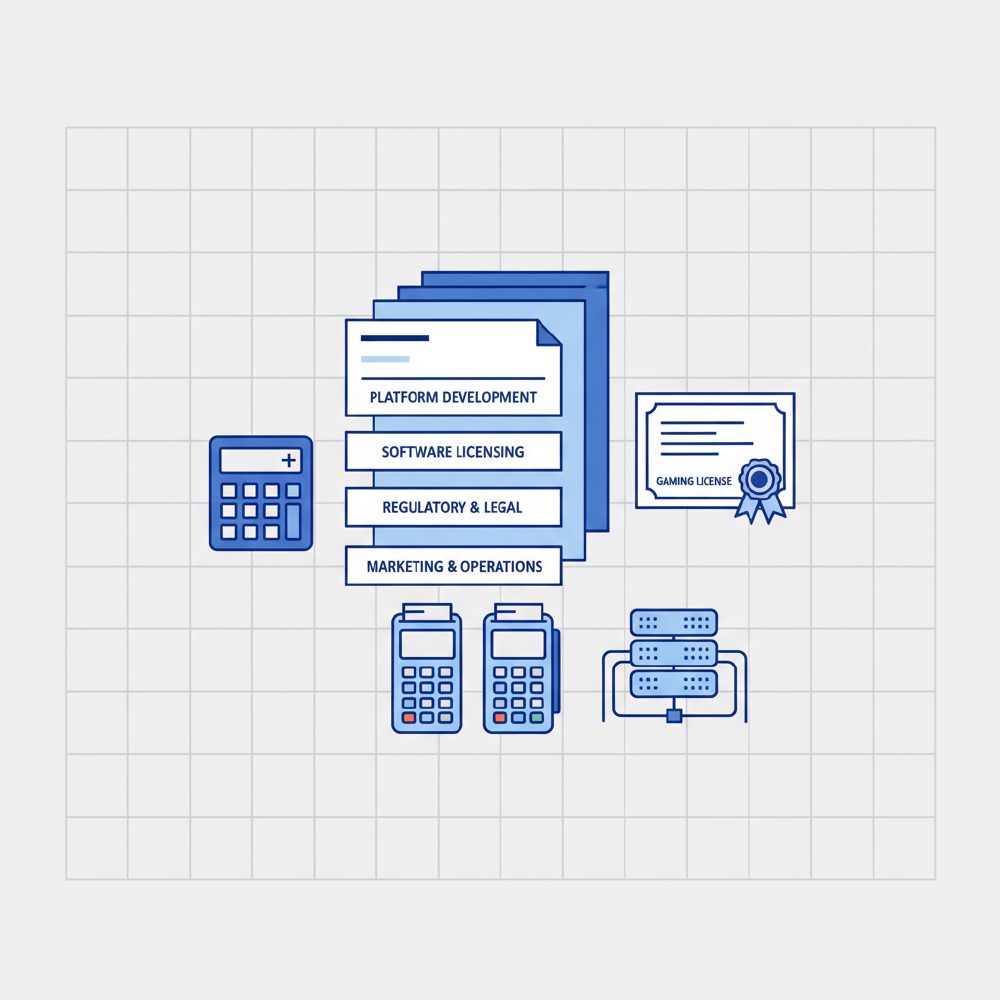
White label casino pricing has five distinct layers: the one-time setup fee, a monthly platform/SaaS fee, a revenue share on GGR, payment processing costs, and licensing/compliance overhead. Each layer is priced independently and negotiated separately — vendors bundle them together in sales conversations to obscure the true run-rate cost.
The setup fee covers platform configuration, your brand skin, CMS setup, and initial game content loading. Expect $15,000–$60,000 depending on provider. This is the most negotiable number in the contract — providers will discount it to close a deal, then make it back in rev-share. Don't optimize too hard on setup fee reduction; optimize on rev-share percentage and what's included in the monthly platform fee.
Monthly platform fees typically run $3,000–$10,000/month at entry level and $8,000–$20,000/month for full-stack providers that include CRM, bonus engine, affiliate system, and 24/7 tech support. Some providers price this as a flat fee; others use a hybrid where the monthly fee is waived or reduced once your GGR rev-share payment exceeds a threshold. The hybrid model sounds operator-friendly but it means you're paying full platform fees during your lowest-revenue months — exactly when you can least afford it.
Game content revenue share is separate from the platform rev-share and is often buried in the contract. Game studios (Pragmatic Play, Evolution, Hacksaw Gaming, etc.) charge operators 15–20% of GGR generated by their titles. Your white label provider may bundle this into the headline rev-share figure or charge it on top. Ask explicitly: is the quoted rev-share inclusive of game content costs, or exclusive? The answer changes your effective margin by 10–15 percentage points.
Below is a layer-by-layer cost reference for a mid-tier white label launch targeting a Curaçao-licensed offshore market in 2026. Figures are indicative ranges, not guarantees — actual quotes vary by provider, negotiation leverage and projected volume.
| Cost Layer | One-Time Cost | Monthly Recurring | Notes |
|---|---|---|---|
| Platform setup fee | $20,000–$50,000 | — | Negotiable; covers skin, CMS, game loading |
| Monthly platform/SaaS fee | — | $5,000–$15,000 | May include CRM, bonus engine, affiliate system |
| GGR revenue share (platform) | — | 15–30% of GGR | Separate from game content rev-share |
| Game content rev-share | — | ~15–20% of game GGR | May be bundled or charged on top |
| Curaçao sub-license fee | $15,000–$30,000 | $3,000–$6,000/yr ongoing | Via master licensee; faster than direct |
| KYC/AML tooling (e.g. Sumsub) | — | $1,500–$5,000 | Depends on verification volume |
| Payment processing (PSP fees) | — | 3–8% of deposit volume | Blended rate including chargebacks |
| Affiliate platform | $0–$5,000 | $500–$2,000 | Some WL providers include basic affiliate tools |
| Hosting/CDN/infrastructure | — | $500–$2,000 | Often included in platform fee at entry tier |
What does licensing cost for a white label casino, and which jurisdiction fits your budget?
Licensing is the cost operators most consistently underestimate. A Curaçao sub-license via a master licensee costs $15,000–$30,000 to activate and is the fastest offshore path. An MGA (Malta) license runs $25,000+ in fees plus $100,000+ in compliance infrastructure. US state licenses are a different category entirely — $500,000+ in some markets.
For most white label operators launching offshore, Curaçao remains the dominant starting point in 2026, despite the Gaming Control Board reforms that took effect in late 2023 under the new National Ordinance. The reformed framework requires operators to hold their own Curaçao license (Class A or Class B) rather than simply sublicensing under a master. The sublicense shortcut still exists through some master licensees, but it's a shrinking window — regulators are tightening enforcement. Budget $15,000–$30,000 for the sublicense path or $25,000–$50,000 for a direct Curaçao Class B license, plus ongoing compliance costs. Anjouan (Comoros) has emerged as a cheaper alternative at roughly $10,000–$20,000, but banking access under an Anjouan license is significantly harder to establish.
MGA licensing is the gold standard for EU-facing operators and is increasingly required by Tier-1 payment processors and game studios willing to offer favorable deal terms. The MGA application fee is €25,000, with an annual license fee of €25,000 on top. But the real cost is compliance infrastructure: you'll need a locally-based compliance officer, AML policies reviewed by Maltese counsel, technical audits, and player fund segregation. Total first-year MGA cost realistically lands at $150,000–$250,000 when you include legal, tech audit, and operational setup. That's not a white label budget — it's a turnkey or custom build budget.
LatAm is an increasingly attractive market but fragmented by jurisdiction. Colombia (Coljuegos) requires a local entity and a license bond; Peru (MINCETUR) is similar. Mexico's SEGOB licensing is notoriously slow and expensive. Brazil's new regulated framework (launched late 2024) is still evolving — operators entering Brazil now are betting on the regulatory timeline stabilizing. If LatAm is your target, factor $50,000–$150,000 in licensing and local legal costs depending on the specific country, and expect 12–18 months before you're fully operational.
| Jurisdiction | Regulator | Approx. License Cost (Year 1) | Timeline | Best For |
|---|---|---|---|---|
| Curaçao (sub-license) | GCB | $15,000–$30,000 | 4–8 weeks | Fast offshore launch, broad market access |
| Curaçao (direct Class B) | GCB | $25,000–$50,000 | 3–6 months | Operators wanting direct regulatory standing |
| Anjouan (Comoros) | AGCGC | $10,000–$20,000 | 4–6 weeks | Budget offshore; limited banking access |
| Malta (MGA) | MGA | $150,000–$250,000 (all-in yr 1) | 6–12 months | EU-facing, Tier-1 payment access |
| Isle of Man (GSC) | GSC | $80,000–$150,000 (yr 1) | 4–9 months | UK/EU operators; strong banking relationships |
| Colombia | Coljuegos | $50,000–$120,000 (yr 1) | 6–12 months | LatAm entry; local entity required |
| US (e.g. New Jersey DGE) | State-level | $500,000+ (yr 1) | 12–24 months | Domestic US only; not viable for white label |
How much does payment processing actually cost for a white label casino?
Payment processing is where white label casino cost projections fall apart. A blended processing cost of 3–8% of deposit volume is realistic once you account for PSP transaction fees, chargeback ratios, crypto conversion spreads, and declined transaction losses. For a casino doing $500,000/month in deposits, that's $15,000–$40,000 per month in payment friction alone.
The problem is that iGaming is a high-risk merchant category. Most mainstream payment processors won't touch it, which means you're dependent on specialist PSPs — companies like Payvision, Nuvei, Paymentwall, Praxis Cashier, or crypto-native processors like CoinsPaid. Specialist PSPs charge 3–6% on card transactions (versus 1.5–2.5% in low-risk verticals), and they reserve the right to hold rolling reserves of 5–10% of your transaction volume for 90–180 days. That reserve is real working capital locked up in someone else's bank account.
Chargebacks compound the problem. iGaming chargeback rates run 0.5–2% of transactions in typical operation, and a single processor will terminate your account if you exceed their threshold (usually 1% by Visa/Mastercard standards). Each chargeback costs you the transaction value plus a $20–$100 dispute fee. If you're running a bonus-heavy acquisition model, your chargeback exposure is higher — bonus abusers and friendly fraud are endemic in the industry. Budget a chargeback reserve and build dispute management into your operations from day one, not after your first processor termination.
Crypto processing is increasingly the default for offshore white label operators, not just an alternative payment method. CoinsPaid, B2BinPay and similar crypto payment processors charge 0.5–1% conversion fees and settle in stablecoins or fiat within 24 hours. The catch is that crypto-only operations lose a significant chunk of the addressable market — most recreational players still prefer cards and e-wallets. A hybrid stack (one card PSP, one e-wallet aggregator like MiFinity or MuchBetter, one crypto processor) is the minimum viable payment setup, and managing three separate processor relationships adds operational overhead that white label providers don't always help with.
What's the real difference between white label casino cost versus turnkey or custom build?
White label trades upfront capex for ongoing opex — you pay less to launch but more per dollar of GGR indefinitely. Turnkey and custom builds cost more to launch ($200,000–$1M+) but eliminate or dramatically reduce rev-share. The breakeven point where white label becomes more expensive than turnkey is typically 18–36 months, depending on GGR volume and negotiated rev-share rates.
The white label model is fundamentally a financing arrangement disguised as a technology service. Your provider fronts the platform development cost and recoups it — with significant margin — through revenue share on your GGR. At 25% rev-share on $200,000/month GGR, you're paying $50,000/month to your provider. After 24 months, that's $1.2M in rev-share payments. A turnkey build from a provider like SoftSwiss GBO or Digitain might cost $300,000–$500,000 upfront and charge 10–15% rev-share on game content only. The math isn't subtle.
Where white label genuinely wins is speed-to-market and risk mitigation. A white label casino can launch in 6–12 weeks versus 6–12 months for a turnkey build. If you're testing a new market, validating an acquisition channel, or launching with limited capital, white label lets you generate real operational data before committing to a larger infrastructure investment. Many operators use white label as a proof-of-concept phase, then negotiate a migration to turnkey once they've hit $100,000–$200,000/month GGR — at which point the rev-share savings justify the migration cost.
Custom builds are a different conversation entirely. Operators building proprietary platforms (think a US state-licensed operator or a large EU group) are spending $1M–$5M+ on technology and aren't in the white label market at all. The relevant comparison for most operators reading this is white label versus turnkey, and the honest answer is: if you're projecting $150,000+/month GGR within 18 months and have $200,000–$400,000 in startup capital, turnkey is likely the better long-term decision. If you're projecting less than that or have tighter capital, white label is the rational choice — just go in with eyes open about the rev-share compounding effect.
| Factor | White Label | Turnkey (e.g. SoftSwiss GBO) | Custom Build |
|---|---|---|---|
| Setup / development cost | $20,000–$60,000 | $200,000–$500,000 | $500,000–$5M+ |
| Time to launch | 6–12 weeks | 4–8 months | 12–24 months |
| Platform rev-share | 15–35% of GGR | 0–10% (game content only) | 0% (own the platform) |
| Control over product | Low — provider roadmap | Medium — configurable | Full |
| Licensing flexibility | Tied to provider's license setup | Operator holds own license | Operator holds own license |
| Breakeven vs. white label | — | ~18–36 months at $150K+ GGR/mo | ~36–60 months at $500K+ GGR/mo |
| Best for | Market testing, capital-constrained launch | Operators with runway and volume projection | Large groups, regulated US/EU operators |
Which white label casino providers are operators actually using in 2026, and what do they charge?
The most active white label casino providers in 2026 include SoftSwiss (Soft2Bet white label), EveryMatrix, BetConstruct, Turnkey Casino, and GamMatrix. Pricing structures differ significantly — some lead with low setup fees and high rev-share; others charge more upfront for better margins. Provider selection has downstream effects on game content access, payment integrations and regulatory support.
SoftSwiss's white label offering (operated through their GBO platform) is one of the most complete stacks available — it includes a CRM, bonus engine, affiliate system, and direct integrations with 200+ game providers. Their setup fees typically run $30,000–$60,000 and rev-share is negotiable, starting around 20–25% for new operators. The advantage is that SoftSwiss has established relationships with Curaçao and MGA licensing bodies and can support operators through the compliance process. The disadvantage is that you're on their roadmap — feature requests go into a queue with 200 other white label clients.
EveryMatrix's white label solution (built on their CasinoEngine and WalletEngine modules) is more modular — you can take specific components rather than the full stack, which is useful if you already have a payment layer or affiliate system. Their pricing reflects this flexibility; expect $40,000–$80,000 in setup and 15–25% rev-share depending on module selection and volume commitments. EveryMatrix's game aggregation layer (RGS) gives access to 10,000+ titles from 200+ studios, which is a genuine content advantage.
BetConstruct sits at the more affordable end of the market — setup fees of $15,000–$35,000 and rev-share starting at 25–30%. They're a reasonable choice for operators with limited capital and a clear acquisition strategy, but the lower setup cost comes with a more templated product and less flexibility in payment integrations. Turnkey Casino (not to be confused with the turnkey build model) is an entry-level white label provider popular with first-time operators; expect $10,000–$25,000 setup and 30–35% rev-share. At that rev-share rate, you're essentially renting a casino rather than building a business — it makes sense only for operators who expect to migrate to a better platform within 12–18 months.
What hidden costs do white label casino operators discover after signing?
The most expensive surprises in white label casino contracts are rev-share clauses that apply to bonuses and free spins (not just real-money GGR), minimum monthly fee floors that kick in regardless of revenue, and migration fees if you ever want to leave the platform. These aren't hidden in bad faith — they're in the contract. Operators just don't read contracts carefully enough before signing.
Bonus GGR rev-share is the most common shock. When a player wagers a welcome bonus, the resulting GGR is often included in the rev-share calculation — meaning you're paying your provider a percentage of money you gave away as marketing spend. Some providers exclude bonus GGR from rev-share by default; others include it unless you negotiate otherwise. The delta can be significant: if 30% of your monthly GGR is bonus-generated, and your rev-share is 25%, you're effectively paying 25% of your marketing budget to your platform provider. Push hard on this clause in every contract negotiation.
Minimum monthly fee floors are another trap. Contracts often specify that if your GGR rev-share payment falls below a minimum (say, $5,000/month), you pay the minimum regardless. In your first three to six months of operation, when you're still building traffic, this floor can represent 50–100% of your actual GGR. It's essentially a dead-weight cost during your ramp-up phase. Negotiate a minimum fee waiver for the first six months or push for a lower floor that reflects realistic early-stage GGR.
Migration fees and data portability clauses are the costs operators only think about when they want to leave. If you decide to migrate to a turnkey platform after 18 months, your player database, transaction history, and game history may be contractually owned by your white label provider or subject to migration fees of $20,000–$100,000. Some providers charge per-player data export fees. Others simply make migration technically difficult by not providing clean data exports. Before you sign, ask explicitly: what does it cost to migrate my player data to a new platform? If the answer is vague, treat that as a red flag.
How do staffing and operational costs factor into a white label casino budget?
White label providers handle technology, but they don't run your casino. You still need customer support, a compliance officer, a marketing function, and someone managing affiliate relationships. For a lean offshore operation, staffing costs run $8,000–$25,000/month. Underestimating this is one of the most common reasons white label launches fail within the first year.
Customer support is non-negotiable and often the first thing operators try to cut. A 24/7 live chat operation covering English plus one or two additional languages requires a minimum of four to six agents on rotation — more if you're running promotions that spike inbound volume. Outsourced CS through providers like Kaizo or dedicated iGaming BPO firms runs $3,000–$8,000/month for a basic setup. In-house is more expensive but gives you better quality control over the player experience, which directly affects retention metrics.
Compliance is the function that saves you from regulatory action. For an offshore Curaçao operation, you can get away with a part-time compliance contractor at $2,000–$5,000/month who reviews your AML policies, handles suspicious transaction reports, and keeps your KYC documentation current. For an MGA-licensed operation, you need a full-time, locally-based compliance officer — budget $60,000–$100,000/year in salary plus benefits. Skimping on compliance isn't a cost saving; it's a deferred liability that shows up as a license suspension or regulatory fine.
Marketing and affiliate management is where the real variable cost lives. A white label casino without a marketing budget is a website — not a business. Affiliate marketing is the dominant acquisition channel for most operators, and running an affiliate program requires someone managing relationships, auditing traffic quality, and negotiating CPA/rev-share deals with affiliate networks. That's a full-time role at $4,000–$8,000/month, plus the affiliate commissions themselves (typically $100–$300 CPA or 25–40% rev-share to affiliates). Budget your total marketing spend at 30–50% of GGR in your first year — that's the realistic cost of building a player base from zero.
What's a realistic ROI timeline for a white label casino investment?
Most white label casino operators reach break-even between month 10 and month 18, assuming competent execution, a viable acquisition channel, and a market with real demand. Operators who reach $50,000–$100,000/month GGR within six months can break even faster. Operators who don't have a clear acquisition strategy before launch often never break even at all.
The math on a mid-tier white label launch: assume $120,000 in first-year fixed costs (setup, licensing, integration) and $20,000/month in operational overhead (platform fee, staffing, compliance). To cover $20,000/month in overhead at a 25% platform rev-share, you need $80,000/month in GGR just to break even on operations — before you've recovered your initial investment. That's not a trivial number for a new brand with no player base. Operators who launch with a pre-existing traffic source (an SEO-ranked affiliate site, a social media audience, a sportsbook converting to casino) reach that threshold much faster than operators launching cold.
The operators who consistently fail are those who treat the white label platform as the business rather than the infrastructure. The platform is table stakes. The business is player acquisition, retention, and lifetime value optimization. A white label casino with a mediocre product but excellent SEO and a well-managed affiliate program will outperform a beautifully designed white label casino with no acquisition strategy every single time. Before you spend a dollar on platform setup fees, map out your first 1,000 depositing players — where they come from, what it costs to acquire them, and what your projected LTV is.
One realistic scenario: an operator launches with a $150,000 total budget, targets English-speaking offshore markets via SEO and two affiliate networks, and reaches 500 active players by month six. At an average player GGR of $200/month, that's $100,000/month GGR. After 25% platform rev-share ($25,000) and $20,000 in operational overhead, they're left with $55,000/month contribution margin. Initial investment recovered by month nine. That's a good outcome — not a guaranteed one. The operators who hit those numbers had an acquisition plan before they signed the platform contract.
How do white label casino costs change when targeting regulated markets like the US or EU?
Targeting regulated markets multiplies your compliance cost by a factor of three to five compared to offshore. US state-level iGaming licenses are largely inaccessible via white label — they require direct operator licenses, substantial capital reserves, and local entity structures. EU regulated markets (MGA, UKGC, Swedish Spelinspektionen) are accessible but add $100,000–$300,000 in first-year compliance overhead.
US iGaming is a state-by-state patchwork. New Jersey, Pennsylvania, Michigan, Connecticut, West Virginia and Delaware have active regulated online casino markets as of 2026. In every one of these states, operating legally requires a direct license issued to the operator — there's no white label sublicensing path. You need a local entity, a key person license for principals, a technology vendor approval for your platform provider, and in some states a land-based casino partnership. The capital requirement alone (surety bonds, player fund segregation) can run $500,000–$2M depending on the state. White label in the traditional offshore sense doesn't exist in US regulated markets.
EU regulated markets are more accessible but still demanding. The MGA (Malta) is the most common EU license for online-only operators and is achievable via a white label structure if your platform provider holds MGA approval as a B2B Critical Gaming Supply licensee. EveryMatrix, SoftSwiss, and several other white label providers hold MGA B2B licenses, which means their white label clients can apply for an MGA B2C license using the provider's approved platform. The operator still needs to meet MGA's capital requirements (€100,000 in paid-up share capital), appoint a Maltese-resident compliance officer, and pass technical certification. Total first-year cost: $200,000–$350,000. That's a serious business, not a side project.
Sweden's Spelinspektionen and the UK Gambling Commission are effectively off-limits for new white label operators without substantial capital and operational track records. The UKGC in particular has tightened its fit-and-proper requirements for license applicants significantly since 2021, and the compliance cost of operating under a UKGC license (responsible gambling tooling, enhanced due diligence, affordability checks) adds $50,000–$150,000/year in operational overhead beyond what an offshore operator would spend. If your target market is the UK, budget accordingly — or consider whether the UK is actually the right first market for your business.




Comments
No comments yet, be the first.