iGaming Tracking Solutions in 2026: What Operators Actually Need From Affiliate Software
What does an iGaming tracking solution actually do?
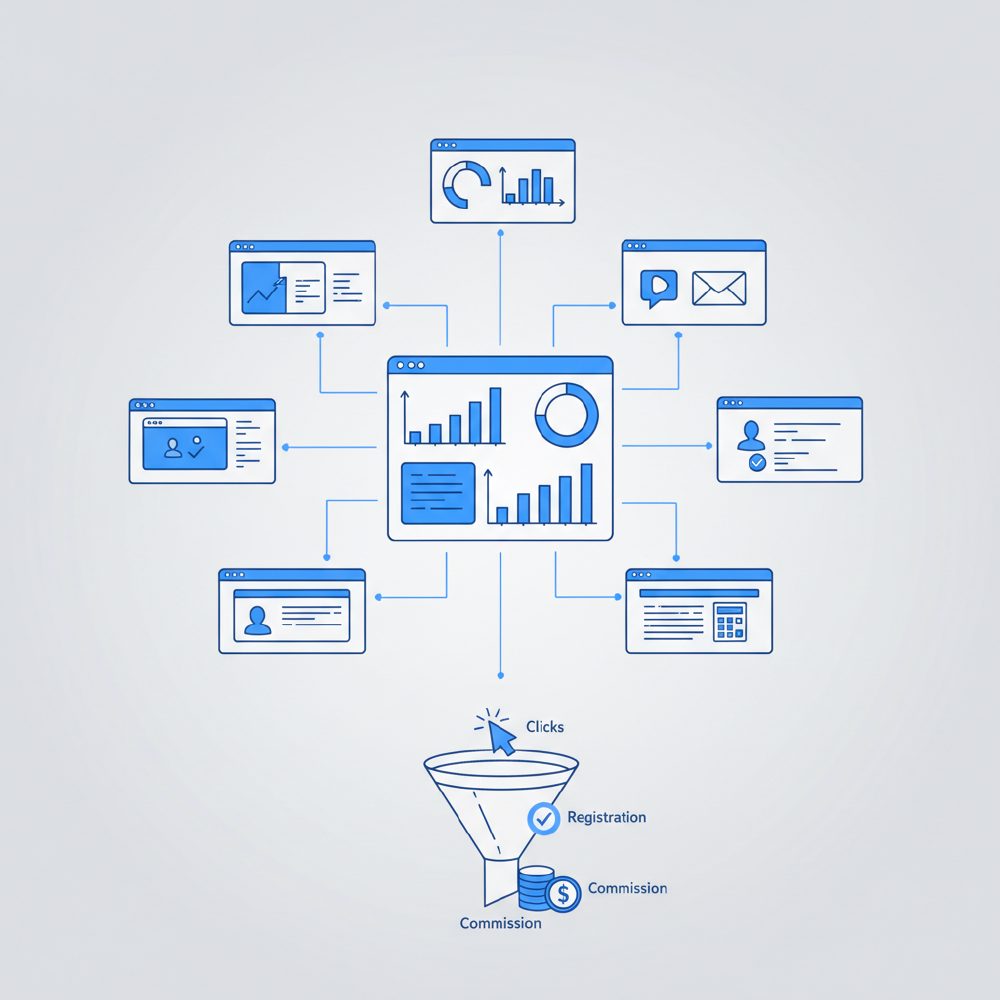
An igaming tracking solution records every touchpoint between an affiliate's traffic and your casino: the click, the registration, the first deposit, and every subsequent wager. It then maps that player's lifetime value back to the originating affiliate and calculates commissions automatically. Without it, you're reconciling spreadsheets manually and losing disputes.
At its core, the software assigns unique tracking identifiers to each affiliate link. When a player clicks that link, a cookie is set and, more importantly, a server-to-server postback fires when the player completes a tracked event, registration, first deposit, or qualifying bet. That postback architecture is why modern igaming tracking solutions are materially more reliable than what most SaaS affiliate tools outside gambling offer. Cookie blocking, incognito browsing, and cross-device journeys all erode cookie-only attribution. Postbacks don't have that problem.
Beyond click counting, a proper igaming referral software layer handles commission calculation in real time. That means applying RevShare percentages against net gaming revenue (NGR), deducting bonuses and chargebacks per your terms, applying negative carryover rules (or not, depending on your policy), and producing a payable figure the affiliate can see in their dashboard. The calculation logic is surprisingly complex once you add multiple brands, multiple currencies, and tiered commission structures. Platforms that can't handle this natively push the work onto your finance team.
Regulatory compliance is a less-discussed function that matters enormously in licensed markets. MGA-licensed operators, for example, need to demonstrate that affiliate marketing materials are compliant and that player data shared with affiliates is governed by data processing agreements. Some platforms, Affilka and Income Access in particular, have built compliance audit trails into their reporting modules. That's not a nice-to-have if you're operating under a Curaçao SUB license or applying for a Colombian Coljuegos license where affiliate oversight is scrutinized.
Finally, fraud detection is baked into the better platforms. Incentivized traffic, self-referrals, and bonus abuse rings all show up as statistical anomalies in deposit-to-wager ratios and geographic clustering. A tracking solution without fraud flagging is an open invitation for affiliates to game your CPA offers, and in my experience reviewing operator P&Ls, CPA fraud is one of the top three causes of affiliate program losses in the first 12 months.
Which igaming tracking platforms dominate the market in 2026?
Affilka by SoftSwiss, MyAffiliates, Income Access (now part of Paysafe), and Cellxpert are the four platforms you'll encounter most often in operator RFPs. Each targets a slightly different operator profile. The right choice depends on your platform stack, affiliate volume, and whether you need white-label branding on the affiliate portal.
Affilka is the natural choice if you're already on the SoftSwiss casino platform or SOFTSWISS Sportsbook. The integration is native, the data flows without middleware, and the RevShare calculation pulls directly from the back-office NGR figures. For operators outside the SoftSwiss ecosystem, Affilka can still integrate via API, but the setup requires more engineering time. Pricing is not publicly listed; expect a monthly SaaS fee in the $800-$2,000 range based on affiliate count, with a setup fee that varies by integration complexity.
MyAffiliates has been around since 2007 and powers programs for some of the largest operators in the EU and offshore markets. Its strength is commission rule flexibility. You can build genuinely complex tiered structures, apply different rules per product vertical (casino versus sportsbook), and manage sub-affiliate networks with automatic split payments. The UI is functional rather than beautiful, which affiliates occasionally complain about, but the reporting depth is hard to match. MyAffiliates also has a strong track record with MGA-licensed operators.
Income Access, now branded under Paysafe, carries institutional credibility and integrates cleanly with a wide range of payment and platform providers. It's the dominant choice among North American operators, particularly in regulated US states like New Jersey and Pennsylvania where the audit trail requirements are strict. The platform is more expensive than the alternatives at scale, and its customization options for commission structures are somewhat less flexible than MyAffiliates. If you're launching in a US regulated market and want a platform your compliance team and regulator will recognize, Income Access is a defensible choice.
Cellxpert is the newer entrant worth watching. It's built API-first, which matters if you're running a headless or custom front-end. It handles multi-brand programs well and has invested heavily in its affiliate self-service portal, which reduces support tickets. Pricing is competitive in the $500-$1,500 monthly range. The trade-off is a smaller ecosystem of pre-built integrations compared to MyAffiliates or Income Access, so your dev team will do more work upfront.
| Platform | Best For | Commission Models | US Market Ready | Approx. Monthly Cost |
|---|---|---|---|---|
| Affilka (SoftSwiss) | SoftSwiss ecosystem operators | RevShare, CPA, Hybrid, Sub-affiliate | Limited (no regulated US state integrations) | $800-$2,000+ |
| MyAffiliates | EU/offshore, complex tier structures | RevShare, CPA, Hybrid, Sub-affiliate, Custom | Partial (case by case) | $700-$2,500+ |
| Income Access (Paysafe) | Regulated US, institutional compliance | RevShare, CPA, Hybrid | Yes (NJ, PA, MI, etc.) | $1,200-$3,500+ |
| Cellxpert | API-first, multi-brand, modern UX | RevShare, CPA, Hybrid, Sub-affiliate | Growing | $500-$1,500+ |
| Scaleo | SMB operators, crypto casinos | RevShare, CPA, SmartCPA | No | $299-$999+ |
What tracking technology should operators require: postback, pixel, or API?
Require server-to-server postback tracking as a non-negotiable baseline. Pixel and cookie-based tracking are supplementary at best in 2026. Browser privacy changes, iOS tracking restrictions, and the prevalence of ad blockers have made pixel-only setups unreliable for conversion events. Any affiliate tracking software for igaming that leads with pixel tracking deserves skepticism.
Server-to-server postbacks work by having your casino platform fire an HTTP request directly to the affiliate tracking platform's server whenever a tracked event occurs. No browser involved, no cookie required. The player registers, your platform sends a postback with the click ID and event type, the tracking platform logs the conversion and attributes it to the correct affiliate. This is the mechanism that makes igaming tracking reliable in a way that, say, e-commerce affiliate tracking often isn't.
The practical requirement is that your casino platform must support outbound postback firing. Most modern platforms, SoftSwiss, EveryMatrix, Softgamings, BetConstruct, do this natively. If you're on an older or more bespoke platform, verify this before signing a tracking platform contract. I've seen operators discover mid-integration that their platform can only fire postbacks for deposits, not registrations, which breaks CPA tracking entirely.
API-based tracking is the third option and the most powerful. Rather than relying on event-triggered postbacks, your platform pushes a continuous stream of player activity data to the tracking platform via API. This enables retroactive attribution, more granular fraud analysis, and real-time commission dashboards. Cellxpert and the enterprise tier of MyAffiliates both support this. The downside is integration complexity and ongoing API maintenance. For most operators launching their first affiliate program, postback is the right starting point.
One underappreciated detail: make sure your tracking solution supports cross-device attribution. A player who clicks an affiliate link on mobile and deposits on desktop will break attribution in systems that rely solely on device-matched cookies. The better platforms handle this with probabilistic matching or by tying attribution to the player account ID once registration occurs, which is the cleanest method.
| Method | Reliability | Setup Complexity | Works Without Cookies | Best Use Case |
|---|---|---|---|---|
| Server-to-Server Postback | High | Medium | Yes | Standard operator launch, CPA programs |
| JavaScript Pixel / Cookie | Low-Medium | Low | No | Supplementary click tracking only |
| API Integration | Very High | High | Yes | Multi-brand, high-volume, fraud-sensitive programs |
| Fingerprinting (probabilistic) | Medium | Medium | Yes | Cross-device attribution fallback |
How do commission models affect your tracking solution requirements?
Your commission model determines how complex your tracking logic needs to be. RevShare is the most technically demanding because it requires real-time NGR calculation with deductions. CPA is simpler but demands robust fraud detection. Hybrid models need both. Make sure the platform you choose can run all three simultaneously across different affiliate tiers before you commit.
RevShare requires your tracking solution to receive net gaming revenue figures from your platform, apply the agreed percentage, and handle edge cases: negative NGR months (does the affiliate carry a deficit into the next month?), bonus cost treatment (are bonuses deducted from NGR before or after the affiliate's cut?), and currency conversion if affiliates operate in multiple markets. These aren't hypothetical complications. They're the exact disputes that blow up affiliate relationships in months two and three. A tracking platform that lets you define these rules explicitly, and shows affiliates the calculation breakdown in their dashboard, prevents a large share of those disputes.
CPA models are operationally simpler but fraud-prone. You're paying a fixed amount per qualifying player, so the incentive to send fake or incentivized sign-ups is high. Your tracking solution needs to enforce qualification criteria automatically: minimum first deposit amount, minimum wagering requirement, geographic restrictions. Platforms that only check the deposit event and not the wagering completion will cost you. I've reviewed programs where 30-40% of CPA payouts went to players who deposited once, claimed a bonus, and never returned. That's not affiliate fraud necessarily; it's a tracking logic gap.
Sub-affiliate tiers add another layer. If your affiliates recruit other affiliates and earn a percentage of their referrals' commissions, the tracking platform needs to maintain a hierarchical relationship map and calculate cascading payouts accurately. MyAffiliates handles this well. Some smaller platforms technically support sub-affiliates but cap the tier depth or can't handle the payout math correctly at scale. Test this with a real scenario during your evaluation, not just a vendor demo.
What does igaming affiliate tracking software actually cost in 2026?
Expect to pay $500-$3,500 per month for a SaaS affiliate tracking platform, plus a one-time setup fee of $1,000-$10,000 depending on integration complexity. Enterprise custom builds cost significantly more. The hidden costs are integration development time, ongoing API maintenance, and the affiliate portal customization that vendors quote separately.
The SaaS fee structure varies by platform. Most charge a flat monthly fee based on active affiliate count or click/conversion volume. Scaleo, which targets smaller operators and crypto casinos, starts around $299/month at the low end. Income Access at the enterprise tier can exceed $3,500/month once you add dedicated account management and compliance reporting modules. The middle ground, MyAffiliates, Affilka, Cellxpert, runs $700-$2,000/month for a program with 200-1,000 active affiliates.
Setup fees are where operators get surprised. The platform license fee doesn't include the technical integration work. If your platform provider doesn't have a pre-built connector, you're paying your dev team (or the platform vendor's professional services team) to build postback endpoints, map event data, and test attribution. That work runs 40-120 hours depending on complexity. At $80-$150/hour for a competent iGaming developer, the integration alone can cost $3,000-$18,000 before you've sent a single affiliate link.
White-labeling the affiliate portal is another separate cost most operators don't budget for. The default affiliate dashboard on most platforms is functional but generic. Affiliates notice when the portal looks like a template, and it affects your program's perceived professionalism. Custom branding, subdomain setup, and UX adjustments typically cost $1,500-$5,000 as a one-time project, sometimes more if you want deep UI customization.
Ongoing costs that don't appear in vendor pricing decks: data storage fees if you're processing high click volumes, transaction fees if the platform handles affiliate payouts directly (some charge 0.5-2% per payout), and the internal staff time to manage the program. A mid-size affiliate program with 500 active affiliates needs at least one part-time affiliate manager to handle approvals, disputes, and promotional material reviews. Budget for that role before you launch, not after your inbox fills up.
How does jurisdiction affect your choice of igaming referral software?
Jurisdiction shapes your tracking requirements more than most operators expect. Regulated markets like New Jersey, MGA Malta, and Colombia impose specific affiliate disclosure rules, data processing requirements, and in some cases require that affiliates be registered with the regulator. Your tracking platform needs to support these compliance workflows, not just track clicks.
In US regulated states, the compliance bar is high. New Jersey's Division of Gaming Enforcement requires operators to maintain records of all affiliate agreements and marketing materials. Pennsylvania and Michigan have similar requirements. Income Access has built its platform with this audit trail in mind, which is partly why it commands a price premium in the North American market. If you're launching in a regulated US state and your tracking platform can't export a clean record of affiliate activity, approved creatives, and commission payments, you have a compliance gap your regulator will eventually find.
MGA-licensed operators face GDPR obligations when sharing player data with affiliates. Specifically, you cannot pass personally identifiable information to affiliates through tracking links or postbacks. Your tracking solution must be configured to share only anonymized player IDs and aggregate performance data. Most platforms support this with a configuration toggle, but it needs to be explicitly verified and documented. Affilka and MyAffiliates both have documented GDPR compliance modes. Smaller or newer platforms may not.
Curaçao and Anjouan operators have more flexibility but shouldn't interpret that as no requirements. Curaçao's new gaming authority (CGA), which replaced the sublicense model starting in 2024, has tightened expectations around responsible gambling and marketing. Affiliates promoting your brand need to follow responsible gambling guidelines, and your tracking platform should let you enforce creative approval workflows before affiliates go live. This is a feature gap in several cheaper platforms that only offer post-hoc creative review.
LATAM markets like Colombia (Coljuegos) and Peru (MINCETUR) are worth flagging separately. Both regulators require that affiliates operating in-country be disclosed in the operator's marketing approval submissions. If your tracking platform can't generate a clean affiliate roster with activity timestamps, you'll be producing that report manually for every regulatory review. Small operational detail, significant compliance headache.
What fraud risks does igaming affiliate tracking need to address?
Affiliate fraud in iGaming takes several forms: incentivized sign-ups, self-referrals, bonus abuse rings, and click injection. The financial exposure is real. CPA programs without automated fraud controls routinely see 15-35% of payouts go to non-genuine players. Your tracking solution needs behavioral analysis, not just event counting.
Self-referral fraud is the simplest and most common form. An affiliate registers their own player accounts using their tracking link to generate CPA commissions. Basic mitigation: require a minimum number of unique IP addresses per affiliate's referred players, flag accounts where the registration IP matches the affiliate's login IP, and enforce a deposit-to-wager ratio threshold before CPA fires. Most platforms support these rules natively. The question is whether they're enabled by default or require manual configuration. Check this during your demo.
Click injection is a more sophisticated attack where fraudulent affiliates inject fake clicks immediately before an organic install or registration, claiming credit for a conversion they didn't generate. This is more common in mobile acquisition campaigns. Server-to-server postback tracking with click ID validation reduces this risk significantly because the click ID must match a legitimate click event in the tracking log. Platforms that rely on cookie attribution are vulnerable; postback-based platforms are substantially more resilient.
Bonus abuse rings are organized operations where affiliates coordinate groups of players to exploit welcome bonuses, generating artificial NGR that inflates RevShare calculations before the players churn. Detection requires behavioral analysis: deposit patterns, game selection (low-variance games are favored by bonus abusers), withdrawal timing, and geographic clustering. Affilka and Income Access both have built-in anomaly flagging. Smaller platforms often don't, which means this analysis falls to your risk team.
One underappreciated fraud vector: affiliate account takeover. If a legitimate affiliate's credentials are compromised, an attacker can redirect traffic, change payout accounts, and extract commissions. Your tracking platform should enforce two-factor authentication for affiliate logins and alert on bank detail changes. This is a basic security requirement that some platforms still make optional rather than mandatory.
How long does it take to integrate an igaming tracking solution?
For a standard white-label or turnkey casino with a supported platform, integration runs 4-8 weeks. Custom builds or platforms without pre-built connectors extend that to 10-16 weeks. The bottleneck is almost always the postback configuration and NGR data mapping, not the tracking platform itself.
The integration timeline breaks into three phases. Phase one is technical setup: provisioning the tracking platform, configuring postback endpoints on your casino platform, mapping event types (registration, first deposit, qualifying bet) to the tracking system's event schema, and testing attribution in a staging environment. This phase takes 2-4 weeks for a standard integration and is mostly dev work. If you're on SoftSwiss and using Affilka, this phase is closer to one week because the connector is pre-built.
Phase two is commission rule configuration. This is where operators consistently underestimate the time required. Defining RevShare tiers, CPA qualification criteria, negative carryover policies, bonus deduction rules, and sub-affiliate structures takes time to do correctly. Rushing this phase creates calculation errors that surface months later as affiliate disputes. Budget two weeks minimum, and have your affiliate program terms finalized before you start configuring rules, not after.
Phase three is the affiliate portal setup: branding, subdomain configuration, creative library upload, affiliate onboarding email sequences, and testing the affiliate self-service experience. This is often deprioritized and done in parallel with launch, which is a mistake. Affiliates form their opinion of your program in the first 48 hours. A broken registration flow or a portal that shows zero stats on day one sets a bad tone that's hard to recover from.
One practical tip: run a parallel test with two or three trusted affiliates for at least two weeks before opening the program publicly. Have them generate real clicks, registrations, and deposits, and verify that every event tracks correctly and commissions calculate as expected. This catches the 80% of integration issues before they affect your full affiliate base.
Should you build a custom igaming tracking solution or buy a SaaS platform?
Build only if you have 10,000+ affiliates, a dedicated engineering team, and a specific competitive reason to own the infrastructure. For every other operator, buying a proven SaaS platform is faster, cheaper over a three-year horizon, and less risky. Custom builds routinely cost $200,000-$500,000 to develop and maintain, and they age poorly.
The argument for building is usually about data ownership and customization. Operators who've been burned by SaaS platform limitations, inflexible commission logic, poor API access, vendor lock-in, sometimes conclude that owning the stack is the answer. In most cases, that conclusion is premature. The real issue is usually that they chose the wrong SaaS platform for their use case, not that SaaS is fundamentally inadequate.
The economics of a custom build are brutal when you lay them out honestly. A minimum viable affiliate tracking system, click tracking, postback handling, commission calculation, affiliate dashboard, fraud detection, requires at least 6-9 months of development from a team of 3-4 engineers. At $80,000-$120,000 per engineer per year, you're looking at $150,000-$300,000 before the first affiliate logs in. Then you have ongoing maintenance, security patches, and feature development. SaaS platforms amortize those costs across hundreds of customers. You can't match that economics at operator scale unless you're operating at the level of a Bet365 or Flutter.
There is a middle path worth considering: using a headless or API-first SaaS platform like Cellxpert and building a custom front-end affiliate portal on top of it. You get the tracking infrastructure and commission engine from a proven vendor, but your affiliates interact with a fully branded experience you control. This approach costs $30,000-$80,000 in front-end development and gives you 80% of the customization benefit of a full custom build at a fraction of the cost and risk.
What reporting features should operators demand from affiliate tracking software for igaming?
Demand real-time dashboards, cohort-level player value reporting, affiliate-level NGR breakdowns, and exportable raw data. The platforms that show affiliates only aggregate stats while giving operators granular data are the ones worth paying for. Transparency with affiliates on performance data reduces disputes and improves retention.
Operator-side reporting should give you affiliate performance segmented by traffic source, GEO, device type, and acquisition campaign. The ability to compare cohorts, players acquired via CPA affiliate A versus RevShare affiliate B, is essential for understanding which acquisition channels are actually profitable at 30, 60, and 90 days post-acquisition. Most platforms provide this. The difference is in how easily you can extract and manipulate the data. Platforms that lock you into their built-in report formats and don't offer raw data export via CSV or API are a long-term operational constraint.
Affiliate-facing reporting is a program retention tool as much as a compliance requirement. Affiliates who can see their performance in real time, drill down by campaign and landing page, and understand exactly how their commissions are calculated stay in your program. Affiliates who have to email your team to get basic performance data leave for a competitor. The self-service reporting quality of the affiliate portal is worth evaluating with the same rigor you apply to the operator back-office.
One reporting feature that separates mature platforms from basic ones: negative carryover visibility. If your program applies negative carryover (an affiliate's negative NGR month carries forward as a deficit before commissions resume), affiliates need to see their running balance clearly. Programs that obscure this information generate disproportionate support volume and trust issues. MyAffiliates handles negative carryover visibility particularly well. Affilka is also clear. Some smaller platforms show affiliates only their commission balance, not the underlying NGR calculation, which creates confusion.
Regulatory reporting is the final category. If your regulator asks for a report of all affiliate-generated player acquisition activity in a given period, can your platform produce that in a format the regulator will accept? Income Access has built specific report templates for US regulated markets. For MGA operators, audit-ready affiliate activity logs are a standard feature. Verify this capability before you're in a regulatory review scrambling to produce data manually.






Comments
No comments yet, be the first.